

I do think it is bad for women's MMA that one of the top female names, and the most dominating figur...more
posted 01/08/12 at 11:52am
on Cyborg Tested Positive for Steroids. Now What?





posted by The Rabbit Hole
Tuesday, December 27, 2011 at 10:06am EST
Blogger Courtney Szto is a Master's Student studying the socio-cultural aspects of sport, physical activity and health (or as some call it Physical Cultural Studies). Bachelor's in Sport Management. Former tennis coach & ropes course facilitator.
Support women's sports and SHARE this story with your friends!
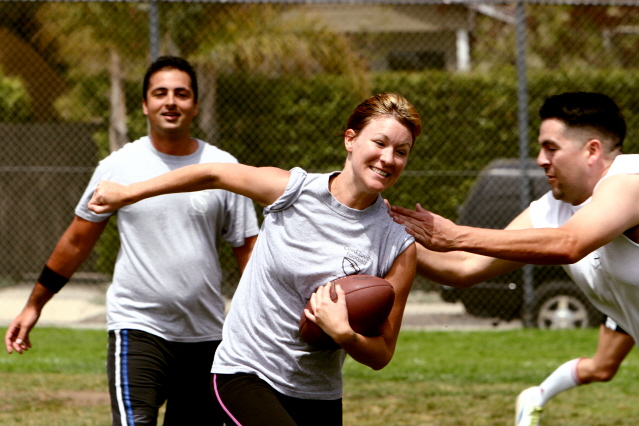 Photo from Plantsocialsports.com
Given that sport is one of the few arenas where genders are (predominantly) still separated from the outset, co-ed sport seems like a reasonable middle ground. The argument stands that co-ed sports provides more opportunities for women and young girls to participate, but I think it is about time that we re-vamp the co-ed sports system to move it past increased participation and towards equitable experiences.
For women, co-ed sports generally offer greater athletic challenges. The play is faster and the skill set often higher than that of playing with other women, at any level; yet for men, co-ed sports represents relaxed play. For women, co-ed forces you to step up your game; for men, co-ed is designed to make sure that you tone down your game. Sharing the same playing surface provides anything but an equal experience.
Most co-ed leagues institute rules changes to make things "more fair" for women participants. For example, goals/baskets/runs scored by women equal more points than any goal/basket/run scored by a man. There are rules on the numbers of genders on the field at the same time, which often states that it is okay to have more women than men on the field but it is never okay to have more men than women. As much as these rules might have been appreciated a few decades ago, these concessions just don't cut it anymore. Yes, the opportunities exist to compete with men, which would have been unthinkable before but these "rules" also reproduce the ideas that ALL women athletes are at a disadvantage on the field/court/ice and EVERY man poses more of a competitive advantage than any number of women. It is also important to note that novice men who participate in co-ed sports receive no advantages and are never perceived of needing them.
As someone who loves to play co-ed hockey, I have recently run into two personal co-ed conundrums. The first is that playing organized co-ed hockey (versus open competition where gender numbers do not matter) means that I usually don't get to play with my fellow women players. Recently, I was asked to be a spare in a co-ed league where a minimum of two women were required on the ice at all times. We had five women at this particular game - two on defense, three at forward positions. The team decided to switch out woman-for-woman. In other words, a woman defencemen would change with a woman defenceman and women forwards would only change for women forwards. Thus, we met the gender quota but I never got to play with my friend! Half the fun of sports is socializing with your friends but the emphasis on avoiding male domination makes it extremely difficult for women to bond with each other while playing.
The second occurrence which got me thinking was the locker room. This rink decided that it was better to place women competitors in the same locker room and men competitors in the same locker room rather than having opposing teams in different rooms. Arguably, the whole point of sports is Us vs. Them but suddenly I found myself in the locker room with Them! So rather than attempting to build relations between genders and through teams this particular co-ed rink reinforces the notion that gender is the defining line between people.
I have been looking into co-ed programming in Western nations and have found that, unfortunately, everyone operates on a very similar basis - rule concessions for women and gender quotas. The best thing that I have found so far is the 'open' competition I mentioned earlier where gender and skill are irrelevant and everyone plays together; however, depending on the individuals that show up for this I can see it going very well or very poorly. I am on a quest to figure out if there is a better way for men and women to compete against and with each other. I suppose I should mention that most of the gender discrepancies we see in sports today exist merely because sports were never created with women in mind; and hence, sports showcase the biological advantages that men possess - speed, strength, power etc. If sports were designed with difference skills in mind (e.g., strategy, endurance, accuracy) I doubt that the need for extra rules and quotas would be necessary. Nevertheless, I believe there is a way for women and men to compete in the sports that exist today in a far more equitable manner and I am reaching out to my fellow bloggers (and blog readers) to help me out. If you know of any programs or participate in any programs that seem to be doing something right I would really appreciate a comment or please contact me.
Support women's sports and SHARE this story with your friends!
MOST POPULAR ARTICLES & POSTS
January 7, 2012 at 3:05pm
December 28, 2011 at 10:58pm
July 31, 2010 at 10:26pm
October 27, 2011 at 10:48pm
December 18, 2011 at 4:24am
January 6, 2012 at 9:25am
LATEST ARTICLES & POSTS
Tue at 2:15am
Tue at 1:51am
Tue at 1:48am

Blogger Courtney Szto is a Master's Student studying the socio-cultural aspects of sport, physical activity and health (or as some call it Physical Cu...
full profile
For more, visit Resident_Badass's Full Profile
RECENT COMMENTS
I do think it is bad for women's MMA that one of the top female names, and the most dominating figur...more
posted 01/08/12 at 11:52am
on Cyborg Tested Positive for Steroids. Now What?
At least you recover up or recovering yet :) Better do fight with your depression... Kick it's ass o...more
posted 01/08/12 at 6:08am
on Lauren Fleshman: A New Year�s Break Up ...with Depression

Wendy,
Looking forward to your 2012 projects. If they are anything like what you produced in ...more
posted 12/31/11 at 12:35pm
on Best of 2011: Issues in women�s sports

Is there any new update about that movie?
...more
posted 12/30/11 at 6:12am
on Next American Girl Doll of the Year Is a Gymnast

Wow! Okay, let's see if I can answer all that you have brought up:
1.) You are absolutely cor...more
posted 12/29/11 at 7:55pm
on Sharing the field: The conundrum of co-ed sports


There are 4 comments on this post. Join the discussion!
How do you define "equitable experiences" as used in the first paragraph of your post?
Wednesday, December 28, 2011 at 10:56am EST
Thanks for asking! Equitable experiences meaning that I would like to see the dividing lines fall between skill levels rather than between genders. I don't, necessarily, think that everyone should have the same experience when playing sports because different roles and positions will always ensure a difference. But I would like to see co-ed sports move away from the assumption that women always need a little help to be successful when competing against and with men. Therefore, equitable as viewing each player as valuable not based on their gender but by what they bring to the team. Currently, most of the co-ed programs use an "affirmative action" type approach, which is not equitable it merely reinforces difference.
Wednesday, December 28, 2011 at 12:35pm EST
It sounds very subjective. I suppose the question then becomes who should evaluate, rate and rank the "skill levels" and fairly judge a participant%u2019s "value" to the team? While women may have other reasons to compete, most men play to win. They aren't interested in a subjective, let's make everyone feel good approach to sports, particularly hockey. They also don't care if you bond with your girlfriend during the contest. I would add that their desire to win doesn't make them somehow dysfunctional although many from academia would like to make that association.
If you don't feel the quota approach is fair to women and you believe co-ed sports are a valid model then it makes sense to go with the "open" competition model that you indicate you feel is the best currently out there. Contextually it appears you feel you are a pretty competent hockey player. If so your performance should speak for itself and men will respect that. If you are good enough you get to play in the open model. If not you sit. Just like a guy that isn't strong enough to be in when it matters. That%u2019s what we call sex-neutral objective equality. The reason the co-ed quota system exists is that most women can't earn the right to play in your "open" model due to their inadequate skill levels. They subsequently don't feel good about themselves if they don't get in the contest and get treated like they know what they're doing, even if it costs their club the contest.
As a hockey freak you understand that when the gloves drop many "skills" go out the window and your value to your club is measured by your ability to step up to whatever challenge comes your way on the ice. To the extent you can't step up when the time comes you become a liability and someone that needs to be protected versus someone that can bring meaningful force to bear. If you believe that co-ed sports will somehow change that aspect of hockey or other sports in which conflict sometimes comes to a head I think you are being a bit naive. You of anyone should clearly understand that not only do most of your fellow male hockey dudes not care about your politically correct position concerning their sport but they will never change their basic approach. Until you can drop gloves you're a spectator on skates even if they let you dress out. Call yourself whatever you like if it makes the sisterhood happy.
Seems to me that you believe that women bring some sort of value to co-ed sports that men should appreciate and play to a significantly lower skill set level "just because%u201D. As you note men already understand they need to "tone down their game" in the co-ed environment. I'd add that most guys that are even semi-serious about a given sport don't go looking for a co-ed participation opportunity unless it involves a wife, girlfriend, potential girlfriend or co-worker that thinks it matters or could impact the guy's future in some way. Short of that they are going to play with other guys that can actually play hard and don't have to worry about hurting one of the girls that wanted in to validate her girl power.
I see you're working on an advanced degree. Even so quoting feminist sexual social constructionist theory as fact in this context is a flawed and ill-advised approach. I'd appreciate you citing independently confirmable and peer-reviewed sources validating you and your girlfriend's innate strategy, endurance and accuracy talents, which you feel are superior to those of the other sex. In that context I'd be happy to forward historical performance stats that clearly delineate times, distances and other clearly objective measurements of performance based upon the gender of the participant.
Finally and on an entirely different issue, I see you are Canadian, which comes as little surprise given your interest in hockey. In that context I'd appreciate some input from you concerning Canadian citizens on the rosters of collegiate women's hockey clubs in the United States. I see that almost fifty percent of the women on the rosters of the ECAC Women%u2019s Hockey Conference are Canadian citizens. It's particularly interesting that Ivy League institutions including Brown, Dartmouth, Harvard, Princeton and Yale have Canadian team membership of 45% including Dartmouth at 48%, Brown at 55% and Yale at 58%. I'm assuming that you have some knowledge of Title IX here in the States and I'd appreciate your opinion as to the appropriateness of Title IX supporting the granting of Ivy League educations to Canadian Citizens at the expense of young men and women U.S. Citizens.
Looking forward to your input.
Thursday, December 29, 2011 at 12:44pm EST
Wow! Okay, let's see if I can answer all that you have brought up:
1.) You are absolutely correct in saying that determining what an equitable system would look like is largely subjective, I agree. However, I don't think we can generalize to say that most women play sports for reasons outside of winning or competition. I certainly play to win/compete but I also think people who are drawn to team sports participate because of the camaraderie. I have no problem with guys wanting to win but lets put things in perspective here - most co-ed sports leagues are beer leagues, despite wins or losses no one is making a career out of their favourite sport.
2.) I agree that not all women would be comfortable enough or "good" enough to play in open competition; but, at the same time, I don't think most women want "pity" rules either. For example, my mother hates hitting of the "ladies tees", she takes every opportunity to hit off, what she calls "the boys tees". Like I said, the "gesture" of co-ed rules was nice but I think we have moved past the point of courtesy (or I HOPE that we have moved past the point of courtesy).
3.) I'm not entirely clear about your point about "dropping the gloves" - do you actually mean fighting in hockey? Or are we talking about a metaphorical "ability to protect myself on the ice"? If we're talking about actual fighting, it's not allowed in any recreational leagues that I know of, co-ed or otherwise, so I'm not sure why you think women would be a liability in this instance.
4.) I do not believe that men should have to play down in order to participate in co-ed sports. I would like to explore the possibility of men and women competing at their best on the same field. Is this possible? Maybe not but it doesn't seem like too many have put a lot of effort into figuring it out.
5.) I have completed my Masters now and am working in recreational programming. I have run into complaints in my day-to-day work about my program's current co-ed structure; hence, my blog post. I am not saying that women would/do excel at games of accuracy, strategy etc. but that it would be a step towards levelling the playing field because these skills do not play towards physiological advantages that men have (although endurance may).
6.) This certainly is a topic on a different tangent but funny that you include Brown in your statistics as my hockey playing friend I was alluding to played varsity for Brown. Anyways, I think the "appropriateness" comes down to what is the purpose of Ivy league athletics or NCAA athletics, which is to win, I would assume. Thus, you seek out the best players from wherever they hail. I was a competitive tennis player and I know that most of the US schools I was looking at boasted rosters full of international students (and not canadians since we aren't know for our tennis). Our Canadian Hockey League, which is a stepping stone to the NHL, has a rule of 2 international imports only - a way of keeping the CHL "pure". Not sure that I agree with it because it creates a sense of nationalism and us vs. them that I don't think is great for the game; but at the same time I can certainly understand wanting to keep spots open for those who are citizens. I guess in short, do you want the best competition or do you want collegiate sports to be a product of said nation?
I have a feeling we come from different sides of the bench on certain topics, given your comments about feminist social theory and the "sisterhood", but I appreciate the time and thought you have put into your comments. Thanks for reading and I look forward to more discussion.
Thursday, December 29, 2011 at 7:55pm EST