








Why Can’t DIII Football Be Co-Ed?
|
posted by Fair Game News Seeking equality on -- and off -- the field. The strong connection between organized athletics and power (political, economic, social) means sports have consequences far beyond the game. FairGameNews.com aims to challenge sex-stereotyped assumptions and practices that dominate sports -- and recognize that sports can be a tool for seeking equal treatment and fair play. |

|

|
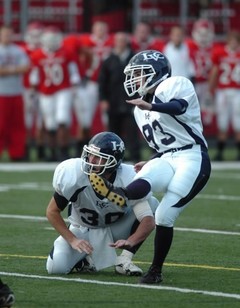
Lebanon Valley College photo
By Laura Pappano
The phrase “college football” evokes testosterone-charged pre-U.S. Marine-style intensity and mammoth bodies colliding at ridiculously odd angles and high speeds.
That may accurately describe DI teams on Saturday TV or at bowl game time, but how about the 0-6 Amcats at Anna Maria college, outscored this season 302-90? (And the college just spent $2 million to build “Amcat Field” with real NFL turf!)
The team’s problem? Many players are “undersized.” On the upside, the school draws more tuition-paying student/players, kids get to play college football – and people love to watch and cheer on Saturday afternoon.
On some campuses, in other words, football is more about the “event” than about the quality of play. It is this community-enhancing aspect we hear about when colleges start football teams, which they have been doing in recent years.
According to an NCAA study, even as wrestling lost a net of 101 teams between the 1988-1989 academic year and 2006-2007, football added 78 teams (some football teams were cut; the net gain is 31 over that time).
But guess what? Most of the new teams – 49 of them – have been in Division III. (And this current year – not part of the study – is turning out to be a popular time for starting new football programs, the Amcats among them.)
So why can’t DIII football be coed?
There are – and have been – girls playing high school and even college football. Two seasons ago, Holley Mangold (who weighed 315, bench pressed 264 and squatted 525) was certainly not undersized or under-abled to compete for Alter High School in Ohio (they lost the championships by one point).
Mangold played the on the offensive line. But not everyone on the field needs to be as big or as strong as she is. At Lebanon Valley College in Pennsylvania, 5-6, 129-lb No. 93 is the Dutchmen’s kicker, Brittany Ryan (see photo). And at Trotwood-Madison High School in Ohio, No. 85 (nickname: Ocho Cinco) is 5-2, 114 lb. senior placeholder and wide receiver Kryshana Pierce.
Football is a spectacularly appealing sport with too much of a “No Girls Allowed” culture. It doesn’t need to be that way — especially in DIII.
View Original Post at fairgamenews.com
|
|
|
- Filed Under:
- Football, Sports, SportsPLUS, College, Discrimination/Title IX, Student-Athlete











There is 1 comment on this post. Join the discussion!
Dr. Nicole M. LaVoi