








Help save Michelle Akers Horse Rescue and Outreach Farm
posted by Soccer Science A look at the soccer world from the personal perspective of Amanda Vandervort, a former college coach and fan of professional soccer, with an emphasis on the technologies that are revolutionizing the way we see the beautiful game. |

|

|
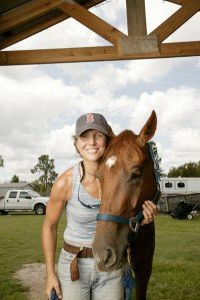
As you may have heard by now, unprecedented storms have struck the Michelle Akers Horse Rescue and Outreach Farm. Over four feet of rain water overwhelmed the barn and destroyed some of the pastures. She almost lost everything including all of her horses. Saving the horses and farm has required her to work tirelessly for 48-hour stretches.
I’m writing this blog in an effort to support Michelle Akers, the most prolific female soccer player of all time. My hope is that we, the collective soccer community, can come together and help this amazing woman in her time of need. She fought for the women’s game, literally through sheer fatigue and exhaustion… Now it’s our turn to repay the gift.
How You Can Help
There are several ways you can help:
1) DONATE – Any amount will help.
Secure Donations through PayPal
Or mail a check to:
Michelle Akers Sundance Horse Rescue & Outreach, Inc
214 E. Lucerne Circle
Orlando, FL 32801
 2) SPREAD THE WORD – Forward an e-mail or send these links:
- http://www.soccerpluseducation.org/michelleakers/michelle_akers_horse_rescue.html
- http://www.amandavandervort.com/blog/2009/12/help-save-michelle-akers-horse-rescue-and-outreach-farm/
Rob Raju, owner and CEO of Axiom Entertainment said, “Last week Michelle informed me that in order to fix the farm, she has decided to auction off/sell all of her personal soccer possessions including Olympic and World Cup memorabilia. All of the medals, rings, trophies, balls, jersey’s and Rolex watches which are of significant value will be up for sale so that she can save her farm and continue to rescue and rehabilitate her horses. Needless to say after hearing this I was absolutely horrified and tried to put a stop to it and asked her to give me some time to explore other avenues to assist her. However, Michelle insists that “It’s is not a big deal…All this stuff was just sitting in a closet anyway and my animals are way more important”. She reinforced to me that she needs to repair her farm immediately or her animals could suffer. Time is of the essence.”
Do not let this happen! Please send a donation, no matter how small, to the farm here: http://www.michelleakershorserescue.com/howyoucanhelp/donate.html. Imagine, if 100 people read this blog and each send $5, we could supply over a year’s worth of vitamins for one of her horses! Read Michelle’s personal letter about the flooding.
An Amazing Story
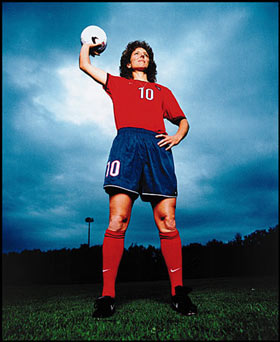
(From Healthy & Natural Journal, Feb 2001) In 1991, Michelle Akers was at the top of her game, lead the U.S. Women’s National team to victory for the first FIFA Women’s Soccer World Championship in China. She had been named the best female soccer player in the world and had also become the first to have a paid endorsement. After the World Cup, Michelle returned home completely exhausted. She rested and changed her diet. However, two years after the initial symptoms began, Michelle collapsed during a game at the Olympic Sports Festival in San Antonio, Texas. Diagnoses progressed from mononucleosis to Epstein-Barr virus (EBV) and finally, in the spring of 1994, to Chronic Fatigue Immune Deficiency Syndrome (CFIDS).
Yet Michelle continued to play.
“I can honestly say these few years were pure hell for me. I went through a divorce. I struggled to get through the day or hour, depending on how bad I was feeling. I desperately searched for medical answers and help but found very little. I frequently asked myself, what happened to that strong, dynamic, tireless Michelle Akers? Will I ever see her again? And who am I now? I was alone. I was scared. I was in agony.” In a 1996 journal entry, Michelle described the long-term effects of CFIDS: “I have realized on a deeper level that this disease is not only physically debilitating and emotionally gut-wrenching, but as the days and months pass by, it gradually steals away who you are and how you define yourself. It not only makes you sick, taking away your lifestyle, career and friends. It also kills your identity.”
She continued to play for her country, and six years later…
On August 24, 2000, the greatest women’s soccer player in history announced her retirement. The 34-year-old internationally renowned female athlete ended her historic 15-year career. Michelle was scheduled to compete with the United States Women’s National Soccer Team in the 2000 Olympic Games. However, one month before the Olympics, Michelle accepted the fact that her reinjured shoulder was not healing properly and her longtime battle with CFIDS had taken a toll on her body. “After winning the gold medal in 1996, I promised myself to never again play in the condition I was in during those Olympic games,” said Michelle in her official retirement announcement.
“This year just seems to have been a non-stop climb of Mt. Everest with 80-mile gale winds at my face. But even in saying that, I know that to climb a mountain, one only needs to put one foot in front of the other and hopefully, if you do that long enough, you will eventually reach the summit. That’s how it has been in years past for me, and that’s how I fully expected it to be this year. I knew it would be tough and I knew I would want to quit at times, but I have always been able to find something from somewhere to pull me through,” explains Michelle. “I rehabbed and worked my rear off to miraculously make the Olympic roster, but after falling on my shoulder a couple of times and reinjuring it, and on top of that having to deal with Achilles tendonitis (in both feet), chronic bum knees, and a raging blood pressure condition (neurally mediated hypotension associated with CFIDS), I realized maybe I wasn’t going to be able to fight through this after all,” she concludes.
The Circle of Life
Today, things are apparently much different for the decorated Akers. Here’s an excerpt from a 2008 article, Where are they Now: Michelle Akers
Today, removed from the soccer spotlight, Akers, her inquisitive son, second husband Steve Eichenblatt and assorted pets share a 12-acre rural residence outside of Orlando, Fla. She rescues abused horses statewide and nurses them back to health, and has a Web site www.michelleakershorserescue.com verifying her humanitarian pursuits.
This is all very fitting because Akers first had to put herself through physical recovery. Her body was spent from years of dealing with chronic fatigue immune dysfunction syndrome, a condition that ultimately led to her collapse during a game. Different injuries likewise knocked her out of competition, least of all a concussion. If there was a positive, all this pain led to love.
“My husband is a personal injury attorney, that’s how I met him,” she said. “I was going through some stuff with U.S. Soccer. Two years later, after he settled the case, he asked me out.”
Akers was an overactive fourth-grader, a tomboy in need of something to throw herself into, when her family moved to Lake Forest Park. Ballet didn’t cut it. Blue Birds didn’t last long. She had tried soccer in California the year before and rejected it, but this time she made a connection with the game.
Her first soccer team was the Shorelake Thunderbirds. Her coach was 19 and loved to play. His passion for the game was contagious.
“He made it really fun,” she said. “He was really skillful and that challenged me a lot. That’s where I fell in love with playing and focused my attention on one sport. I played with dogs. I broke windows with a soccer ball. I broke fences with it.”
Akers took her game to Shorecrest High School, won a state championship as a junior in 1983 and received All-America honors three times. She practiced with the boys’ team as much as the girls’. She also played club rather than select soccer because her family couldn’t afford the elite level.
That didn’t limit her college opportunities any. Most elite women’s programs knew all about her and pursued her. She was oblivious to her talent level at first.
“I was so immersed in playing,” she said. “I just loved it. I loved training. I was dominating games and practices, but I didn’t realize until I got to college that, ‘Gosh, I’m good.’ ”
Always headstrong, Akers rejected North Carolina, the foremost women’s soccer school, in favor of Central Florida. Tar Heels coach Anson Dorrance, who remains on the job today, didn’t make a favorable impression.
“I didn’t like the coach, so I didn’t go there,” she said. “I thought he was very conceited. Frankly, I thought my club team was better than his team. The way he pitched it, the package, the deal, the team, it just wasn’t what I wanted to be part of. They were national champions, and I didn’t like his demeanor. Central Florida wasn’t polished, the forerunner, the expected winner. They were like blue-collar workhorses, and that’s why I liked them.”
North Carolina lost out on a four-time All-American and instant national team player. One year out of high school, she scored her first U.S. goal against Denmark. She collected 39 goals in 26 national team games in 1991. She totaled 105 goals throughout her international career. She shared in World Cup championships in 1991 and 1999, and an Olympic gold medal in 1996. She hung in there as long as her beaten-down body would allow, and then retired before the Sydney Olympics in 2000.
Akers would prefer to live in the Northwest, but knows her husband wouldn’t do well with the cooler temperatures. She’s had to bunker down when hurricane weather has battered her Florida home, with Tropical Storm Fay most recently flooding everything.
She has much shorter hair and far longer patience as a mother instead of a world-class athlete. She’s made significant adjustments in her new role.
“I wasn’t ready to have a kid until I did,” Akers said. “Maybe maturity-wise I didn’t think I could have been a good mom. For me, it’s been a huge learning curve. I wasn’t one who went out and hugged kiddies. Once I had a son, it was, ‘How cool is this?’ But it was also, ‘How do you give him a bath, how do you hold him, how do you wrap a blanket around him?’ ”
As for soccer, the world’s greatest women’s player can’t even kick a ball anymore. Her right knee needs more reconstructive surgery. However, there’s no pressure to get it fixed any time soon. Memories work just fine, as do those meet-and-greet appearances, even if young Cody doesn’t quite understand them.
Horse rescues fill up her time now. Her son also has shown a decided preference for baseball, already swinging an aluminum bat at overhand pitching, giving everyone reason to think the family might have another athletic prodigy on its hands.
“I don’t even have a soccer ball on the property,” Akers said. “I’m having so much fun with horses and life now, it just doesn’t occur to me anymore.”
One more time: How You Can Help
There are several ways you can help:
1) DONATE – Any amount will help.
Secure Donations through PayPal
Or mail a check to:
Michelle Akers Sundance Horse Rescue & Outreach, Inc
214 E. Lucerne Circle
Orlando, FL 32801
More resources
I do hope the soccer community can come together for this cause and drum up some cash. $5, $10, $100… anything will help. Also, here are a few more links if you want to read up on Michelle Akers and her amazing story.
World Beater – Sports Illustrated Written in 1995!
Michelle Akers – National Soccer Hall of Fame
Michelle Akers – Wikipedia
Michelle Akers – Soccer Times
Michelle Akers – Women’s Soccer
Michelle Akers – Google Image Search
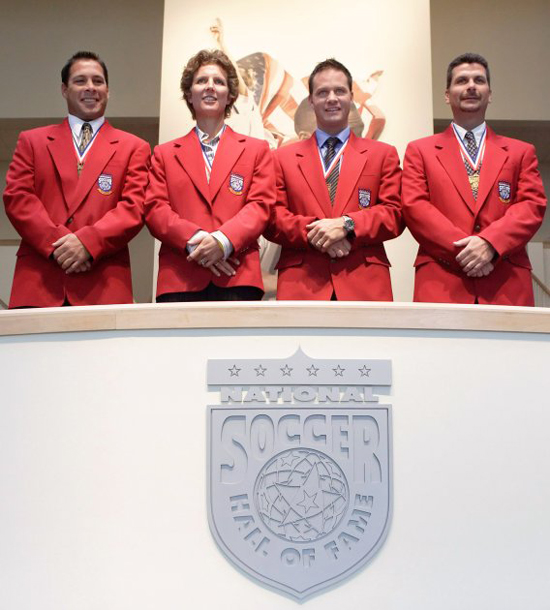
Photo: The 2004 Hall of Fame inductees Paul Caligiuri, Michelle Akers, Eric Wynalda, and Michael Windishmann pose for a group photo before the start of the ceremonies. on Monday October 11, 2004 at the National Soccer Hall of Fame and Museum, Oneonta, NY. Taken by Howard C. Smith of isiphotos.net
View Original Post at amandavandervort.com
|
|
|
- Filed Under:
- Soccer, Sports, SportsPLUS, Cause/Charity
- Tags:
- Amanda
- michelle akers





No one has commented on this yet. Be the first!