








It sucks to win silver

|
posted by Draft Day Suit A (usually) humorous look at sports written by popular parent bloggers and some of their friends. |

|

|
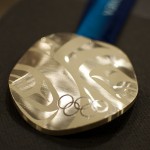
Photo by John Biehler
Yep, that’s what U.S. women’s Olympic hockey team captain Natalie Darwitz said when interviewed after her team lost to Canada in the gold medal game. I can sympathize with the sentiment. In Olympic hockey, you don’t win the silver, you lose the gold. I just wish she’d said that—”it sucks to lose the gold”, or just plain “it sucks to lose”—instead of “it sucks to win silver.” It feels… unsportsmanlike, somehow.
The game itself was a thriller, the exciting matchup hockey fans like me have been waiting for since the Games began. Canada and the U.S. are by far the strongest, fastest, most skilled teams in the world, and it showed on the ice last night. Even the refs couldn’t keep up with the speed and intensity of the game, missing several offsides calls and a few more serious ones as well. (The announcers chalked this up to the single-referee system, and the fact that the pool of competitive-level women referees is small. There’s more research and another post in there about why only women can ref women’s games—but calling offsides is the linesman’s responsibility, and there were two lines(wo)men at this game.)
Announcer A.J. Mleczko pointed out a few times that you wouldn’t be able to tell by watching this game that women’s hockey was non-checking, and she was right. It was intensely physical, and there were even a few punches thrown (though there were no gloves-off fights as in men’s hockey). There was more checking, both penalized and unpenalized, than I’ve ever seen in a women’s game before. I am not a fan of checking as it’s practiced on the men’s side and recently declined to join a women’s league that allowed checking, but honestly, the level of physicality in the U.S.-Canada matchup seemed appropriate for the skill level of the teams. If I could play that well and skate that hard, I wouldn’t mind going hard at an opponent or having an opponent come hard at me.
The disappointment of the evening for me (aside from the clunky pace of the bronze medal game, which I had planned to watch first but abandoned in the first period because I knew much better hockey was being played live) was that the U.S. didn’t manage to score any goals. Yes, they only lost by two—the smallest margin by far of any game Canada *or* the U.S. was involved in this tournament—but being shut out was a big, fat bummer. The U.S. women, used to being able to get traffic in front, make trick shots, and have passing lanes and players open at all times, ran into a disciplined Canadian defense—and a goalie with a seemingly magnetic glove—that kept almost everyone and everything out of the slot, even on a 5-on-3.
A.J. suggested that the American players stop shooting high on the glove side, which Canadian goalie Shannon Szabados totally had covered, but often that was the only shot available. When a low shot was possible, it was often blocked or otherwise turned aside, and there were few rebound opportunities.
Speaking of blocked shots, Julie Chu had several, including one where she knelt to block the shot, successfully blocked it, and then popped up, took the puck, and charged the other way. It was probably my favorite moment of the game. My favorite announcer comment—and I’m sorry to say that I can’t remember who made it—was, “wouldn’t you like to see a best-of-seven series with these two teams?”
OH YEAH.
In fact, until the rest of the world catches up, how about next Olympics we just have seven U.S.-Canada games to determine who gets the gold?
~lorihc
View Original Post at draftdaysuit.com
|
|
|
- Filed Under:
- Skating, Ice Hockey, Olympics, Sports, Winter Games
- Tags:
- Olympics
- womens sports
- Hockey
-
This post is related to an event on our Calendar:
- Olympic Winter Games






No one has commented on this yet. Be the first!