


Quantcast
  

The “success” of Twitter in promoting women’s sports: ‘Show me the money!’

posted by One Sport Voice
Tuesday, May 5, 2009 at 7:12pm EDT

Dr. Nicole M. LaVoi: This blog reflects my critical eye and voice on all things sport. I am a critical thinker, scholar, and researcher in girls & women in sport, youth sport, and coach & sport parent education.

Add to Technorati Favorites

There seems to be much discussion over Twitter and how it might be “the answer” to successfully marketing and promoting women’s sports. Jayda Evans (Seattle Times columnist & Twitter-er) wrote about it, the Women’s Professional Soccer League is using it, and Megan Hueter, Co-founder of Women Talk Sports, has two recent blogs about the importance of social media for women’s sport (A recent blog is about Twitter and an earlier blog was about Facebook). I responded to Megan’s blog, and she responded back (scroll down on her blog about Facebook to see our exchange). I enjoyed this dialogue and have been thinking about this issue ever since.

I get that social media is a platform to market women’s sports in a saturated market, and it is accessible, current, relevant, provides athlete-generated content etc…I got it. I love social media, really I do, so this is not a critique of social media or those that love it, promote it, and live for it. I have a Blog (obviously), a Facebook page, am connected to colleagues through LinkedIn, and recently conquered my Twitter fascination. However, even with my love for social media I’m reluctant to make claims about the effectiveness of it in promoting female athletes and women’s sports. It is the researcher in me—I’m critical and skeptical until I see the proof (i.e., empirical data).

I have seen ZERO research that demonstrates if, and how, social media tangibly and effectively promotes and markets women’s sports. I queried one of our very smart graduate students who is immersed in this research, and she didn’t know of any either. We will stand corrected if it exists. Just because everyone is all atwitter about Twitter doesn’t mean it “works” or will “save” women’s sports.

twitter-image1Here is what we generally DO know about Twitter and sport:
1. Twitter exists and is rapidly growing in popularity
2. Some people, but not many (~5% of the population), are currently using Twitter
3. Some professional athletes are included in that 5%
4. Many professional sport leagues have a Twitter presence

Here is the $1,000,000 question: Has Twitter lead to an increase in—attendance, ticket sales, merchandise sales, sponsorships, media coverage in mainstream sport media, number of teams in women’s professional leagues, or any measurable interest in or consumption of women’s sports? Right now, Twitter is a good listening tool and provides a way to listen to brand champions of women’s sport (i.e., the core, loyal consumer). But other than that, show me the data. It might be doing some good, but has anyone thought about the flip side?…. that social media might not be good for female athletes or women’s sports? So how might Twitter and other social media (including those not invented yet) be “bad” you ask? Well here are a few things to ponder.

It is a well known fact that female athletes receive only 6-8% of coverage in traditional sport media. This statistic has remained consistent over the last 20 years, despite increases in girls and women participation in sport. When female athletes are covered in traditional sport media, they are often portrayed in ways that marginalize or minimize athletic competence and highlight sexy, hetero, feminine aspects of the female body or identity.

A perfect example of this is the March 23, 2009 ESPN magazine cover of pregnant WNBA Rookie of the Year Candace Parker in which the opening sentence discusses that Parker “…is beautiful. Breathtaking, really, with flawless skin, endless legs and a C cup…” If you want a thorough, and I think well done, sociological critique of this article read this blog which appears in Contexts. I did a little mini investigation after I saw the Parker cover and found: In five years (2004- March 2009) females athletes have appeared on 5 of 168 ESPN covers (3.6%…less than the average) and when they do….well see for yourself.espn-mag-women-covers-5-yrs
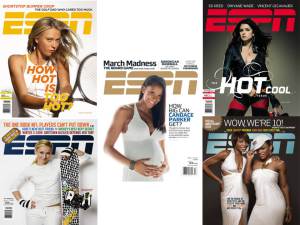
While social media is changing the role of sport journalists, sport media scholar Marie Hardin argues this is both good an bad. I add it is good if it changes coverage patterns of female athletes, but I would add it is bad if it becomes expected that female athletes have to be partially or largely responsible for promoting themselves as well-rounded “girls next door” through social media as a way to “save” their leagues or bolster their own “brand”. Why isn’t it just enough for Candace Parker to play basketball to the best of her abilities? The NBA doesn’t ask Kobe Bryant to be more than a great basketball player do they?

Could it be possible that social media, including Twitter, is just another means to replicate the ways in which traditional sport media marginalizes and sexualizes female athletes? Twitter’s existence does nothing to challenge the status quo or existing structural inequalities between men’s and women’s sports…especially since it is an “opt in” platform.

Another point to ponder: How are female athletes and professional leagues presenting themselves on Twitter? Stay tuned for results on cutting edge research two of our graduate students are just completing on this very question—this is cool stuff! In the meantime, I’ll give you one example that occurred on the 2009 WNBA draft day which caught my eye and highlights my previous point. I saved three (of many) Tweets written by draftees, the WNBA, and other attendees who were collectively discussing “how we look and what to wear” rather than “how we play” on Draft Day 2009.

What everyone should do who cares about this issue and the cause of women’s sport, is think less about hyping social media and more about how social media can be used to create real social change and lead to sustainability (meaning…show me not only the data, but the $$$$) of women’s professional sport leagues…and more importantly, how can we prove and measure “success”?

View Original Post at onesportvoice.wordpress.com

Add to Technorati Favorites

There are 11 comments on this post. Join the discussion!


AnnGaff
I think that Kobe Bryant actually is appreciated for his good looks in addition to his performance, just like Shaq gets more attention because of his personality. There are probably players just as good as these guys who aren't necessarily as "marketable" in the public's and media's eyes and so we don't hear about them as much off the court. This is similar with women, and I don't see it as a negative thing until the line is crossed and she is seen only as a sexual object regardless of her performance. Let me be clear: I definitely view that as an issue female athletes still face. But I view it as progress when a woman who is 6 feet 8 inches tall wears heels proudly and is applauded for it. It was not too long ago that she would be made to feel ashamed for her height and thus would slouch and wear flats so as to not stand out. But we have progressed to an era where athletic, muscular women are now being seen as attractive in our society, as opposed to "manly". I think it is also progress that players such as the Paris twins are so popular even though, by traditional societal standards, they may not be the "perfect woman" in terms of their appearance. But they are funny and endearing (AND excellent ball-players), and we love them for that, just like many love Shaq for his goofy smile and personality, regardless of whether we think he is the "hottest" man on the court. While we may have a long way to go, I think there has been progress, and it is not automatically a negative thing to comment on an athlete's appearance; it is the context in which it is commented on that can be the problem.
Thursday, May 7, 2009 at 3:06pm EDT

robm
A sensible (via media) outlook you have there, Ann. There is indeed nothing wrong with a female athlete's being regarded as attractive and sexy; and as you rightly point out, this may even be a sign of progress. Problems arise only when appreciation for her athleticism is meanwhile lost or overlooked.
Friday, May 8, 2009 at 9:58am EDT

mhueter
In short, here's my opinion. Social media is a set of tools used to develop relationships between people. They increase communication and open the door for transparency. Much like your blog, you can share your thoughts/personality in whatever form you'd like. So if social media can be used to develop relationships between professional women's players and fans (or potential fans) that can only be a good thing. Relationships build trust and vested interest, which in turn, over time (could) lead to increased ticket sales. There is no hard, quantitative evidence you can put to a trusted relationship earned over time with sustained communication and openness. And, by having control over their own image, these athletes are able to tell their own stories (as opposed to those of traditional media) which - as you pointed out - research has shown is not equal between genders. I have spoken with representatives from both the WNBA and Women's Pro Soccer. They do not "force" their players to do anything. The leagues simply gave them the green light to say whatever they want. These players are participating because they want to. They WANT interaction with their fans. Krisi Toliver said that to me, here: http://www.youtube.com/watch?v=5946A-oxuI4andfeature=channel_page And, if you take a look at the female pro athlete widget Women Talk Sports has on the side of the homepage, just by browsing through the conversations you can see that there are plenty of conversations about games and practices, as well as discussions of "off the court" topics that may/may not allow them to relate to their audience. The point is, as long as the athletes are being honest and truthful, how can it hurt their sport to tell a little bit about themselves? The answer is no. So in answer to your question, "Could it be possible that social media, including Twitter, is just another means to replicate the ways in which traditional sport media marginalizes and sexualizes female athletes?" My response is yes, it could be, but the difference here is that the female athletes have the control over the conversation (not journalists). And that is very, very powerful.
Monday, May 18, 2009 at 8:58am EDT

Dr. Nicole M. LaVoi
Megan, You raise some thought provoking points. I agree you can't quantify relationship building, which is one problem of social media research right now. I love your point about female athletes getting to control their own message(s) and "brand", rather than leaving it to traditional sport media which is largely comprised of men (see AP Sports Editor Report, 2008) and as a whole has been responsible for scarce and marginalizing coverage. I do think this aspect of social media can be positive if female athletes want to "opt-in" and interact with each other or fans, but it might also be problematic. If both the WPS and WNBA representatives "give them the green light to say anything they want" that can be both good and bad. As evidenced by the Twitter widget and blogs, these women have a lot to say and finally have an outlet to say it! (We all know they don%u2019t get the opportunity much in traditional media. However, all of the athletes in those leagues have grown up in the post Title IX era and have not had to "fight" for the right to play. They've also consumed a lot of sport media, a majority of which tells them they should be sexy, pretty, feminine AND athletic...so they've bought into the dominant way of "marketing" themselves...perhaps INCLUDING their use of social media. If female athletes are given free reign to say what they want, without guidance, advice, media training or any critical thought about WHAT messages they are sending, not only about themselves but their leagues, that could be problematic. I'm certainly not about stifling free speech or advocating for somebody to play Big Sister/Brother and monitor what female athletes say, but I do think there might be times when as you say "being truthful and honest" may hurt the women themselves and the league, not help. Thanks for your post I appreciate your perspective. -nml
Monday, May 18, 2009 at 4:40pm EDT

Jane
This may be a bit off-topic since the original post was about quantifying success in social media but in response to your last comment, do you really think that female athletes have been coerced into being sexy and pretty in order to market themselves? What if they simply enjoy their femininity and don't feel the need to suppress it in order to have their athleticism taken seriously. Why does anyone's identity have to be reducible to one personality? It's the range of talents, personalities, abilities, etc. that contributes to sports' appeal and each participant should feel free to rep themselves honestly.
Monday, May 18, 2009 at 6:34pm EDT

Dr. Nicole M. LaVoi
Jane, this isn't off topic at all. Thanks for your thoughts. No I don't think female athletes are coerced into being sexy, I think they have internalized years and thousands of images of "what it means to be a woman" (i.e. a narrow range of sexy, pretty, feminine). In essence some females athletes (if not all to some degree) have unconsciously adopted these ideas. There is a great report by the American Psychological Association (http://www.apa.org/pi/wpo/sexualization.html) that outlines this process and how dangerous it is for females, and athletes are not excluded. The report does recognize the important role of sport/physical activity in counteracting the many negative outcomes associated with the sexualization of girls. It also outlines the high value placed on physical attractiveness can result in girls experiencing reduced cognitive functioning, low self-esteem, eating disorders, depression, diminished sexual health, and internalization of stereotypes. I'm not saying that female athletes should be limited to only representing their athletic selves, but when they have grown up in a culture and society that has continually sexualized females, it is not surprising that some female athletes find this an important aspect of their identity to promote. In short, I guess what I and others would argue is that to change this cycle, and to have women take control of their own messages as Megan points out, females athletes have to primarily promote what their bodies can DO, rather than what their bodies look like. When that happens, all the young female athletes growing up now will have different images and messages that are positive...which can hopefully counteract all the other less positive messages they are bombarded with every day.
Tuesday, May 19, 2009 at 11:48am EDT

robm
Nicole: I see at least two problems here. First, implicit if not explicit in this position is that female athletes are somehow incapable of making such discriminations without special help. These are capable, intelligent women, most college educated, who are no doubt aware by now of the many, often conflicting messages that emanate from our culture, and have decided how best to parse those messages for themselves. I see no reason to question their judgment out of hand. Second, frankly this position betrays a "sex is dirty" mindset that serves no purpose here. Sex is part of life's essence, with no more inherent evil to it than any other aspect of life. It is unrealistic, and more than a bit unfair, to expect these young women to suppress that part of their nature. Nor is this an either-or decision between advertising what their bodies can do and what their bodies look like, both can be done while sending a "positive" message--e.g., that the strong female body is acceptable, nay attractive.
Tuesday, May 19, 2009 at 2:41pm EDT

Dr. Nicole M. LaVoi
Rob: I agree with you that the female athletes we are talking about are intelligent women, but that doesn't mean they are all trained to manage their own messages. Even the most intelligent and capable athlete, celebrity, politician etc...can benefit from professional media training. That was the point I was making. I think we'd all be surprised of the % of women (or men) that don't have a clue about, as you say "the messages than emanate from our culture" or how to manage their own messages. If all people did, the entire industry of media and communication training (such as Kathleen Hessert's Sport Media Challenge, http://sportsmediachallenge.com/) would not exist.
Secondly, I was talking about "sexualization" of female athletes, not healthy (or 'dirty' as you say) sexual health. According the the APA (http://www.apa.org/pi/wpo/sexualizationsum.html) sexualization occurs when any one of these four criteria exist:
1.a person's value comes only from his or her sexual appeal or behavior, to the exclusion of other characteristics;
2.a person is held to a standard that equates physical attractiveness (narrowly defined) with being sexy
3.a person is sexually objectified--that is, made into a thing for others' sexual use, rather than seen as a person with the capacity for independent action and decision making',' and/or
4.sexuality is inappropriately imposed upon a person.
I would also argue that "suppressing" female athletes' "nature" to promote sex, is not a product of nature (meaning it is inherent in everyone), but speaks to my original point-women grow up internalizing societal and cultural messages about femininity, and what it means and looks like to be a female...in addition to the (sometimes conflicting) set of messages about what it means to be a female athlete. Unfortunately, currently only a narrow range of female athletic bodies are seen and promoted in main stream media, and those bodies are the ones that most closely align with dominant ideas of femininity. I can\'t wait for the day that main stream media embraces and promotes all shapes and sizes of females athletes like Ann G. writes above. That is why WTS (www.womentalksports.com) is so needed (thanks WTS!) to provide an alternative means to promote all types of female athletes and their athleticism.
Tuesday, May 19, 2009 at 4:45pm EDT

robm
Perhaps media consultants are useful at times--would it really be so great to have our female athletes posturing like politicians as they blog and Twitter? I'm not sure myself--but there is more here, Nicole, and much of it comes off Orwellian. It's as though these women were mere automatons that require (re)programming by someone with your particular views. And while the following is spot on: "only a narrow range of female athletic bodies are seen and promoted in main stream media, and those bodies are the ones that most closely align with dominant ideas of femininity", in practice you condemn the actions of women who clearly do not fit the stereotype; e.g., Chantelle Anderson and Dara Torres. It's difficult, then, not to see a strain of puritanism here, since the only common theme one can discern is sex. Additionally, much is needlessly jumbled, as Jane rightly points out; namely, coercion is implicated where it doesn't exist; choices are presented as either-or when in fact they can be both.
Wednesday, May 20, 2009 at 10:40am EDT

mhueter
I am convinced that people should be themselves online. Anything different than that is just a lie.
Wednesday, May 20, 2009 at 6:47pm EDT

MagsHofmann
What I think is really sad is the statistic that only 6-8% of women sports or female athletes get coverage by the traditional media. This really stood out to me. This needs to change. I can't believe this has remained consistent for the last 20 years. I thought it was getting better. I am also tired of hearing people say that we don't get the coverage because no one likes to watch female sports. That is nuts. I have followed female sports my whole life, I am a former collegiate Div. I vb/sb player and former college coach and now the owner of Female Athletes First. I have been training and mentoring female athletes for years. I know people want to watch. Why don't we get more coverage? And when we get the coverage it is so much about how we look instead of what we do. Traditional media thinks they have to sexualize it in order to get people to watch. Not true. The ESPN covers to me are marginalizing and sexualizing female athletes. You do not see the same standard apply to male athletes. Treat us the same. Could you imagine an ESPN cover with a male athlete such as Kobe Bryant, talking about his beautiful bod., luscious skin, sculpted muscles, breathtaking appearance, great butt and jock size. No way. Female athletes also need to stop letting the media do this to them. Does a high level pro female athlete really have to pose half nude in magazines to make money and get exposure and respect, don't think so. When asked in interviews to talk about sexuality, bra size, clothes they wear and other personal questions they should refrain from talk about personal issues and instead ask to discuss my traits and successes/failures and contributions on the field or court. I wish these top stars would stop these sexy photo shoots in skimpy bathing suits etc. etc. I believe this is harmful to women's sports and we are sending the wrong message to our young female athletes. You don't see high level male athletes in the traditional media in Maxim or in speedos much or half naked. Have you ever seen, Payton Manning in a speedo posing on a beach. We need to be treated the same but also demand respect in how we are marketed and portrayed to the public and fans. Look at pro beach sand volleybball. They are practically naked when the play... Then look at the men's uniforms in the beach, long shorts, T-shirts or tanks and visors or caps. And, all female athletes, coaches of female athletes, fans and women sport enthusiasts need to start speaking up more about the ridiculous coverage of women's sports. I live in Columbus and I am amazed at the poor coverage. For instance, in last Sundays paper, the sports section, they had the Solheim golf coverage on the last page after the Outdoor sports section, after hunting, birds and deer, and nothing about the NJ pro soccer team that won the title. This has got to change. All of us have to put pressure on these editors, write them, call them and demand changes in this. People want to know about the successes of women's sports but in the newspapers they are blatantly leaving female athletes out. No one says anything and we all go on putting up with this. It is high time women sports at least should be before outdoor sports. So, I think female athletes and all those associated need to speak out, demand change. If we can't get more than 6-8% coverage in traditional media we are not going anywhere. We are packing stadiums and are having record numbers of fans out to women's athletic events, but no body knows about this. Traditional media is leaving us out and there in no excuse or reason for it. Why don't we have a women's sports channel on cable TV? We have everything else. There is enough going on all around the world in women's sports to fill 24 hours a day and people will tune in. Americans love athletes, male or female, that are in competition, reaching for a goal, making a comeback, going for the gold, going for a record or just trying to change their life. We are looking for hope, we want to be inspired and affected.
As far as twitter is concerned I think it is a good way for the fans to build a relationship with an idol/female athlete/mentor/possible friend. When you can respond to an idol of yours and get instant info. on them and their life and their sports competitions/game schedules this does bring more to the events and puts fan in the stands. Female athletes also need to reach out more to the fans... answer their twitter questions. Don't just sit back and think that we all just want to hear about every little thing you are doing in your day. As I explore twitter, I am a bit surprised what I am seeing by the female athletes. I don't really care that your dog just pooped on your bed. But I do want to know how it felt when you crossed the finish line and won that gold medal. We want a meaningful response, we want to feel connected, nt just spoken to. That creates the relationship and excitement. T
I feel constantly reminded of the fact that the traditional media is run by men and we are in a mans world, but we better start speaking up and demanding change. We can all blog, twitter, and talk amoungst ourselves, this is good, but how is that going to increase our poor coverage in the traditional media. We need a revolution in women's sports and the change must come from leaders in women's sports, fans, the athletes. We need to set the standards and the bar. Demand respect, show respect in ourselves. Be good examples and mentors. We can't leave it up to the traditional media.
Saturday, August 29, 2009 at 11:30pm EDT

Leave Your Comment:  Read our comment policy

  |