








Observation #1: The Bicycle Built for 2

|
posted by One Sport Voice Dr. Nicole M. LaVoi: This blog reflects my critical eye and voice on all things sport. I am a critical thinker, scholar, and researcher in girls & women in sport, youth sport, and coach & sport parent education. |

|

|
It didn’t take long for me to log my first observation of the new academic year. I was out taking a bike ride and all of a sudden a 2 seated bicycle and its passengers passed me going the other way. I’ve seen many of these bikes over the years, but today for some reason I noticed something different. Those of you who’ve been reading this blog might find this ironic, but today I noticed that when 2 people ride a 2-seater….the woman is ALWAYS riding behind the man (see picture).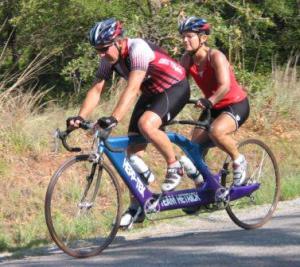 When I noticed this today, I shuffled back through past bikers and thought…I don’t recall ever seeing the woman riding first, and a man riding behind. I’ve seen 2 women, 2 men, an adult/child…but when the twosome is man/woman, the woman is always riding second. Is there some kind of physics, momentum, safety, or scientific explanation that I’m not aware of, that dictates why the woman rides in the second seat? Please enlighten me, I’ve never ridden one of these bikes, so perhaps I’m missing something? It appears to me as another inane example of outdated, status quo gender roles which place men in the forefront and women following behind and not in charge of steering their own destinies. The analogies and metaphors are endless…..
View Original Post at onesportvoice.wordpress.com
|
|
|
- Filed Under:
- Cycling, Sports, SportsPLUS, Discrimination/Title IX







There are 15 comments on this post. Join the discussion!
velogirl
The captain on a tandem really needs to have a lot of physical strength, not only to steer the bike, but also to support the bike when stopped.
The weight of a one-person bicycle = bike weight rider weight.
The weight of a two-person bicycle = bike weight rider weight rider weight. Yet only one rider is responsible for supporting all of that additional weight. Riding a tandem essentially doubles the weight that one individual rider (the captain) must support.
If you don't believe me, I would challenge you to grab your favorite guy-pal, borrow a tandem, and see just how challenging it would be for you to captain the bike.
heidiswift
To put it simply... Yes, there are a lot of physics, momentum, safety, and scientific explanations that the writer of this post is not aware of.
Jim J.
As a male tandem captain, let me assure you the positioning has very little to do with pure physical strength and a lot more to do with cycling strength. I've seen a number of female captains and some of them were smaller than their male stokers.
Many tandem teams form because one of them is stronger cyclist than the other and they decide that they would actually like to ride together rather than in the general proximity of each other. Put it this way. The stronger rider, being stronger and faster ends up ahead and is always trying to slow down to enable the partner to keep up. The slower partner feels guilty about slowing the faster partner down. There's this double guilt thing going on and neither of them is having as much fun as they could be. The tandem is the great equalizer. The stronger rider can put as much as they like into their riding but the team stays together.
The other thing worth knowing is that the most important component in any tandem team is a stoker who is comfortable riding in that position and surrendering control to the captain. In many cases this is because the stoker is not as strong a rider or as experienced and the partner. And yes, it often is the female half of the team that finds herself in this position. However, it really isn't about sexism but rather a new activity that a couple can do together that is both healthy and rewarding.
Jim J.
velogirl
"Whichever direction your relationship is going, it'll get there faster on a tandem!"
wombatgrrl
So why are the guys usually in front? IMHO, it's mostly the economy of mass production. It's easier to build and mass produce the standard frame that fits a taller person in front and guys are usually taller. A tandem for a shorter smaller person in front can be built, but it's more complicated and has to be custom made (expensive). And what guy in a couple is going to agree to that? Add the submission factor, and there you have it!
Claire
We're an unusual team in that I ride about 5000 miles a year, my husband rides maybe 1500 miles a year. About 1250 of our miles are together on the tandem. Since I have more experience cycling in general, the usual "captain decides everything" is not the way we operate.
Look, tandeming amplifies power issues. If you already have some power/control issues with your spouse, they can get much worse on the tandem. Yes, the captain steers the bike and sets the speed and the pace - but a stoker can be passive-aggressive and make life miserable for him if he's ignoring her needs and desires.
In our team, we divide up duties. Example 1: I am in charge of scanning the road from the middle of the bike back; he looks ahead. He has to trust me when I say that no one is approaching us as much as I have to trust him that he's going to use the information I'm giving him safely. Example 2: while my husband might be in front, and has control of the handlebars, he has little sense of direction. Since I better know where we're going, and can have my hands free to handle maps, I'm the one to call out the turns.
Riding tandem has strengthened our sense of teamwork as a couple, and strengthened our mutual trust, and overall, strengthen our relationship.
ROMP
There is one simple rule to remember while tandeming - "The Stoker makes no mistakes."
http://www.gtgtandems.com/tech/propmethod.html
ROMP
Dr. Nicole M. LaVoi
ROBTEMPLIN
Jim J.
Bikedude
wombatgrrl
got it, you use it. If you don't, you find another way. For example -
rock climbing. Men have upper body strength, so they use it to climb.
Women don't generally have this strength, so instead they use their
brains (which tends to be a stronger muscle in women) and their legs.
As a result, you'll find women at the top of the ranks in the world of
rock climbing.
msrw
It's understandable that you might draw a hypothesis related to gender in having seen a bunch of tandem teams with the man in front and the woman in the back. However, I've been riding tandem bicycles for a number of years, and I can assure you that gender has absolutely nothing to do with rider positioning--Rob and others above provided very accurate info on the actual considerations.
In other sports, like tandem kayaks or canoes, the positions of male/female teams can be completely reversed. The lighter weight paddler tends to do best in the front, so when a woman and a man kayak or canoe together, the woman is usually in front. Again, there is NOTHING sexist about this at all. It's just body mass.
I think anthropologists have the challenge and the burden NOT to try to fit all social interactions into theoretical stereotypes that given even a modicum of actual knowledge, would not have been drawn.
So it's great that you asked the question before drawing a definitive--but incorrect--conclusion.
Dr. Nicole M. LaVoi