
unfortunately these myths have persisted. -nml...more
posted Thursday, June 24, 2010 at 10:23am PDT on Mythbusting in honor of Title IX's Anniversary

|

|

|

|

|

| ||
|
| |||||||




posted by All White Kit All White Kit offers coverage of women's soccer around the world from a fan's perspective. AWK will feature the latest news, analysis, and commentary on the women's game. Match reports, scores, schedules, standings and opinion pieces will be on share. We aim to become a resource for any follower of women's soccer. |

|

|
|
A football team donning the Three Lion’s striking kits took to the pitch this week. They had everything to prove and they knew it. They essentially needed to win their match and were expected to. After a shockingly uninspired first 45 minutes, their manager vociferously reminded them of who they were and what they needed to do. Their captain knew that this would likely be the last opportunity in a World Cup for many of the team’s players. So the team’s courageous central defender stood up and scolded, “there’s not one person in this dressing room who’s done enough – not even 50% of what they can do”.
They returned to the field and delivered a rousing comeback, coming back to equalize from two goals down. And who scored the decisive equalizer in the 88’?
The captain.
As you probably know, that team wasn’t the England team currently led by Fabio Capello. Capello’s men didn’t manage to show a hint of heart, tenacity, spirit or national pride in their performance against Algeria on Friday in South Africa. The dismal result has launched the squad – and maybe the entire country – into a frenzy. How could players that can excel at the domestic level come out so flat against the assumed worst team in the World Cup?
Questions regarding Fabio Capello’s man-management style and team selection abound. The England camp apparently can do little right. (Hell, at least the French can successfully launch a player revolt, Mr. John Terry). But perhaps England can now realize that its wild pomposity has little to do with its national team’s quality.
At least one national team’s quality, that is. England’s Women’s National Team exhibited everything its male counterparts didn’t in their performance one day after the Algerian disaster. The team needed to earn a result against group co-leaders Spain to have any chance of qualifying for their third Women’s World Cup. Things looked dicey as England performed poorly, conceding two early goals in the first half. But the team came roaring back for the draw, thereby keeping their World Cup dream alive.
It’s kind of a shame that the team’s comeback occurred a day after the men’s comedown. Not that it would get much time in the national press anyway. Does England even know it lays claim to perhaps the most indomitable national team in all of women’s football?
Not only does the team feature some tragically underrated players like said captain Faye White, fullback Rachel Unitt and winger Rachel Yankey, it also has a top-class manager in Hope Powell. Beyond shepherding her team’s fight back, Powell outclassed Fabio Capello in another way. She recognized her formation wasn’t working so she successfully changed tactics. She moved striker Eniola Aluko to the right and shifted Kelly Smith up top as the lone striker. It worked. Perhaps Capello (or Tony DiCcco!) could take a pointer from Powell’s adaptability.
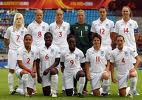
Full disclosure here: England’s improbable run all the way to the 2009 European Championship Final is what initially got me hooked on the women’s game. Maybe it was seeing Kelly Smith hit that rocket shot to win England’s final group game or perhaps it was witnessing Jill Scott’s late winner against the Dutch in the Semifinal (the image above is from that night in Helsinki, by the way). Whatever it was, it was proof positive that the England’s WNT has heart.
If only more English folk would recognize it.
England is probably one of the two most football-obsessed countries on the planet. It’s the country that bore the sport after all (and one that is never loath to remind you). So it’s especially disheartening to see how apathetic – dismissive even – it is of its female footballers.
There seems to be just one British writer devoted to covering the women’s game. Tony Leighton writes for both the BBC and The Guardian, the only two media outlets that feature weekly coverage of women’s football.
But one particular event epitomizes England’s indifference to women’s football: After England’s stirring romp to the Euro 2009 Finals last September, a male caller phoned into the BBC’s 606 Football Phone-In (the UK’s most prominent phone-in radio program) to sing the team’s praises. Alan Green (the show’s ornery host) feigned any interest before proclaiming he still didn’t feel a woman could finish the 90 minutes of a football match. The caller was audibly too shocked to rebut. But was there any rife indignation over Green’s blatantly sexist remarks? Did anyone ever even mention it again? Did a producer take him aside and demand an on-air apology? No.
I’ll let Britons comment on whether this kind of misogyny is so prevalent in British society that it simply doesn’t carry any shock value. I’d argue that that’s how it is in the American sports culture so perhaps it shouldn’t be too surprising to hear such odious remarks so carelessly spoken from one of the most visible football commentators on one of the most visible football programs in the country, if not the world.
But it’s also institutional. The English Football Association doesn’t need my help in portraying them as incompetent fools. But their treatment of women’s football only further illustrates the point.
In May 2009, the FA had finally cobbled together enough money (1.28 million pounds) to offer its Women’s National Team players central contracts. Apparently the Football Association weren’t interested in paying its female players a single pence prior. The practice of women’s national teams getting paid by their football federations certainly isn’t widespread around the world. But for a country like England, waiting until just 13 months ago to consider even paying its female players is inexcusable.
Regardless, the pot of the 1.28 million pounds would be divvied up amongst 17 players. (It should perhaps be noted that that amount is tantamount to what John Terry earns for Chelsea every ten weeks.)
The contracts would only be awarded under a few conditions. The number could be expanded to 20 players, thereby shrinking the total amount that could be allocated. The players could also work up to 24 hours a week for supplemental income if they chose to (it’s commonplace for players to take up side jobs as massage therapists or youth coaches to help with the wages). And in an obvious attempt to keep English players on English shores, the contracts would only be extended to players who “could ensure availability at all times of the year”. Thus, WPS players like Kelly Smith, Eniola Aluko, Karen Carney, Alex Scott and Anita Asante were not offered FA contracts.
Moreover, the supposed FA Women’s Super League is set to take begin in March of 2011 after years of delay. It would replace the Women’s Premier League and become the country’s semi-professional top flight. Eight teams have already been allocated to the new league (which will boldly conflict with WPS in its scheduling) so perhaps it really will kick off soon. But the FA’s clear lack of enthusiasm for the project is self-evident, hence the extended holdup.
If only a league could be forged totally independently of the FA. The United States Soccer Federation certainly doesn’t own either MLS or WPS. The USSF is only the arbitrator of the men’s second-division NASL/USL because it kinda had to be. But since national football leagues in England have traditionally been under the direct auspices of the FA, the Super League has no chance of being self-governed. After all, it only took 104 years for the First Division (now known as the Barclay’s Premier League) to break away from the manacles of the FA. So what chance do the women have of evading the FA’s ineptitude?
England’s Women’s National Team will play its next match on July 29th in Walsall. If they defeat Turkey, they will have assured qualification into the final round of UEFA World Cup qualifying.
Perhaps it will be England’s only chance of World Cup glory anytime soon.
View Original Post at allwhitekit.wordpress.com
|
|
|
|
MOST POPULAR POSTS
posted by MsAkiba 10/11/09 at 11:40am
posted by AnnGaff 06/23/10 at 10:41pm
posted by Women Undefined 06/23/10 at 9:22pm
posted by McCarter.Nathan 06/23/10 at 2:34pm
posted by AnnGaff 06/22/10 at 9:33pm
posted by WTA Women's Tennis 10/07/09 at 12:14pm
posted by From A Left Wing 06/21/10 at 5:20pm
posted by HoopFeed.com 06/23/10 at 1:35pm
posted by Draft Day Suit 05/13/10 at 5:00pm
posted by kacileigh 06/22/10 at 7:03pm
LATEST WTS POSTS
posted by Dyla Magazine - Women's Action Sports Coalition
Today at 8:44pm
posted by All White Kit
Today at 3:18pm
posted by From A Left Wing
Today at 2:18pm
posted by Draft Day Suit
Today at 1:55pm
posted by Dyla Magazine - Women's Action Sports Coalition
Today at 1:51pm
posted by HoopFeed.com
Today at 1:49pm
posted by All White Kit
Today at 1:10pm
posted by Byline to Finish Line
Today at 1:09pm
posted by Balanced Health and Nutrition
Today at 1:06pm
posted by Womenstake
Today at 1:05pm
RECENT COMMENTS
unfortunately these myths have persisted. -nml...more
posted Thursday, June 24, 2010 at 10:23am PDT on Mythbusting in honor of Title IX's Anniversary
Who knew? Thought it was always about athletics.......more
posted Wednesday, June 23, 2010 at 12:45pm PDT on What is Title IX?
the quote in your title is a saying that Tucker Center Director Mary Jo Kane has coined....more
posted Wednesday, June 23, 2010 at 12:43pm PDT on "In one generation, young girls have gone from hoping there's a team to hoping they can make the team." -Mary Jo Kane
Great post!...more
posted Tuesday, June 22, 2010 at 10:11am PDT on Women�s sports: Visibility matters
Jane - we should get tickets for July 10th!...more
posted Monday, June 21, 2010 at 2:31pm PDT on WNBA and 2010 Lilith Tour unite to celebrate female artists and athletes all summer long





No one has commented on this yet. Be the first!