
I'm not a big Stanford fan, but at least they have a legitimate program and did it largely without t...more
posted 04/10/13 at 5:50pm
on Why Cal is my new favorite team





posted by From A Left Wing
Monday, August 13, 2012 at 7:45am EDT
Meditations on the Beautiful Game from an Unlikey Player and Fan.
Jennifer Doyle
Support women's sports and SHARE this story with your friends!
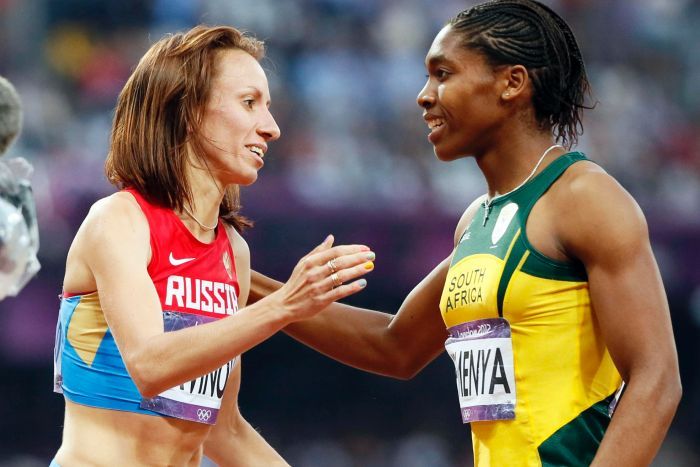 Mariya Savinova and Caster Semenya
When Caster Semenya raced from last to second in the final stretch of the women's 800 meters, some wondered is she aimed for silver. She has a turbo drive of a kick - if she'd engaged it sooner she might have taken gold. Maybe.
Second guessing someone who comes in second is a strange thing. This isn't to say that the thought didn't occur to me. It was being fed to us all by BBC commentators who wondered how someone with that much "in the tank" could wait so long to use it.
Semenya looks different from her competitors. When she switches from running really fast to her full sprint, it's hard to miss her singularity. Her strength and her power make her simply magnificent to watch.
Like Semenya, Mo Farah spent much of his last race (10,000m) at the back of the pack. As they fought their way forward, he and his training partner (Galen Rupp) had to work hard to avoid being boxed in. The back of the pack is safe in that regard but dangerous in others. You have to know your kick and everyone else's.
Maybe Semenya was working the same strategy and kicked too late. The 800 is a war of strategy and speed. There isn't time to hide.
The Olympic final was a very fast race. Mariya Savinova won in 1:56.19. The Russian looked amazing from start to finish. She won with nearly a second to spare. She very nearly wept on the podium when they played her country's anthem. She ran 1:55.87 at the 2011 World Championships.
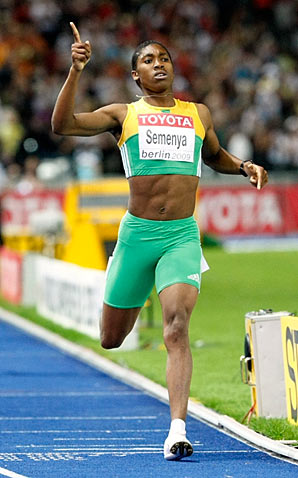
The year Semenya became the object of global scrutiny, the year she was sandbagged into what can best be described as a medical rape, she ran 1:55.45. It was the fastest 800 run by any woman in 2009 and the fifth fastest ever. Just over a half a second faster than Savinova's 2011 race. She moved up early, stayed with the leaders and then kicked coming out of the last turn, as one does.
She won that 2009 race by a huge margin. She stood out. She looked like no one else. It looked easy.
When Usain Bolt runs, it looks like he is from a different planet. Some place in the Jamaican Galaxy. His stride is noticeably longer than that of his competitors. He's freakishly tall for a runner. He's different. A man apart. His exceptionalism makes him into a god. It is not in conflict with his masculinity. In fact, his is a standard. All men who sprint are measured against him. In fact, all people who sprint measure themselves against him. He is the fastest person.
One of my nieces has had a poster of Bolt taped to the wall over her bed since the 2008 Olympics. She's a runner.
When Joan Benoit won the first marathon that women were allowed to run at the Olympics, she broke away from the pack early. She was on her own. She clocked in at 2:24:52. Until 1952, the men's world record was slower than that. If she'd run that time in the 1984 men's Olympic marathon she'd have placed 52nd - about two-thirds of the way back into the pack. But of course, if she'd been running with people faster than her, she'd probably have run faster.
Unlike celebrated world marathons, men and women are forced to run completely separate races at the Olympics. They run in "women-only" and "men-only" races.
Not so long ago, the IAAF created a new rule. No times run by women in races that include men count as a women's record unless women are given such a huge head start that no man could possibly race with them. This new rule would invalidate the world marathon record set by Paula Radcliff. Graciously, the IAAF has let it stand as a record for women running "mixed" marathons.
In "mixed" marathons, officials now see men as illegal pace-setters. In this view, male "pace-setters" (meaning here, simply other runners who are faster than the fastest woman) give women an unnatural advantage. A woman who runs faster when she runs alongside the fastest runners in the world has betrayed her sex.
Women must not run raster than women can run.
Women can't run faster then men.
A woman who breaks from the pack isn't doping. She's a man.
Or she is running with men.
One man can run with longer legs than everyone else. Another can run with prosthetics. But a woman can't run in her own body.
***
The new IOC gender testing policy mirrors this ideology - defining women by what they must not have or be - by marking testosterone levels as the border it defends against women's exceptional capacities.
Women, now, will be tested for their testosterone levels. Too much (and what that level might be hasn't actually been clearly identified) and she can't compete.
A woman's capacity must be limited. It must be fixed by removing whatever excess officials have latched onto. Men in the race. Maleness in her body. She must be produced as castrated.
In an article for the June 2012 issue of American Journal of Bioethics, scholars condemn the new policy on multiple grounds.
The current scientific evidence...does not support the notion that endogenous testosterone levels confer athletic advantage in any straightforward or predictable way. Even if naturally occurring testosterone levels confer athletic advantage, is that advantage unfair? It bears noting that athletes never begin on a fair playing field; if they were not exceptional in one regard or another, they would not have made it to a prestigious international athletic stage. Athletic excellence is the product of a complex entanglement of biological factors and material resources that have the potential to influence athletic advantage. However, the IAAF and IOC target testosterone as the most important factor in contributing to athletic advantage. The policies seek to do the impossible: isolate androgen from other possible biological factors and material resources to determine that the impact that it alone, in the form of testosterone, has on athletic advantage. ("Out of Bounds: A Critique of the New Policies on Hyperandrogenism in Elite Female Athletes")
They conclude:
Considerations of fairness support an approach that allows all legally recognized females to compete with other females, regardless of their hormonal levels, provided their bodies naturally produce the hormones.
And then proceed to embrace the contradictions that such a policy will bring on. (Different countries define women differently.)
***
When I was a child "women's lib" and the Equal Rights Amendment were much in the news. Shirley Chisolm was running for president. My parents hosted National Organization of Women meetings in our living room. I pinned an "ERA NOW!" button to whatever I wore to school.
This meant that I got into a lot of arguments with my classmates. Almost always with boys who wanted me to admit the men are faster/smarter/stronger than women. That ERA button was a red flag I waved before little bulls.
I was reminded of this schoolyard training for the junior feminist at a public forum on gender testing in sports. A local radio station invited me to join a panel to talk about the case of Caster Semenya and the recent changes in the IOC's gender testing policy.
All three of the panelists came from feminist and anti-homophobic perspectives - in principal and in practice all three of us are opposed to gender policing. But there was a moment when I felt baited by the one man on the panel, when he tried to engage me in an argument about how men are faster/stronger than women - how the fastest man is stronger than the fastest woman and therefore men and women's sports must be absolutely distinct from each other.
Now, he said this after I'd already indicated that I opposed gender policing and gender segregation in sports. If he was goading me I'd certainly offered myself to be goaded.
But when he put that bit of gendered common sense into play ("the fastest man...") I called him out for baiting me. I couldn't respond to the issue lightly.
This post is not about what gender is faster.
This post is about what gender is given to us, over and over again, as second. It is about all the work we do to make sure that women and men can be told apart from each other, to perpetuate the fiction that male and female are "opposites."
I am protesting a system that produces "female" as a debility.
That is what a policy forcing exceptional women to take a hormone suppressant is: The production of the fiction that women are quantitatively and qualitatively less than men.
***
A policy that negates the accomplishments of a woman runner because she ran alongside a man is ludicrous and offensive. It is ludicrous because every runner except the one in front is being paced.
It is offensive to deny women the opportunity to be paced by the fastest runners in the world. It is, plain and simple, discrimination. That kind of rule should be against the law.
Men and women should run the marathon together. They just should. Why not have men and women compete with and against each other, as they do in the best events in the world? Why not embrace the fact that it will make the women run faster?
***
Every elite runner runs against the history of running. It's the difference between a race and a game. A race and a routine.
In their minds, women around the world will run with Usain Bolt and Mo Farah. This takes nothing away from Shelly-Ann Fraser-Pryce and Tirunish Dibaba. Surely they run with them too. Surely, as members of an imagined community of athletes, we run with each other.
Caster Semenya reminds me of Usain Bolt.
I want Caster Semenya to lope like him across the finish so far ahead of the pack she makes everyone else look like they are standing still. I want her to avenge the idea that what a woman can do should be limited by some notion of what a man is.
But last night Semenya wasn't our avenging angel. Last night she was Mariya Savinova. She's a ropey figure. More like Farah than Bolt.
As they played her country's anthem Savinova fought back tears of joy. And Caster Semenya looked just as she did when she crossed the finish line. After nearly a year out of the sport and in the headlines, she seemed relaxed - happy to be on the track and pleased as punch with being second.
Support women's sports and SHARE this story with your friends!
Today on the Women's Sports Calendar:
| The Ultimate Fighter 17 Finale April 13: The Joint at Hard Rock Hotel & Casino in Las Vegas | FC Kansas City vs. Portland Thorns FC April 13: Shawnee Mission North High School Stadium |
MOST POPULAR ARTICLES & POSTS
April 6, 2013 at 4:00pm
November 28, 2009 at 5:06pm
March 30, 2013 at 11:32am
April 10, 2013 at 3:12am
March 30, 2013 at 11:15am
April 9, 2013 at 8:54am
March 20, 2013 at 10:46am
April 12, 2013 at 9:44pm
March 9, 2013 at 11:35am
April 11, 2013 at 8:59am
LATEST ARTICLES & POSTS
Fri at 9:44pm
Fri at 9:37pm
Fri at 9:12pm
Fri at 9:09pm
Fri at 9:01pm
Fri at 8:56pm


More on:
Meditations on the Beautiful Game from an Unlikey Player and Fan.
Jennifer Doyle...
full profile
For more, visit jennifer's Full Profile

RECENT COMMENTS
I'm not a big Stanford fan, but at least they have a legitimate program and did it largely without t...more
posted 04/10/13 at 5:50pm
on Why Cal is my new favorite team

Ooh, is that bitterness I smell wafting up from Palo Alto? It almost seems like you are bashing Cal...more
posted 04/10/13 at 4:20pm
on Why Cal is my new favorite team

Cali - I understood what you were saying the same way I understood Gottlieb when she slipped her Soc...more
posted 04/10/13 at 4:06pm
on Why Cal is my new favorite team

Crimson, I was actually responding to the points made by the author this this article, and talking a...more
posted 04/10/13 at 1:20pm
on Why Cal is my new favorite team

We'll see. Stanford is certainly over the novelty of Cal at this point. That's a given. The Cardi...more
posted 04/10/13 at 8:42am
on Why Cal is my new favorite team

Women Talk Sports Podcast - March 5, 2013
In the March edition of the "Women Talk Sports" podcast, Cara and Stephanie use their running background to explain the Dayton 500 and break down the ...[Listen/Download for iTunes]
Women Talk Running Podcast - March 5, 2013
In the March edition of the "Women Talk Running" podcast, Cara and Stephanie wrap up the Millrose Games, give you more Mary Cain news, give our respon...[Listen/Download for iTunes]
Women Talk Sports Podcast - January 28, 2013
In the January 2013 episode of the Women Talk Sports podcast, Cara and Stephanie share several points that will leave you feeling hopeful about the Na...[Listen/Download for iTunes]
There is 1 comment on this post. Join the discussion!
Please spare everyone your gendered drama. Caster Semenya is nothing like Usain Bolt. If you'd like to be honest about the conversation then you should recall that most of the complaints about Semenya have come from female competitors, not some representative of the Partriarchy.
If you'd like truly fair competition then just do away with sex based competition altogether. Several contributors to this site support and actually have written books advocating that position and I haven't seen any contributors here try to rebut the theory.
It is intellectually dishonest to advocate for separate Male / Female competition and not deal with testosterone. Men outperform women in virtually every measurable quickness, speed and strength metric. I challenge any reader to prove this statement wrong.
You can't continue to segregate the sexes in sports without dealing with situations like this.
Politicizing it in a gendered fashion just highlights your lack of intellectual integrity.
Monday, August 13, 2012 at 12:43pm EDT