
Boxing is the best way to tone your whole body and to train your self discipline at the same time. I...more
posted Friday, June 25, 2010 at 12:49am PDT on Basic Boxing Workout

|

|

|

|

|

| ||
|
| |||||||




|
posted by From A Left Wing Meditations on the Beautiful Game from an Unlikey Player and Fan. |

|

|
|
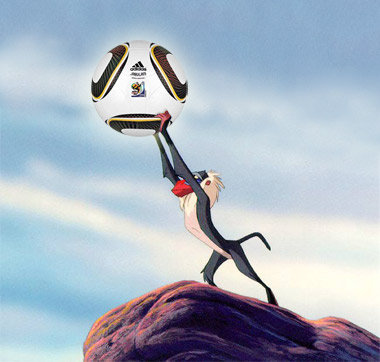
From the first 2010 World Cup broadcasts on ESPN, my fellow tweeters cracked jokes about The Lion King. We imagined Rafiki calling the matches, or James Earl Jones (who provided the voice for Mufasa), and half expected the referees to raise the Jabulani aloft to announce the arrival of the New Ball. Most folks simply observed, "I feel like I am watching The Lion King."
There is a good reason for this. The score used by ESPN to frame its broadcasts was written by Lisle Moore, a Utah composer who had worked with the network in the past. Moore gave us muscular music for a sporting event, upbeat music for a media event organized around putting us all in the mood to buy a shirt, a ball, or a Coke. Layered over the orchestral swells are the oddly familiar sounds of African voices, or, I should say, African-sounding voices. Africa is scored here as a noble landscape, peopled by a unified chorus, singing together in a harmonic convergence of tribal cultures.
"With the exception of the African choir," reports the Salt Lake Tribune, "all of the music is performed by Utah musicians." ("ESPN Turns to Utah for World Cup Music") That African choir, lending this score a sense of location, is actually made up with members of The Lion King's Broadway cast. The African-sounding choir from New York City was hired to sonically channel an idea of African authenticity keyed to ESPN's American audience. This is of course true of all scores produced by the World Cup broadcasting networks as they reach for music their imagined audience will understand. Without a doubt, we are hearing not African music but (to invoke philosopher Valentin Mudimbe) a musical "Idea of Africa."
In the mix of the music draped over the 2010 World Cup, are more specific strains - signals clearly audible to the listener of African music, the sound of a continent being ripped off. This is nowhere more obvious than "The Official 2010 FIFA World Cup (TM) Song", "Waka Waka (This Time for Africa)", sung by Shakira and Freshlyground, a South African Afro-fusion bad. The global pop hit has a clear relationship to a Cameroonian military song, Zangaléwa, popularized by Golden Sounds in 1986. "Waka Waka" doesn't just borrow from "Zangaléwa" - listen to the two and you see that "Waka Waka" is, very nearly, an illegal cover (the chorus is a direct use of "Zangaléwa).
First, Golden Sounds' 1986 hit:
And Shakira/Freshlyground:
In his article "Undermining African Intellectual and Artistic Rights: Shakira, Zangalewa and the World Cup Anthem," (from which I draw heavily below) Dibussi Tande situates this appropriation within a longer history of intellectual theft - he begins with perhaps the most infamous case of an international pop star absorbing the work of an African musician in Michale Jackson's use of Manu Dibango's hit song "Soul Makossa" in the opening track on Thriller.
Dibango sued Jackson and won - incredibly, given the topic here, Dibango's song was the B-side to Movement Ewondo which the artist composed for the 1972 African Cup of Nations (hosted by Cameroon and won by Congo-Brazzaville). It's a frenetic football score in which strings seems to scurry underneath Dibango's expressive and light-footed sax.
Jackson's appropriation of recognizable lyrics and melodies pale in comparison with what Shakira and Sony music pull off with "Waka Waka". Given their direct use of a song which seems to be known a generation of Cameroonians, it's surprising that they thought they could get away with it. (See WFMU's record of their efforts to figure out the song's genealogy.)
Tande, a digitial activist, points out that the origins of the song were only acknowledged by FIFA, Shakira et al in response to online activism by those who knew the song, and were horrified to see it stolen in this way. He writes:
To Cameroonians and many African, the origins of the song was no mystery as they instantly recognized it as a remix of “Zangalewa”. Thus began a frenzied online campaign to alert the world that this was not a Shakira original but a remix. The task was made all the more easier thanks to videos of the Golden Sounds performing Zangalewa that were available on the web. The campaign picked up steam as the international media began taking an interest in the story. (Tande, "Undermining African Intellectual and Artistic Rights", May 23 on Scribbles from the Den)
The internet sped up a process which normally takes years to resolve - clearly, obviously "Waka Waka" is a version of "Zangaléwa." Under pressure from the Cameroonian musicians and their advocates, FIFA gingerly inserted a statement of "Waka Waka"'s relationship to the Golden Sounds hit. FIFA/Shakira/Sony attempt to control the spin here by calling "Waka Waka" a remix, but that's just not true - unless "remix" is now a codeword for "plagiarism" - as none of the original material for the World Cup song acknowledge the existence of "Zangaléwa". (See also Guanabee's April 10 article "Shakira's World Cup Song 'Saminamina' Rips From the 1980s African Hit 'Zangaléwa'.")
The definitive riffs, melodies and lyrics of "The Official 2010 FIFA World Cup (TM) Song" belong not to FIFA at all, but to the makers and listeners of Cameroonian music.
Tande connects this story to Puma's use of a photograph of Ngado Pickett, a celebrated Cameroonian fan in an Paris-based advertising campaign. Puma never asked Pickett for the use of his image to endorse its product. Tande brings it all back around to the starting point for this post: The Lion King. Responding to those who tell Pickett and the artists behind "Zangaléwa" that they should be happy for the exposure, Tande argues:
For decades, African artists have had their works plagiarized by the West with little or no compensation or acknowledgement. The most memorable example of the theft of the intellectual rights of an African artist is that of Solomon Popoli Linda who in 1939 wrote the song "Mbube" and received 10 shillings (less than $US 2) for his efforts. The song which later became the pop hit "The Lion Sleeps Tonight" was reinterpreted by dozens of American artists without Linda or his family receiving a dime. In fact he died penniless. In 1995, the Lion Sleeps Tonight earned an estimated $15 million dollars just for its use in the movie Lion King – a movie which has since grossed about 800 million USD worldwide. Linda's descendants sued Walt Disney for 1.5 million dollars with the full backing of the South African government. Disney settled for an undisclosed sum just as the trial was about to begin. (Tande, "Undermining African Intellectual and Artistic Rights", May 23 on Scribbles from the Den)
This is not something the company is eager for its consumers to know - behind that feel-good African sound is the noise of the gear-works of colonial exploitation, turning.
Here we arrive at the big story of the sound of the world cup - the awful, awe-inspiring but terrifying sound of the vuvuzelas.
Perhaps the noise of the vuvuzela is the sound of resistance - African noise being fed back to us through the television set, a sonic interference, drowning out all else in a collective refusal to play a pretty song.
View Original Post at fromaleftwing.blogspot.com
|
|
|
|
MOST POPULAR POSTS
posted by MsAkiba 10/11/09 at 11:40am
posted by McCarter.Nathan 06/23/10 at 2:34pm
posted by AnnGaff 06/23/10 at 10:41pm
posted by Women Undefined 06/23/10 at 9:22pm
posted by AnnGaff 06/24/10 at 10:30pm
posted by AnnGaff 06/22/10 at 9:33pm
posted by HoopFeed.com 06/23/10 at 1:35pm
posted by WTA Women's Tennis 10/07/09 at 12:14pm
posted by From A Left Wing 06/21/10 at 5:20pm
posted by Draft Day Suit 05/13/10 at 5:00pm
LATEST WTS POSTS
posted by AnnGaff
Fri at 10:59pm
posted by Chic Runner
Fri at 2:54pm
posted by C and R's Stanford Women's Basketball Blog
Fri at 2:19pm
posted by Jayda Evans: Womens Hoops Blog
Fri at 1:35pm
posted by Women's Sports Blog
Fri at 1:33pm
posted by Title IX Blog
Fri at 1:21pm
posted by Swish Appeal
Fri at 1:06pm
posted by They're Playing Basketball
Fri at 11:36am
posted by All White Kit
Fri at 11:36am
posted by Byline to Finish Line
Fri at 10:02am
RECENT COMMENTS
Boxing is the best way to tone your whole body and to train your self discipline at the same time. I...more
posted Friday, June 25, 2010 at 12:49am PDT on Basic Boxing Workout
unfortunately these myths have persisted. -nml...more
posted Thursday, June 24, 2010 at 10:23am PDT on Mythbusting in honor of Title IX's Anniversary
Who knew? Thought it was always about athletics.......more
posted Wednesday, June 23, 2010 at 12:45pm PDT on What is Title IX?
the quote in your title is a saying that Tucker Center Director Mary Jo Kane has coined....more
posted Wednesday, June 23, 2010 at 12:43pm PDT on "In one generation, young girls have gone from hoping there's a team to hoping they can make the team." -Mary Jo Kane
Great post!...more
posted Tuesday, June 22, 2010 at 10:11am PDT on Women�s sports: Visibility matters



No one has commented on this yet. Be the first!