


Erin, I agree! This is despicable, and for it to happen at the same time as the Women's World Cup In...more
posted 06/08/11 at 11:44pm
on Iranian women�s soccer team forfeits 2012 qualifier over head scarves
| Check out our newest addition: @WTSAthleteWatch on Twitter, where we track female athletes beyond the game! |




posted by Ask Lauren Fleshman
Sunday, June 5, 2011 at 1:24pm EDT
Welcome to Ask Lauren, where you get bomb diggity advice from a pro distance runner who's been through it all. Also, don't be afraid to check out the Journal for some unfiltered pro-runner life, Lauren style. Peace out!
Support women's sports and SHARE this story with your friends!
I was recently asked by Ann Gaffigan, USA Steeple Champion and Co-Founder of Women Talk Sports, to do a radio show on eating disorders in the sport of women’s running. This issue really fires me up for lots of reasons, so my first reaction was to say “Bring it!” But as I sat there thinking about it, I started to worry that what I had to say may not be very well received.
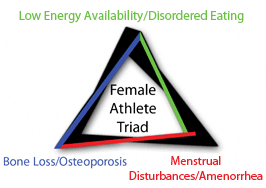
learn more at http://www.femaleathletetriad.org
For example, my natural reaction is to want to kick anyone who starts talking about the “Female Athlete Triad.” Considering that the Triad is the primary philosophy by which we are proactively identifying at risk girls and intervening, there is a good chance I’d piss some people off. Don’t get me wrong, I want to proactively intervene, but as a holistic-minded human biologist and educator, I think the triad is too simplistic and vague, and essentially casts such a wide net that pretty much every weight conscious woman (not just athlete) is touched by part of it.
Whether I was at the gyno, the orthopedist, or in for bronchitis, I’d end up in a conversation about the triad and probed about my eating habits. In the end, there was rarely anything that came out of it for me except the feeling that I was being judged.
 In deciding whether or not to do the show, I realized that any good radio talk show has a variety of opinions, so what the hell? I agreed, and I’m so glad I did. From the get-go, the subject was approached with the respect it deserved. Lize Brittin brought the perspective of a runner who almost lost her life to anorexia, and we discussed the way the culture of the 80’s, her team environment, and her high achieving personality all played a role in the process. I was very struck by her story, and with Ann’s hosting skills tying it all together, it ended up being quite a memorable discussion. I added what I could, and I recommend the broadcast for those who are interested:
Click to listen: WTS Radio Show with Lauren Fleshman and Lize Brittin (opens in new tab)
However, you don’t need to listen to the show to give an opinion on the subject…a subject that is shaped everyday by millions of women doing the best they can to stay fit in a food-overloaded country. The issues of body image and diet are complex for female AND male runners, and too often men are ignored. On this blog, I’d rather hear what the readers have to say about the matter. Feel free to disagree with me people; I love to discuss more than I love to be right.
Support women's sports and SHARE this story with your friends!
MOST POPULAR POSTS
posted by anngaff
06/04/11 at 5:21pm
posted by Women Undefined
07/31/10 at 10:26pm
posted by anngaff
06/09/11 at 12:06am
posted by A Glam Slam
06/04/11 at 8:48pm
posted by MsAkiba
10/11/09 at 2:40pm
posted by Women in Sport International
06/08/11 at 12:39pm
posted by SkaterGirl
06/06/11 at 11:40am
posted by Ask Lauren Fleshman
06/05/11 at 1:24pm
posted by anngaff
03/19/11 at 11:32am
posted by MarQFPR
06/06/11 at 7:30am
LATEST WTS POSTS
posted by Your Daily Dose of Chocolate
Today at 6:32pm
posted by After Atalanta
Today at 5:36pm
posted by Pat Griffin's LGBT Sport Blog
Today at 5:33pm
posted by Run Girl Run
Today at 5:02pm
posted by Wendy Parker's Extracurriculars
Today at 1:03pm
posted by HoopFeed.com
Today at 12:19pm
posted by The Track & Field Superblog
Today at 12:17pm
posted by Byline to Finish Line
Today at 12:14pm
posted by The Track & Field Superblog
Today at 12:12pm
posted by Inspiring Sports Women
Today at 12:11pm
Welcome to Ask Lauren, where you get bomb diggity advice from a pro distance runner who's been through it all. Also, don't be afraid to check out the ...
full profile
For more, visit laurenfleshman's Full Profile
RECENT COMMENTS
Erin, I agree! This is despicable, and for it to happen at the same time as the Women's World Cup In...more
posted 06/08/11 at 11:44pm
on Iranian women�s soccer team forfeits 2012 qualifier over head scarves
Thanks Ann. I'll post it. Good idea.
And yes, I think the best thing we could do for women ...more
posted 06/08/11 at 8:48pm
on Eating Disorders in Female Runners
Lauren, that needs to be a blog post. Other coaches need to use ideas from your coach, he sounds lik...more
posted 06/08/11 at 1:58pm
on Eating Disorders in Female Runners
The entire women's soccer community really should rally behind the team from Iran, and all women who...more
posted 06/08/11 at 1:16pm
on Iranian women�s soccer team forfeits 2012 qualifier over head scarves
Ahhh, Becky, haven't seen her in ages! Tell her I said hi Kara! What a great recap, looks like you m...more
posted 06/07/11 at 9:49am
on Diamond League: When in Rome...Learn


There are 5 comments on this post. Join the discussion!
L-Flo, after our radio show I was thinking about your team of 60 girls in high school and the fact that you only had 1 instance of an eating disorder. And I was thinking about you as the leader of the team - you were the one who was having success, you were the one naturally taking charge. And you had a healthy perspective on food and your body. It reminded me of the It Gets Better Project, where instead of talking about the negatives, the issues, the possible problems, they focus on the good stuff. That's what happened without you even realizing it - you were naturally a good example and you set the tone for the rest of the team. On the other hand, on Lize's team, the leaders were dealing with eating disorders themselves, and therefore it spread like wildfire through the team.
So now the question is, how do we develop strong team leaders who influence their team members positively? How can we make sure the natural leaders of the high school and college teams are setting positive examples? What can the coaches do? The parents? The professional athletes?
Why do you think you were so unaffected by this problem? Your environment must have been healthy, your influences must have been great. Tell us about them. We need to emulate that!
Tuesday, June 7, 2011 at 12:09am EDT
Ann, You are right on about the environment, but you definitely give me too much credit. I stepped into my high school team as a dweeby little freshman, and the environment was already there. I wasn't the fastest girl and we were State Champions on a team with five amazing seniors who I looked up to. I emulated them and added a little of my own flare when it came my turn to lead, and I brought those experiences with me to college.
I put all the credit in the hands of my coach. Our head coach, Dave DeLong, showered his attention on the kids who were the best role models, not simply the fastest kids. And he was an awesome guy with carefully chosen, fun assistant coaches, and you wanted their attention.
Kids respond to what is rewarded.
He had top 10 lists for all grades for all major workouts and races, and top 10 lists for total team time, so performances WERE important.
But he used an Athlete of the Week shirt ceremony every week to highlight someone new each week for a variety of reasons: courage, dedication, leadership, helpfulness, selflessness, etc. They were cool looking shirts that everyone wanted (which makes a difference).
He kept in touch with alumni and would talk to his team leaders about what these alumni were up to. He would say things like, "Steve So-and-So who was #3 guy on our League Championship team in 89, he works with at-risk kids now in New Mexico...most amazingly generous guy..." You knew that life was about more than running and that you would be admired and followed and talked about for living a good life.
When there was a problem on the team, he would jump on it publicly and express his disappointment but always tell us we were better than that. He treated us like the people we COULD be. If we won a race but acted like jerks, he came down on us for it.
Additionally, he recruited volunteer assistant coaches based on what they could offer as examples to us. He was picky about who he let influence his team. It really was about developing good people by showcasing good people.
There was always so much going on with our team that you didn't worry or think about what anyone else, any other team, any other fast runner...was doing. DeLong capitalized on the teenage tendency to feel like they are the center of the universe.
Our end of the season banquet was the most important part because it solidified the culture and environment of the team. This is where you saw what qualities were awarded, and set your sights on what you wanted to earn next year.
Dave would plan a speech about the team, and he would spend a butt-load of team money on awards. He said that was the best investment you could make. He always bragged about how smart and hard working his team was, and when he gave out the awards for students with over a 3.5 average, it was hard to fit us onto the stage. I remember that leaving a big mark on me as a freshman. The fact that a huge percentage of the team was squeezing together, laughing and being celebrated, all holding plaques for their brains...it made a strong point that being on our team was going to be about being a multi-dimensional person, not just a fast runner.
The wide variety of awards you could win gave every runner on the team something to shoot for, some niche to fill, knowing that it would be recognized.
Finally, our booster club of parents had clear leadership that was in line with our coaches vision. DeLong got them involved early in the summer as drivers for team activities, and gave them free lodging and gas for our team pre-season camp in Mammoth for a week if they helped out. This created a group of invested parents who bonded with one another, who were willing to help year-round.
I think that providing an environment that keeps kids focused on larger, broader, more holistic ideals makes it almost impossible to get lost in obsessions over things like food. When one student did do that, DeLong preemptively talked to the other influencers on the team about how doing that was a mistake. Then the teams reaction to that one person's actions was like, "what the hell would someone do that for?"
I've been out for 12 years now. Canyon hasn't always won, but we are always good; and whenever I talk to DeLong, he still talks about so and so who is "such a good kid." It still makes me want to be a good kid too.
Tuesday, June 7, 2011 at 1:45am EDT
This was such an awesome discussion! It was great to see two different sides of this problem: hearing someone who fell into its trap, ultimately leading to the end of her career, and, on the opposite spectrum, hearing a woman who is surrounded by it but keeps a safe distance in order to sustain her life in the sport. In college I was aware of a few people who got bad enough that they had to stop running and besides everyone knowing that anorexia was their problem they still focus on the persons successes. Not that these athletes shouldn't get credit for the fast times they put out or the records they established, by any means, but when fellow athletes recognize the success and push away the consequences it can become dangerous. You see the success that the person had and you want to be as successful. Especially in youth, people tend to know that there are consequences but it's nothing they will have to deal with NOW. Although we know that they will have to deal with it eventually, the concept of these consequences for young girls, young women, young athletes is difficult to grasp. They are a bit disillusioned on how detrimental it can be. It is such a multidimensional topic that is so important to discuss, and the more professional athletes open up and talk about the truthfulness of this problem throughout their career, the more encouragement it will offer to those youth that really really want to be fast and are vulnerable to these types of thoughts and behaviors. I hope as many young women and girl athletes as possible get a chance to hear this so they can see both sides of this disorder and see how choosing not to go down that path CAN pay off.
Keep up the positive stuff, women!
Tuesday, June 7, 2011 at 8:39am EDT
Lauren, that needs to be a blog post. Other coaches need to use ideas from your coach, he sounds like a rock star. I think you did touch on this in another post, when you answered a question about what the coach could do, but it can't hurt to put more information out there.
Sometimes I think our uniforms make for a bad environment. I originated in the soccer culture, where you wear jerseys and long shorts. That's what is "cool." It took me awhile to get used to wearing little running shorts without feeling like a geek. Much less the buns! And then all of a sudden I had to worry so much more about every little piece of my body. We get to see the pro women in plain view, all the way up to their hips and their whole ab region. Then as a kid you look at yourself and are like, "whoa I'm nowhere near that." If you don't have a positive environment around you already, this is going to get to you. Plus, is it really necessary to wear uniforms like that? Where did that come from, when did it start?
Wednesday, June 8, 2011 at 1:58pm EDT
Thanks Ann. I'll post it. Good idea.
And yes, I think the best thing we could do for women in our sport is change it so that we wear shorts at the very least. There is absolutely no reason to wear buns other than "sex sells." If they were actually faster, the men would do it!
Wednesday, June 8, 2011 at 8:48pm EDT