
Great stuff Lisa - first timers should also know that they will be REALLY sore the next day!!...more
posted 09/15/11 at 1:37pm
on What You Should Know Before You Spar





posted by LostCentury, a Women Talk Sports blogger
Wednesday, August 17, 2011 at 1:06am EDT
About LostCentury:
Media reports about the pioneers of American women’s sports & fitness originally published over 100 years ago....more
Support women's sports and SHARE this story with your friends!
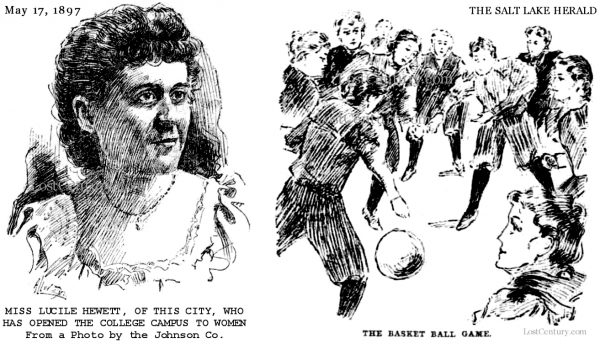
May 17, 1897, Tuesday – The Salt Lake Herald, Utah
WOMEN ON THE CAMPUS
Co-Educational Institutions Admit Women to Play
LUCILE HEWETT’S EFFORTS
Salt Lake Girl the Pioneer in the Movement
She Petitioned the Athletic Association of the University of Utah to Admit Her Team—Now Girls May Play on the Columbia and Harvard Grounds
The Vassar-Utah basket-ball game will take place Decoration day, May 30.
“Owing to a broken nose sustained by the captain of the Vassar team and a succession of broken fingers suffered by the substitutes, the names of the players cannot be accurately stated at present.”
You need not be at all astonished to read a notice like this in your favorite newspaper any day soon, for there has recently been a great stride forward in the woman’s athletic world, and one that offers untold possibilities.
Hitherto the co-educational colleges—and there are 250 of them in this country—have barred the girl students from the college campus. The Columbia college students do not allow the Barnard college annex to play on the Columbia campus. Harvard does not invite its girl students to romp on the boys’ football practice grounds. Yale would scorn a woman on its big kicking acres, and even the least conservative of the broad-minded western colleges draw the line at bloomers on the college grounds.
The bloomer girls have a secluded spot for kicking and running and jumping, but even its location is as carefully guarded as the mine of Golgotha. In most mixed universities the girls practice in a gymnasium.
Things were going on this way when basket-ball struck the University of Utah. In six months this game has revolutionized athletics.
Basket-ball is unfortunate only in name. It if were called by a more vigorous title it would win its way quicker to general approval in athletic circles. It requires all the skill and muscle needed in football, and in many respects a greater athletic prowess. The jumps are higher, the running faster and the body movements quicker. There is less wrestling, as the players are not allowed to touch one another, but where the wrestling is debarred the generalship comes in.The boys’ colleges have discovered this and are taking up the game vigorously; and the girls come in with them…
It is not an easy thing to do—to throw a ball into a net ten feet high, with five pairs of hands trying to prevent you from doing it.
The best playing comes in when the ball first leaves the player’s hands. As it passes into the air a hand suddenly stops it, or hitting it with the finger tip turns it aside, diverting it from its course. The ball must be struck with the open hand, a clenched hand denoting a foul.
With well-matched teams a long game is certain, for basket ball requires more skill and finesse than any other field sport. There is in the game nothing to offend. There is no high kicking, no rolling over, no pummeling on the ground. It is exercise, simple and pure, vigorous and real.
The young woman who has succeeded in opening the campus to girl’s athletic exercises has done much. She took her associates into the athletic association of the college, and did it so successfully that a woman was nominated for president of the athletic association. She made a good run, though she was defeated.
The games played by the girls in the top of the gymnasium were so skillful that the question of an open field came up of its own accord.
Although the campus has not been offered to women in the co-educational colleges, there have been several excellent games played in public, one of the most noteworthy being the game between the University of Michigan and the University of Chicago. This game was public in the sense that the friends of all parties were freely admitted regardless of sex.
It is not feared that the college campus will unfit women for the “sphere” which is still admitted to be theirs. They have stood the other tests well, the bicycle and the gymnasium, and it is to be hoped that Miss Hewett and her athletic girl associates will not find the campus games too much for them.
“We did it,” said Miss Hewett “by simply buttonholing the executive committee of the association and then petitioning the president of the university.”
Excerpted from “The First Decade of Women’s Basketball: A Time Capsule of Media Reports from the Dawn of the Game”
Support women's sports and SHARE this story with your friends!
This article was written by a WomenTalkSports.com contributor. Sign up here to start publishing your own women's sports content.
MOST POPULAR ARTICLES & POSTS
September 11, 2011 at 2:20pm
September 12, 2011 at 10:16am
July 31, 2010 at 10:26pm
September 13, 2011 at 12:08am
September 14, 2011 at 1:51am
September 14, 2011 at 10:45am
August 5, 2011 at 4:32pm
September 10, 2011 at 1:16pm
LATEST ARTICLES & POSTS
Fri at 12:49am
Fri at 12:46am
Thu at 11:30pm
Thu at 6:24pm
Media reports about the pioneers of American women’s sports & fitness originally published over 100 years ago....
full profile
For more, visit LostCentury's Full Profile
RECENT COMMENTS
Great stuff Lisa - first timers should also know that they will be REALLY sore the next day!!...more
posted 09/15/11 at 1:37pm
on What You Should Know Before You Spar

If the football superconfernces do indeed form (and all indications are that is imminent) then one c...more
posted 09/14/11 at 5:57pm
on Another season of college sports scandals--and now what?

Thanks Liz!...more
posted 09/05/11 at 12:36pm
on Meggan Franks Race Recap: 3rd overall, 1st female at Ridgeland 5K Run for St. Jude

Hey! Congratulations on the race!! Awesome job, Meggan! ...more
posted 09/05/11 at 10:53am
on Meggan Franks Race Recap: 3rd overall, 1st female at Ridgeland 5K Run for St. Jude
Thanks for the response. With Women's hockey in it's infancy, was curious how the proponents of the ...more
posted 09/04/11 at 2:46am
on Is Hockey Becoming Football?


No one has commented on this yet. Be the first!