
I'm not a big Stanford fan, but at least they have a legitimate program and did it largely without t...more
posted 04/10/13 at 5:50pm
on Why Cal is my new favorite team





posted by The Rabbit Hole
Monday, October 10, 2011 at 3:52pm EDT
Blogger Courtney Szto is a Master's Student studying the socio-cultural aspects of sport, physical activity and health (or as some call it Physical Cultural Studies). Bachelor's in Sport Management. Former tennis coach & ropes course facilitator.
Support women's sports and SHARE this story with your friends!
I was first introduced to the concept of sport for development and peace (SDP) in 2005. I stumbled upon the United Nations website at a time when I was struggling with reconciling the knowledge that people in this world suffer on a daily basis largely because of the actions of other people and the randomness of geography, with the fact that I had supposedly dedicated my life to the sports industry. Then I heard about Right to Play and it seemed like divine intervention (or something like that) had combined my passion for sports with my new found interest in global issues. Little did I know I had just made my life even more complicated.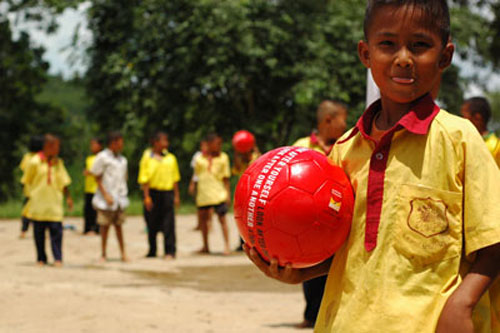 Right to Play Program.
In 2005, explaining Right to Play to people was always a lengthy endeavour (an international humanitarian organization that brings sport and play programs to children in some of the most disadvantaged areas of the world in order to facilitate individual and community development); however, today thanks to Olympic support and a number of high profile athlete ambassadors (e.g. Alex Ovechkin, Ian Thorpe, Wayne Gretzky and Julia Mancuso) Right to Play needs no explanation. Right to Play is easily the most prominent figure in the SDP movement, which includes other notable organizations such as Peace Players International, Magic Bus India, the Mathare Youth Sports Association (MYSA), and Sports without Borders. With variations between each organization, SDP as a whole aims to use sport and play as a method of addressing humanitarian issues with the hopes of facilitating social change. For example, gender equality is a common goal of SDP programs and thus many programs seek to 'empower' (see my post on the Lingerie Football League to understand my feelings about the term empowerment) young girls to stand up for their rights and protect their bodies. The Goal Programme in India, sponsored by Standard Chartered Bank, combines gender equality initiatives with micro-financing lessons. Right to Play and the MYSA include tackling AIDS prevention as one of their goals. If its in the Millennium Development Goals you can bet that there is a SDP program out there somewhere trying to make a difference.
Anyways, I took my enthusiasm for SDP to grad school and there they put a quick halt on my RTP flag waving, and rightly so. My original assumption, I think that many might share, was - how can helping children play be a bad thing? I lovingly say that they beat the enthusiasm out of me with two years of questioning what it was I was supporting, what I THOUGHT I had been supporting and what actually happens on the ground. Today, although I still cringe a little when I hear the words Right to Play, I know I have a far more balanced and healthy understanding of the SDP movement and the 'good deeds' we think we are doing; hence, I would like to provide a quick overview of the pros and cons of the SDP movement for you. Think of it as SDP 101.
The Good:
- can help break down racial/ethnic barriers (Israeli and Palestinian children playing soccer together)
- can facilitate other development initiatives (e.g. vaccinations, health promotion, maternal health, micro-financing etc.)
- promotes the human right to play, leisure and rest
- provides a glimpse into being a "regular kid" for children in refugee camps etc.
- can challenge gender barriers
- can help facilitate the re-integration of child soldiers
The Bad:
- is seen by some as a re-colonization by Western/Northern players; promotes Western/Northern ideas of development
- can create backlash against young women (and their families) who choose to challenge gender norms
- boys and men are often excluded from the process of creating gender equality
- commonly ignores the larger structural issues that create gender inequality, poverty, disease etc.
- may encourage child trafficking (see my post on sport's role in child trafficking)
- little thought given to exit strategies
- promotes fly-in/fly-out appearances by professional athletes
- often utilizes Western volunteers who are uneducated about the harmful power relations involved in "giving back"
- little data demonstrating that SDP programming creates any significant social change
neither of these lists are meant to be comprehensive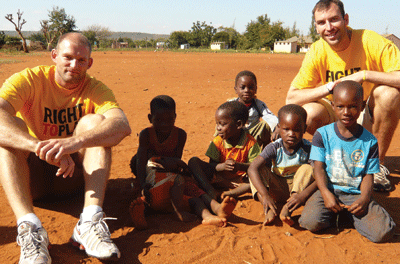 Robyn Reghr of the Calgary Flames and Zdeno Chara
of the Boston Bruins. Photo from The Reflector.Long story short, are there extremely touching and powerful stories about sport changing individual lives for the better? Absolutely. Can outside interference under the banner of a "good deed" cause harmful unintended consequences? Absolutely. Every time we send soccer balls to a "developing" country and pat ourselves on the back we are reproducing a dependence on foreign support and therefore not helping to build capacity by taking away local labour and wages through the importing of foreign goods. Same thing with volun-tourism organizations that say "hey come help build a hospital in Thailand while travelling." Great, you feel better about yourself but what "Thailand", or whichever nation, really needs is the ability to pay their own people to build their own hospitals. This is something that must occur at a state level, but given the fact that individual and corporate social responsibility are now seen as more viable and powerful options over state support we end up putting band-aids on bodies that require major surgery.
I get it, it's easy to donate. It makes you feel like you are doing something because the problems that we face are too much for one person to handle. All I ask is that we question our actions, for example:
- how is a new school going to change the overall landscape of this village? (will girls get to go to school or will it be the status quo because gender norms still exist? will young women be able to afford and have access to sanitary pads to go to school? do jobs exist for the women who do graduate?)
- how is this equipment going to help? (will they actually use it for sport or will they use it for some other primary need [a colleague of mine gives the example that donated mosquito nets end up being used as bridal wear or fishing nets because the threat of malaria doesn't seem as important as a big ceremony or the desire to feed the family])
- where is my money going? (does it go to support programming on the ground or does it pay to fly a professional athlete in for a photo shoot? am i paying for a band-aid or for surgery?)
I may paint a very grim picture of the SDP movement and our supporting roll in it; however, I aim only to highlight the fact it, like many other development/charitable endeavours, go unquestioned. I personally have helped to raise thousands of dollars for Right to Play and I have absolutely no idea where that money went or if it made any difference; but this does not mean that it didn't make a difference. Sometimes a band-aid is necessary and sometimes it is better than doing nothing. Other times we are merely wasting our time and missing the problem completely. Slowly the SDP movement is being asked to be more accountable for its actions and the grand statements it makes. Those who support SDP generally do so because sport has been a positive impact in their own lives. That's great, and I would never tell anyone NOT to support SDP programs; but at the same time they are not perfect and they can recreate some of the very problems that we were trying to solve.
I will conclude with story that helps maintain my enthusiasm for SDP while also being critical about its impact. When I told one of my former high school teachers about my involvement with RTP she said, "Kids in Africa don't have any food or water but you want to make them play soccer?", which at the time definitely put a downer on my excitement. A year later, I was fortunate enough to meet a young man who had been a recipient of RTP programming in a refugee camp and I asked him what he would say to someone like my former teacher about the value of RTP. He said "We know we are hungry, we know we are thirsty, but programs like Right to Play mean that we are not forgotten."
Support women's sports and SHARE this story with your friends!
Today on the Women's Sports Calendar:
| The Ultimate Fighter 17 Finale April 13: The Joint at Hard Rock Hotel & Casino in Las Vegas | FC Kansas City vs. Portland Thorns FC April 13: Shawnee Mission North High School Stadium |
MOST POPULAR ARTICLES & POSTS
April 6, 2013 at 4:00pm
November 28, 2009 at 5:06pm
March 30, 2013 at 11:32am
April 10, 2013 at 3:12am
March 30, 2013 at 11:15am
April 9, 2013 at 8:54am
March 20, 2013 at 10:46am
April 12, 2013 at 9:44pm
March 9, 2013 at 11:35am
April 11, 2013 at 8:59am
LATEST ARTICLES & POSTS
Fri at 9:44pm
Fri at 9:37pm
Fri at 9:12pm
Fri at 9:09pm
Fri at 9:01pm
Fri at 8:56pm


Blogger Courtney Szto is a Master's Student studying the socio-cultural aspects of sport, physical activity and health (or as some call it Physical Cu...
full profile
For more, visit Resident_Badass's Full Profile

RECENT COMMENTS
I'm not a big Stanford fan, but at least they have a legitimate program and did it largely without t...more
posted 04/10/13 at 5:50pm
on Why Cal is my new favorite team

Ooh, is that bitterness I smell wafting up from Palo Alto? It almost seems like you are bashing Cal...more
posted 04/10/13 at 4:20pm
on Why Cal is my new favorite team

Cali - I understood what you were saying the same way I understood Gottlieb when she slipped her Soc...more
posted 04/10/13 at 4:06pm
on Why Cal is my new favorite team

Crimson, I was actually responding to the points made by the author this this article, and talking a...more
posted 04/10/13 at 1:20pm
on Why Cal is my new favorite team

We'll see. Stanford is certainly over the novelty of Cal at this point. That's a given. The Cardi...more
posted 04/10/13 at 8:42am
on Why Cal is my new favorite team

Women Talk Sports Podcast - March 5, 2013
In the March edition of the "Women Talk Sports" podcast, Cara and Stephanie use their running background to explain the Dayton 500 and break down the ...[Listen/Download for iTunes]
Women Talk Running Podcast - March 5, 2013
In the March edition of the "Women Talk Running" podcast, Cara and Stephanie wrap up the Millrose Games, give you more Mary Cain news, give our respon...[Listen/Download for iTunes]
Women Talk Sports Podcast - January 28, 2013
In the January 2013 episode of the Women Talk Sports podcast, Cara and Stephanie share several points that will leave you feeling hopeful about the Na...[Listen/Download for iTunes]
No one has commented on this yet. Be the first!