

Cool Post. I thought the way the race was set up was a great idea. They obviously tried to give ev...more
posted 02/09/12 at 9:39am
on Battle of the Sexes Puma Mile: Parker Makes the Men Earn It





posted by The Rabbit Hole
Saturday, January 28, 2012 at 6:51pm EST
Blogger Courtney Szto is a Master's Student studying the socio-cultural aspects of sport, physical activity and health (or as some call it Physical Cultural Studies). Bachelor's in Sport Management. Former tennis coach & ropes course facilitator.
Support women's sports and SHARE this story with your friends!
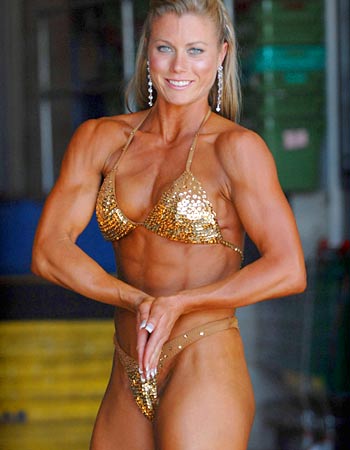
Bodybuilder, Jasyln Hewitt. Photo from Courier Mail, Australia.
Last year at the North American Society for the Sociology of Sport I attended a presentation by Mike Maciejewski from the University of Iowa on the hyperreality of (male) bodybuilding contests. I thought it was a pretty provocative project and wanted to highlight some of his larger observations. Now, I know hyperreality is probably not a word that you have come across in your 'word of the day' calendars but all you really need to know is that it refers to something that is a false representation of the original. As I explain Maciejewski's study I hope that the theory of hyperreality will become more clear.
His study, titled "Seeing isn't believing: Male bodybuilding contests and hyperreality", I believe offers a great entry point into the world of body building as a whole - what is its purpose and what are we really valuing? Maciejewski's main argument was that bodybuilding offers a representation of strength where strength does not necessarily exist. Competitive bodybuilding is the process of altering one's body in order to create a physique that will be critiqued based solely on appearance by a panel of judges. This should not be confused with competitive powerlifting or Olympic weightlifting where, although athletes in both competitions will have above average amounts of muscle, weightlifters are judged on physical strength.
For bodybuilders, the lead up to a competition is a grueling routine of tapering one's training to maximize the appearance of muscle on competition day. This involves decreasing the amount of strength training, calorie consumption and water consumption; therefore, everything that was necessary to create the existing muscular physique is taken away when competition times comes in order to accentuate the appearance of muscle. Bodybuilders are known for dehydrating themselves until the point of fainting in order to further enhance the appearance of their muscles. The bodybuilders in Maciejewski's study explained to him that on competition day some of them barely had the energy to walk and felt extremely weak due to lack of food and water. Hence, his argument that bodybuilding offers a representation of strength where strength does not necessarily exist. Maciejewski argues that at the point where the bodybuilder's body is offered as the pinnacle of strength with every muscle visible for the world to see his or her body is actually at its weakest. It is not news that bodybuilding is about looking good but this presentation, to me, was certainly a revelation that these so-called athletes feel their worst on competition day, which is generally the polar opposite of what most athletes would want, and that their muscles only represent a simulation of strength.
As much as our society privileges muscular bodies because they signify not only physical strength but determination, health and discipline, bodybuilding should force us to question what type of reality truly lies behind muscle. I suppose dedication could still be one of those values, but to what end? Dedicated to looking good rather than feeling good? Determined to sell the world a version of you that doesn't really exist? I haven't even mentioned the fact that many bodybuilders resort to steroid use, which adds another layer of complexity to what strength means. Admittedly, bodybuilding is not a topic that I am extremely familiar with so I welcome comments and any further insights from readers.
Personally, I have always tried to add muscle to my frame because I was the skinny kid growing up, or as my aunt liked to call me - a toothpick. My frame is one that offers the exact opposite of what bodybuilders do - one that holds more strength than it represents. Thus, I have always longed for a truer representation of where I believe my own strength to lie, but this glimpse into bodybuilding really made me question why I assign so much value to muscle. We draw a lot of attention to the waifs that grace the covers of our magazines but so too should we critically evaluate the men and women who are paraded before us as towers of strength because body image works in many directions.
Support women's sports and SHARE this story with your friends!
MOST POPULAR ARTICLES & POSTS
July 31, 2010 at 10:26pm
February 4, 2012 at 3:38pm
LATEST ARTICLES & POSTS
Thu at 3:24pm
Wed at 11:21pm
Wed at 10:45pm
Blogger Courtney Szto is a Master's Student studying the socio-cultural aspects of sport, physical activity and health (or as some call it Physical Cu...
full profile
For more, visit Resident_Badass's Full Profile
RECENT COMMENTS
Cool Post. I thought the way the race was set up was a great idea. They obviously tried to give ev...more
posted 02/09/12 at 9:39am
on Battle of the Sexes Puma Mile: Parker Makes the Men Earn It

Ann,
I'm somewhat disappointed in how this race was couched, i.e., giving the girls a 29 sec ...more
posted 02/06/12 at 9:50pm
on Battle of the Sexes Puma Mile: Parker Makes the Men Earn It
According to the rules posted above, Griner WILL be eligible. The rules state a player is eligible ...more
posted 02/02/12 at 4:24am
on WNBA vs. NBA Draft Eligibility

I agree that this development doesn't necessarily mean the sky is falling.
First, the olymp...more
posted 01/30/12 at 9:54pm
on WPS suspends 2012 season
Go Sharapova!! She's hot.
Loving the blog, Sarah. I'm learning a lot of good 'water cooler t...more
posted 01/28/12 at 5:58pm
on Where is the Dominance in Women's Tennis?


No one has commented on this yet. Be the first!