

Nice article. Tiny error "Oftentimes, she does now even have him tell her the pace."...more
posted 06/17/12 at 5:18pm
on Jackie Areson in Transition





posted by The Rabbit Hole
Monday, June 18, 2012 at 10:24am EDT
Blogger Courtney Szto is a Master's Student studying the socio-cultural aspects of sport, physical activity and health (or as some call it Physical Cultural Studies). Bachelor's in Sport Management. Former tennis coach & ropes course facilitator.
Support women's sports and SHARE this story with your friends!
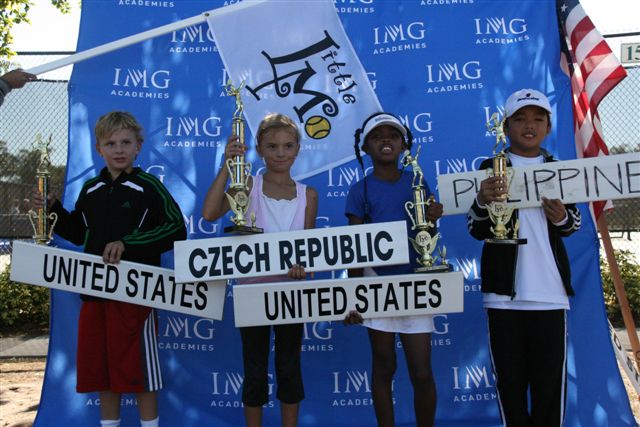 Photo from Xavier School.It is pretty much a given that if you become a professional athlete that you will not get to compete in your home town or country. If you do, consider yourself one of the lucky ones but labour migration in sport is almost a guarantee. But I don't want to talk about what happens once you're a pro, I want to talk about where you train to become a pro and what, if any, significance that has on an athlete's national identity. It is a topic that I tried to write about last year but hit a wall. Then, while watching the women's French Open final Ted Robinson commented that Maria Sharapova's tennis, although Russian in nationality, is 100% American. Even at 7:30am that comment awoke the sociologist within.
For those of you not familiar with Sharapova's biography, she and her father left Siberia when she was nine years old in order to train at the famed Bollettieri Tennis Academy in Florida. Hence, Robinson's statement that Sharapova's tennis is 100% American is because she has done the majority of her formative training in American under an American coach. She doesn't even have a Russian accent. Sharapova, like many before her (including Monica Seles, Tommy Haas and Anna Kournikova), left her native land for better training abroad. Obviously, tennis is not the only sport where this happens but it is far more common for individual sports than it is for team sports. As another example, Canada's conservative hockey pundit, Don Cherry, has highlighted on Coach's Corner that Americans commonly elect to play in the Canadian major junior leagues (e.g. CHL, WHL) as their gateway to the NHL. As Cherry brashly puts it "don't tell me about American development. They learn up here. They come up here and why do they come up here? Because we're the best in the world and kids don't you forget it." Although Robinson's and Cherry's statements both differ greatly in delivery, the underlying message is the same - you trained here therefore, we're gonna take credit for your successes.
Training abroad should not be confused with "muscle drain", which is where players leave their home nations to compete abroad (e.g. Japanese baseball players, Korean women golfers, Russian hockey players). For a player like Ichiro Suzuki, Japan lost one its best players to Major League Baseball. Great for MLB and Ichiro but, terrible for Japanese professional leagues.
Maguire (1993) has argued that nations use sport to celebrate themselves and national sports are thought to "embody all the qualities of national character" (p.297); but what happens if your "national character" was developed by another nation? If a nation takes pride in the accomplishments of its athletes, then is victory slightly tainted if said athlete was trained by the competition? Is this a way of hedging our bets by not only claiming victory for our country's wins but also the wins of all of the athletes who trained under our system? This would mean that, because both Svetlana Kuznetsova and Marat Safin trained in Spain, Spain can take an equal amount of credit for their four Grand Slam titles as they can for Rafael Nadal's eleven titles. Right? At least, this seems to be what Robinson and Cherry have claimed, almost to the extent that where you train (or where your coach is from) is more important than the passport you hold.
When I first heard that the Chinese women's Olympic curling team had hired a Canadian coach I felt like this was cheating. Kind of a "hey, figure it out for yourself" reaction. But realistically, this is what everyone does, they learn from someone who does it better. It's just smart training and it's how we create better competition. So the question here is: should the country in which an athlete trains have the ability to take credit for an athlete's successes or does globalization and the fluidity of movement across borders make credit a moot point? Personally, I'm inclined to say the latter, but you tell me.
Support women's sports and SHARE this story with your friends!
Today on the Women's Sports Calendar:
| USA Olympic Trials T&F; Jun 21 - Jul 1: Hayward Field | WNBA Games June 21: Target Center |
MOST POPULAR ARTICLES & POSTS
May 5, 2012 at 12:54pm
June 19, 2012 at 10:20pm
June 19, 2012 at 9:51am
December 3, 2011 at 9:18am
LATEST ARTICLES & POSTS
Thu at 6:07pm
Thu at 6:07pm
Thu at 6:04pm
Thu at 6:01pm
Thu at 5:52pm
Blogger Courtney Szto is a Master's Student studying the socio-cultural aspects of sport, physical activity and health (or as some call it Physical Cu...
full profile
For more, visit Resident_Badass's Full Profile

RECENT COMMENTS
Nice article. Tiny error "Oftentimes, she does now even have him tell her the pace."...more
posted 06/17/12 at 5:18pm
on Jackie Areson in Transition

mcjack - Most lesbian doctoral candidates aren't in the market for these kicks and totally like call...more
posted 06/15/12 at 7:20pm
on Forget pink shirts and caps...
really? you can draw a link from a pair of shoes to "heteronormative marketing" you have way too muc...more
posted 06/14/12 at 11:23pm
on Forget pink shirts and caps...

Great to hear canoe has been included in the Youth Olympics, and what a fab photo! Keep plugging awa...more
posted 06/08/12 at 1:08pm
on Iran's First Female Canoeist Wins Silver at ICF Canoe Sprint World Cup #3
"Butterflies would never fly around a naked man" - made me laugh out loud. Thank you for adding the ...more
posted 06/07/12 at 10:29pm
on Sam Stosur's "style"
No one has commented on this yet. Be the first!