

Hey Harry Reid, shutty it. Your misplaced outrage is laughable.
Seriously Harry, go walk arou...more
posted 07/14/12 at 10:07pm
on Lawmakers outraged at �Made in China� Team USA uniforms





posted by The Rabbit Hole
Wednesday, July 11, 2012 at 9:32pm EDT
Blogger Courtney Szto is a Master's Student studying the socio-cultural aspects of sport, physical activity and health (or as some call it Physical Cultural Studies). Bachelor's in Sport Management. Former tennis coach & ropes course facilitator.
Support women's sports and SHARE this story with your friends!
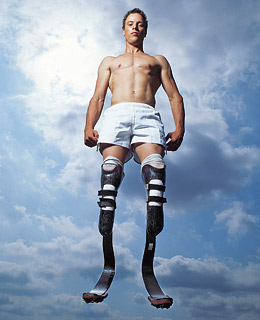
Photo from Running Competitor.
The Oscar Pistorius debate will soon be the conversation of every dinner table as the 2012 Summer Olympics nears closer. The Huffington Post published a poll/article questioning whether or not his prosthetic limbs give him an advantage or not. The comments run the gamut from (and I'm paraphrasing) "they aren't his legs" and "we have to draw the line somewhere" to "shame on you for wanting to hold him back". I have written about Pistorius briefly with regard to technology in sport but I think what sport ethicist and philosopher, Ivo van Hilvoorde, stated in the Huffington Post article is a great topic for discussion. He said "We are used to thinking of disabled as less, but it could be the other way around. Oscar Pistorius is a nice example of this."
I don't want to get into the debate of what happens when prosthetics become better than human legs. I want to discuss the idea of thinking of disabled as less and how Pistorius shatters this notion. The normalization of disability is, in my opinion, the value of Pistorius' success. Persons with disabilities are supposed to be less able than "regular/normal" people. They are supposed to need help and assistance. We are supposed to pity them. We are supposed to be grateful that we are not them. We are supposed to be inspired by those who do not let their disability impede their lives, but when someone's disability is not longer a disability that is when it becomes controversial.
Michel Foucault wrote about bio-power, which can generally be explained as the allure and creation of 'normal'. The medical profession is a great example of bio-power at work. Normal heart rate, normal body weight, normal height for your age development, normal sexual function. Normal. Normal. Normal. Normal. Anything outside of the realm of normal, which is usually pretty limited, is termed abnormal. Anything abnormal should want to strive to become normal. No one and nothing wants to reside in abnormal; that in itself is abnormal. Everything in life has this normalization and it has become institutionalized. In school, a C is average. In economic development, a country is considered developed (normal) or developing (abnormal). In society, a "normal" family consists of a man, a woman and their children. A family missing any of these components is abnormal. In sport, we are taught correct technique (the normal way) and we ridicule and scrutinize those with abnormal technique. It is a power that looms over us without us recognizing it. We especially don't think about it if we are lucky enough to be considered "normal".
Back to Pistorius. The man has no legs. How in the world is this an advantage? If anything, his fancy prostheses level the playing field so that he can compete with legged folk. So are we saying that technology is okay when it pushes the boundaries of the human body but not okay when it facilitates high performance inclusion? Space age materials are allowed in tennis racquets, skis and golf clubs. Companies spend millions of dollars every year designing shoes, clothing, and all sorts of gear that make us better than we actually are so why are Pistorius' prostheses any different? One Huffington Post commenter wrote, "that's why we have the Paralympics." Actually, I'm pretty sure we have the Paralympics because those athletes are largely considered less-than and not better than. It's the idea of separate but equal. You can sit there but you can't sit here. Sport is full of technological and physiological advantages and disadvantages. If Pistorius can't race with "normal" humans then I'm waiting for the NHL to say that Zdeno Chara is too tall and strong to play hockey with the regular sized humans. Tell me gay men have an unfair advantage in figure skating. The fear is that the abnormal is infiltrating our notion of normal. Sure, he wasn't born with those "legs" but shorter tennis players often use longer racquets to make up for their lack of reach. They weren't born with those racquets either and no one calls them out for cheating or redefining boundaries.
How dare we compete alongside a person with a disability because what should happen if we lose to a man with no legs? Just as a woman beating a man at a man's game is unacceptable to the "natural" world order, so too is a man with no legs running faster than a man with two legs. If Pistorius' prostheses were pirate peg-legs and he was able to run the same times he does now would anyone complain? If he were able to run on his two hands as fast as others could run on their two legs would we stop him? I doubt it, but maybe we would. Do we object to the technology he is using or to the inclusion of the man himself? Isn't the real problem that Pistorius is supposed to one of 'them' and not one of 'us'?
Support women's sports and SHARE this story with your friends!
Today on the Women's Sports Calendar:
| FIM Women's Motocross World Championship- Slovenia July 15: Slovenia |
MOST POPULAR ARTICLES & POSTS
July 13, 2012 at 11:54am
July 13, 2012 at 1:17am
July 8, 2012 at 11:09pm
October 7, 2009 at 3:14pm
July 14, 2012 at 6:41pm
January 24, 2012 at 10:48pm
LATEST ARTICLES & POSTS
Sat at 7:03pm
Sat at 6:42pm
Blogger Courtney Szto is a Master's Student studying the socio-cultural aspects of sport, physical activity and health (or as some call it Physical Cu...
full profile
For more, visit Resident_Badass's Full Profile

RECENT COMMENTS
Hey Harry Reid, shutty it. Your misplaced outrage is laughable.
Seriously Harry, go walk arou...more
posted 07/14/12 at 10:07pm
on Lawmakers outraged at �Made in China� Team USA uniforms

I know!! What do you think it's going to be? I'm going with swimming or cycling....more
posted 07/12/12 at 4:46pm
on Joanna Hayes Talks Retirement...and Baby Bottles

Great interview Steph!!...more
posted 07/12/12 at 4:35pm
on Brandi Chastain Talks About The Shirt Incident
The suspense about this "other sport" is going to kill me. LOVE Jo's energy and humor. Gorgeous insi...more
posted 07/12/12 at 4:34pm
on Joanna Hayes Talks Retirement...and Baby Bottles

This general idea that guys on the ATP should just "get over it" is pretty interesting. What is b...more
posted 07/11/12 at 10:45am
on Equal pay in tennis called into question
No one has commented on this yet. Be the first!