


To be clear, I've got no issue with Wambach. She's the best player in the world and has never felt ...more
posted 09/08/12 at 12:34pm
on Lori Lindsey: Out and Proud




posted by The Rabbit Hole
Monday, August 20, 2012 at 8:22am EDT
Blogger Courtney Szto is a Master's Student studying the socio-cultural aspects of sport, physical activity and health (or as some call it Physical Cultural Studies). Bachelor's in Sport Management. Former tennis coach & ropes course facilitator.
Support women's sports and SHARE this story with your friends!
we, at the height of reality - and with information at its peak - no longer know whether anything has taken place or not... - Jean Baudrillard, The Vital Illusion
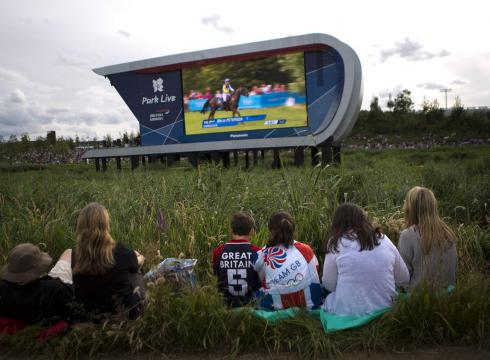 Photo from SWF Kits. "When watching London Olympics 2012 in real-time, audiences can fully experience the thrills brought by London Olympics 2012. Moreover, by watching a certain 2012 Olympic event live online, audiences can feel the same feelings as the athletes."
The 2012 London Olympics are over and our lives are back to normal. In many ways, it's almost like they never happened. Unless you were one of the athletes who actually competed and won a medal and some money your life probably hasn't changed one bit. Sure you have memories, stories and opinions but did watching this Olympics change anything? I would argue that the Olympics can be used an example of Jean Baudrillard's theory of the non-event.
Baudrillard's non-event can be explained as "something that actually occurs, but neither lives up to its projected definition (or purported social significance) nor is proportional to its assigned status in the media" (Atkinson & Young, 2012). For Baudrillard, everything happens at a distance and because so many of us experience life through media we only ever experience simulations of real events. His controversial article, The Gulf War Did Not Take Place, argues exactly this - that the Gulf War was different from every war before it because it was the first time that the images that Americans saw were controlled and constructed into a mediated package ready for consumption.
It was not the first time that images of war had appeared on TV screens, but it was the first time that they were relayed "live" from the battlefront. It was not the first occasion on which the military censored what could be reported, but it did involve a new level of military control of reportage and images. Military planners had clearly learnt a great deal since Vietnam: procedures for controlling the media were developed and tested in the Falklands, Grenada and Panama. As a result, what we saw was for the most part a "clean" war, with lots of pictures of weaponry, including the amazing footage from the nose-cameras of "smart bombs," and relatively few images of casualties, none from the Allied forces...The Gulf War movie was instant history in the sense that the selected images which were broadcast worldwide provoked immediate responses and then became frozen into the accepted story of the war: high-tech weapons, ecological disaster, the liberation of Kuwait.
From war to sport, how does one make such a leap? Through the media. How many of our sporting events, and for the Olympics Games in particular, do we receive controlled packages for our viewing pleasure? We have music, long introductions with spliced images and video montages, voiceovers, close-up shots of muscles moving and tears flowing. These are the things that you don't receive, or at least to the same degree, when you are actually at an event. With the jumbo screens at sporting arenas sport has found a way to make sure that we all receive some common views but otherwise, when you are at a event no one has the same view, everyone has a different commentary running through their head, and no one passes the commercial breaks in exactly the same manner. But through the television sport becomes more real than real life. The camera angles provided, slow-motion replays, and expert opinions are not even experience by those competing in the moment. Through television, we receive better views of what just happened than those who live it.
William Merrin writes in his book, Baudrillard and the Media: A critical introduction, about how television is able to manipulate our experiences with the example of the 1951 parade held in Chicago for General MacArthur:
television's selection of views, editing, orchestration and commentary created the impression of continuously cheering crowds throughout the parade, producing a superior event for the viewer than for the bored crowds...
Hence television offers both 'the truer than true', the experience of being there without being there, and a reality that lacks all the defining dangers, personal investment, relationships and experience of actual presence...All attemps to technologically perfect this simulacrum only increase 'our real absence from the world' Baudrillard argues.
Atkinson and Young (2012) elaborate on the non-event explaining that "there are no longer shared, organic, collective experiences around events that are mass mediated, even when people throughout the world claim meaningful connection or understanding of them." They continue to say that "participants" in such non-events have no personal reference to the event except those that have been framed for them by the media. Perhaps, the most significant aspect of the non-event is the fact that there "are no enduring collective results stemming from the event...no enduring cultural meanings or consequences for most consumers, and thus any social connection, communitas or empathy facilitated through them is ultimately tentative and artificial" (Atkinson & Young, 2012).
This is not to say that there are no material effects from the Olympics Games. Medals were won, injuries occurred, money was spent, and venues still stand; but, for something that projects itself as a global event there is not one remnant left to connect everyone who participated and watched. We jump from watching rowing to marathon to shotput without leaving our seats. We watch the athletes that the cameras allow us to watch. We relive only those parts of the Games that NBC Sports wants us to relive. It gets to the point where we find it difficult to separate what we experience from what we see. The best comparison I can give is when you try to remember something from your childhood - do you actually remember being there through your own eyes or do you just remember the photo that exists of that experience?
With the rise in 3-D movies and televisions I think it is time for us to question that which we are being spoon fed. How much of our lives are simulated and reproduced? Considering millions of people "experienced" the Olympics from the comfort of their own homes, and yet "experienced" it all in a fundamentally similar way, I would say too much of our lives are simulated and reproduced. How much of our lives is actually our own if millions of other people in this world share the exact same memory? Do video replays count as memories?
Works cited:
Atkinson, M. & Young, K. (2012). Shadowed by the corpse of war: Sport spectacles and the spirit of terrorism. International Review for the Sociology of Sport.
Support women's sports and SHARE this story with your friends!
Today on the Women's Sports Calendar:
| U.S. Open Aug 27 - Sep 9: Louis Armstrong Stadium | Women's NTIS Event Sep 6 - 09: USA Baseball National Training Complex |
| WNBA Game September 8: BOK Center |
MOST POPULAR ARTICLES & POSTS
August 18, 2012 at 7:39am
September 5, 2012 at 8:50am
November 5, 2009 at 9:12pm
April 6, 2012 at 12:58pm
September 1, 2012 at 5:21pm
LATEST ARTICLES & POSTS
Sat at 2:31pm
Sat at 9:33am
Sat at 12:40am

Blogger Courtney Szto is a Master's Student studying the socio-cultural aspects of sport, physical activity and health (or as some call it Physical Cu...
full profile
For more, visit Resident_Badass's Full Profile

RECENT COMMENTS
To be clear, I've got no issue with Wambach. She's the best player in the world and has never felt ...more
posted 09/08/12 at 12:34pm
on Lori Lindsey: Out and Proud

If issuing press releases acknowledging her lesbianism helps make Ms. Lindsey feel better about hers...more
posted 09/08/12 at 11:58am
on Lori Lindsey: Out and Proud
I am glad that Lori Lindsey came out. The rest of the gay players on the team should come out as wel...more
posted 09/07/12 at 1:32pm
on Lori Lindsey: Out and Proud

As hard as it may be for a Pittsburgher to root against the Steelers (my dad's from there, so I get ...more
posted 09/07/12 at 10:57am
on AFC North Preview: She Said Edition
Come on all celebrate this event and keep on fighting......more
posted 09/06/12 at 4:53am
on USWNT: Tribute Tour Kicks Off, Coach Pia to Step Down
No one has commented on this yet. Be the first!