
Both of my daughters play Ringette (a fast-paced game played on ice), and are in the process of tryo...more
posted 09/14/12 at 10:24am
on Degree(r) First Team Tryout Giveaway





posted by The Rabbit Hole
Thursday, September 13, 2012 at 9:26am EDT
Blogger Courtney Szto is a Master's Student studying the socio-cultural aspects of sport, physical activity and health (or as some call it Physical Cultural Studies). Bachelor's in Sport Management. Former tennis coach & ropes course facilitator.
Support women's sports and SHARE this story with your friends!
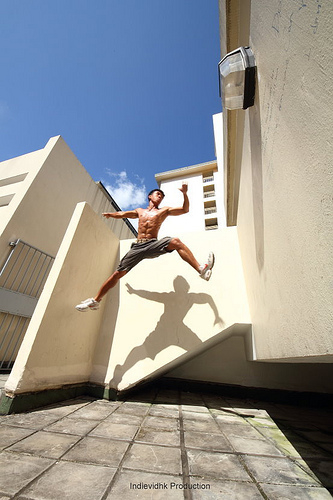 Photo by indie vid.Parkour, also known as freerunning, was created as a physical art form with the goal of moving as efficiently as possible between two points. It was developed in the French suburbs during the 1980's and parkour practitioners, known as traceurs, move through urban spaces as if they are playgrounds. Nothing is an obstacle and everything is an option. Guss (2011) explains "One of the core ideas of parkour is that being able to overcome physical obstacles translates into a mental suppleness and confidence to overcome other kinds of less literal obstacles in the traceurs' lives" (p.75). Parkour is an attempt to reclaim urban space. It came about as "an art whose main themes are escape and spatial appropriation" which were a response to feelings of claustrophobia "created by recent French urban policy" (p.75). It takes place predominantly in urban areas in order to appropriate spaces that were never intended for sport or physical activity (Ameel & Tani, 2012). Much like skateboarding which, at one time, was seen as an alternative sport that turned urban spaces into a never ending playground, parkour is a subversive activity that challenges our understanding of space.
Parkour says to our built environment, and everyone who built it: that bench is not a bench; this road is no longer just for cars; the structure you built to funnel movement in one direction is now my launch pad. How many signs have you seen in the past day that dictate your movement, whether they be driving signs or pedestrian instructions? Walkways determine where we are allowed to walk. Roadways have pre-determined how we will drive to work and the gym. Buildings are lined up like Monopoly hotels in order to create efficiency and intimidation. The endearing part of parkour is that it enables adults to move and think like children (Atkinson, 2009). Kids run, jump and hang from things that they are not supposed to all the time. At a certain age it becomes inappropriate to explore the physical space around us. Either that or we become physically incapable of doing so. Basically, parkour is a big "F#$@ you" to the establishment who put that building in your way and to all those who believe that parks and beaches are the only spaces that enable creative physical activity and movement.
But just like skateboarding before it, parkour has also become less subversive and more mainstream. We have skateboarding parks designed to contain the sport and engineers now ensure that skateboarders are unable to use benches, rails and concrete structures for skateboarding by strategically placing bars or protrusions in the way of long straight lines. What promoted this post was the opening of Vancouver's first and only parkour gym, Origins. The website says that it has been designed by traceurs and offers classes to anyone who wants to get involved. It costs $27 for a drop-in class and up to $320 per month for unlimited use. Wait a minute? Wasn't this sport designed so that you could do it anywhere and for free? How does that saying about capitalism go? Something like "it will take what you have for free and sell it back to you" (e.g. walking is free but a treadmill will cost you around $1000).
Atkinson (2009) describes parkour's appropriation by television commercials, clothes, schools and competitions as sportization.
Sportization is the process by which subaltern or alternative forms of sport, leisure, and play are co-opted and incorporated into mainstream sport cultures. They become formalized, institutionalized, hierarchical, and rule-bound types of sport that are organized and operated on the basis of intense competition, social exclusion and domination of others. (p.173)
We see this with Origins Parkour and Athletic Facility with its built environment. In my opinion, a parkour gym makes about as much sense as paint-by-numbers. The essence of creativity has been stripped away and now everyone ends up with the same result. Everyone who attends the "Movement Basics" class will learn, more or less, the same technique. Granted, as in every sport not everyone who learns the same technique will end up with the same result because there is always individualization with movement. However, there is also a difference between guiding someone through a movement and just saying "there is a fence - get over it". A parkour facility in itself is now part of the built environment that is was created to challenge. Furthermore, $27 for a drop-in class is expensive! Considering it is something I could do outside by myself as a political statement it now becomes only accessible to certain people. It happened to yoga, snowboarding and every sport you see in the X-Games. It joined the mainstream and thus controlled. Atkinson (2009) interprets the essence of parkour as a scapeland. In other words:
physical spaces that produce an emancipating experiential awareness of impermanence, emptiness, unconscious remainder, and presence...A scapeland is characterized by the absence of direction and destination provided by cultural scripts or modes of thinking and understanding...A scapeland is raw, open, primitive, and decolonized space. (p.192)
Hence, in this interpretation a parkour gym is anything but a scapeland. It has regulated ways of thinking and moving. It determines what times you should participate. It determines with whom you can participate. It sells you your own movement. The formalization of parkour invites the claustrophobia that spawned its birth.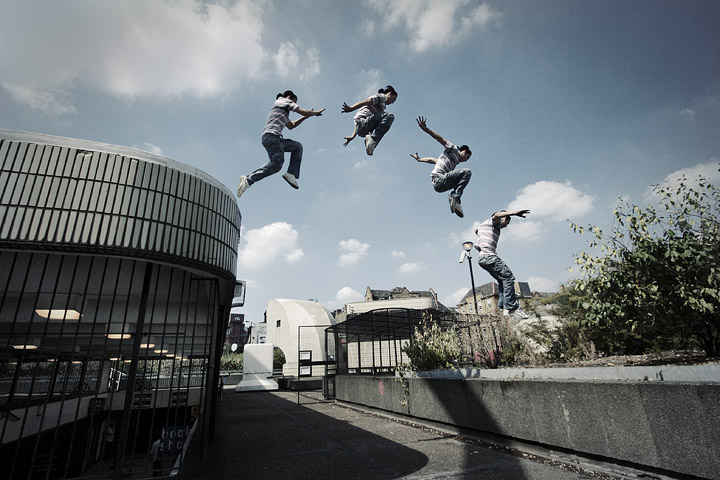 Photo from My Modern Met.
Works Cited:
Atkinson, M. (2009). Parkour, anarcho-environmentalism, and poiesis. Journal of Sport and Social Issues, 33(2), pp.169.194.
Ameel, L. & Tani, S. (2012). Parkour: Creating loose spaces? Human Geography, 94(1), pp17-30.
Guss, N. (2011). Parkour and the multitude: Politics of a dangerous art. French Cultural Studies, 22(1), pp.73-85.
Support women's sports and SHARE this story with your friends!
MOST POPULAR ARTICLES & POSTS
September 12, 2012 at 8:37pm
April 6, 2012 at 12:58pm
September 14, 2012 at 9:44am
August 18, 2012 at 7:39am
September 13, 2012 at 9:14am
LATEST ARTICLES & POSTS
Fri at 7:32pm
Fri at 2:04pm
Fri at 10:04am

Blogger Courtney Szto is a Master's Student studying the socio-cultural aspects of sport, physical activity and health (or as some call it Physical Cu...
full profile
For more, visit Resident_Badass's Full Profile

RECENT COMMENTS
Both of my daughters play Ringette (a fast-paced game played on ice), and are in the process of tryo...more
posted 09/14/12 at 10:24am
on Degree(r) First Team Tryout Giveaway

The unfortunate trend of Title IX zealots at the state level filing mass complaints with the OCR con...more
posted 09/10/12 at 1:54pm
on OCR Called to Investigate Title IX Violations by the South Carolina Department of Education and 20 School Districts
I can't speak for Rapinoe and Lindsey but my perception is their goal is not to use women's soccer t...more
posted 09/09/12 at 8:58pm
on Lori Lindsey: Out and Proud
I think Wambach should come out as well. She has nothing to hide. ...more
posted 09/09/12 at 8:50pm
on Lori Lindsey: Out and Proud
To be clear, I've got no issue with Wambach. She's the best player in the world and has never felt ...more
posted 09/08/12 at 12:34pm
on Lori Lindsey: Out and Proud
No one has commented on this yet. Be the first!