
I'm not a big Stanford fan, but at least they have a legitimate program and did it largely without t...more
posted 04/10/13 at 5:50pm
on Why Cal is my new favorite team





posted by The Rabbit Hole
Wednesday, November 21, 2012 at 7:28am EST
Blogger Courtney Szto is a Master's Student studying the socio-cultural aspects of sport, physical activity and health (or as some call it Physical Cultural Studies). Bachelor's in Sport Management. Former tennis coach & ropes course facilitator.
Support women's sports and SHARE this story with your friends!
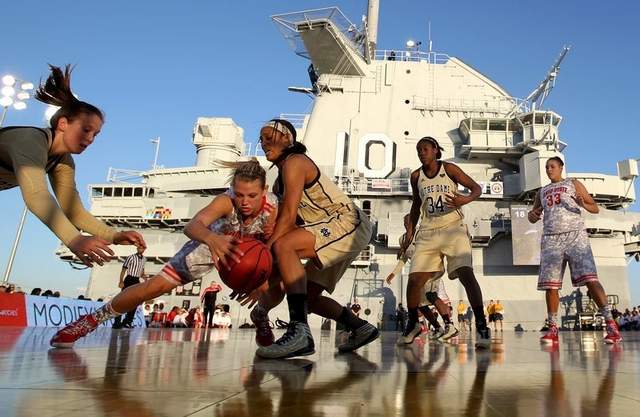 Notre Dame vs. Ohio State. Photo from Indy Star.Sport and war have always had strong parallelisms. Our athletes become warriors and soldiers in the trenches of sport. As Canadian hockey commentator Don Cherry has said about his favourite enforcers, "This is how a fighter gets ready. This is a man. This is a guy. This is the guy you want at the end of the trench." Particularly since 9/11 the link between military and sport has become increasingly pervasive both in America and Canada. After 9/11 the opening and trophy ceremonies of the US Tennis Open have incorporated court sized American flags and military personnel. The re-emergence of the Winnipeg Jets to the National Hockey League was presented from the belly of a Royal Canadian Air Force transport plane. Fighter jets doing a fly-by before the start of NASCAR races and male athletes in camouflage jerseys have become common ways of supporting a wider agenda of everyday militarization. A recent article in the Sociology of Sport Journal has highlighted Under Armour's (the sporting apparel company) connection with military and the notion of "protecting our house". As Weedon writes, "What Under Armour has arguably constructed...is a site for the advocation and affirmation of a particular form of citizenship, marked by neoliberal, masculine and militarized traits, and exemplified by wounded soldiers" (p.277). However, what I had yet to see in this discourse of militarization was the inclusion of female athletes in these narratives; that is until this week's Carrier Classic basketball game which included a women's game between Notre Dame and Ohio State University.
The Carrier Classic is about as blatant as the militarization of sport gets. It started in 2011 as a celebration of Veterans Day and places the spectacle of an NCAA basketball game on the deck of an aircraft carrier. This year's proceeds went to the Wounded Warrior Project and this year they added a women's game. If flaunting one's physical abilities on an aircraft carrier is not a statement of military might and national unity I'm not sure what is. Historically, sport has been used a method of disciplining men and training them so that when duty called said nation would have relatively fit bodies for defence; however, as traditional warfare decreased sport was allowed to become more of a recreational endeavour. Yet, what we face now is the militarization of our everyday lives. Due to the fact that the "enemy" has no singular face we are now asked as citizens to be ready to protect this house as evidenced by this entry from a retired army Captain as a part of the Under Armour Freedom initiative:
I have competed in Triathlons and even ran the New York City Marathon with my dear friend and fellow amputee last year. Failure is not an option, and we are only limited by our minds. I will never fail my wounded warrior brothers and I will never forget those who made the ultimate sacrifice so that we may live free in this great country. My house is perseverance. I will never quit until the mission is complete despite obstacles, discouragement, or difficulties! PROTECT THIS HOUSE. I WILL. (Chad Fleming, retired U.S. army Captain, Under Armour website entry) (Weedon, 2012, p.275).
When I saw the photo of female basketball players in the Carrier Classic the first thing that came to mind was, "Wait a minute! Women are not allowed to fight in combat but they can play basketball on the carrier?" Yes, the US military might be "close" to allowing a trial period of allowing women in combat but that decision is obviously fraught with gender tension. I also understand that military women have, for all intents and purposes, already been in combat. If you can get shot down from your airplane that sounds like combat to me; however, as the military itself acknowledges currently it has "moves that put women in combat, but never officially recognize them for being there." Furthermore, these changes would not alter the ability for women to advance into the upper echelons of the institution because these openings would be for support positions. Thus, what we have before us is a society that is considerably polarized on the issue of "allowing" women into combat and the rather insidious use of women athletes to galvanize support for the military.
We could see the women's game as a move towards gender equity - if the boys can play the girls should be allowed to play too; it could be as simple as that, end of story. But we must keep in mind that "there are arguments that the public is going to be so much more distressed by women being killed or taken prisoners of war that they will not support the war effort if they see it happening". Furthermore, traditional notions of femininity and motherhood are still so prevalent in North American society that this NCAA game all too easily laughs in the face of conservative gender roles, while it is concurrently being used to serve a neoconservative military agenda. Thus, I wonder if showing women in a "military setting", if we can call it that, is a ploy to try and desensitize us to the dominant idea that women can't. Perhaps, if we showcase how strong and athletic our women are maybe some will be more willing to support women in combat. If this is an attempt to promote gender equality we must ask whether the context of that equality is appropriate for anyone regardless of gender. Anne Coughlin, a professor at the University of Virginia School of Law, whose research has led to the law suit against the military demanding that women be allowed to fight in combat, argues that women being held from combat "means you're not being allowed to do the very things that are the most prized in our culture - to die in the service of your nation is one of the highest virtues that we know. Excluding women from that possibility means that we're not full citizens." If this statement is true we should take a step back and evaluate "what is most prized in our culture". Personally, I find Coughlin's statement frighteningly accurate, which is why I find the connection between sport and war so troubling.
If we want to take this as a win for women in sport that is one issue, but it is also important to question what types of social implications result from the increasing militarization of society. A number of scholars have identified how sport has been used post-9/11 to further legitimize the War on Terror outside of the United States to Australia (Silk, 2005) and Canada (Scherer & Koch, 2010). The Under Armour Freedom initiative, much like the Carrier Classic, also supports the Wounded Warrior Project. The entanglement of sport and militarization must be questioned when the following entry becomes used as a method of fostering nationalism on Under Armour's CentCom site (transcribed verbatim):
Like many of my brothers in arms i joined shortly after 9-11 2001. Me and my brother both decided to turn down college football to do so. My brother was right out of high school with few offers from schools. I was already on a team and the university of Cincinnati. we decided that we could offer more to the world and nation with our physical gifted bodies and abilities. I have since been on 2 deployments to Iraq and Afghanistan. my brother to Iraq. we are happy with our choices and thank the us army for everything it helped us with as we try to play it back with our time and service. i plan to try and get back on my college team but if my nation calls then I'll be ready regardless. (Weedon, 2012, p.277).
We can see in this entry that sport and war have become interchangeable for some. Unsurprisingly, physical prowess on the field and court are seen as valuable assets in the battlefields of Iraq and Afghanistan. But as Dr. Samantha King (2008) explains, sport and war have become entangled not only at an institutional level but also at a psychosymbolic level.
In this context, and in spite of relentless attempts to distinguish sporting prowess from military might, it becomes increasingly hard within U.S. national culture to discern where the war ends and the game begins, and more crucially, why we are playing in the first place. (p.538)
It is on the bodies of a nation's men and women that national power speaks most loudly. Who is valued and who is forgotten. If the militarization of sport seemingly reproduces the dominance of a patriarchal society then what does it mean when women are included in this dynamic? And if sport, as a realm of popular culture, reflects the values of a nation then what does it say about us that sport and war have become one in the same?
Works Cited:
King, S. (2008). Offensive lines: Sport-state synergy in an era of perpetual war. Cultural Studies, Critical Methodologies, 8(4), 527-539.
Scherer, J. & Koch, J. (2010). Living with war: Sport, citizenship, and the cultural politics of post-9/11 Canadian identity. Sociology of Sport Journal, 27, 1-29.
Silk, M. & Falcous, M. (2005). One day in a September/a week in February:Mobilizing American (sporting) nationalisms. Sociology of Sport Journal, 22(4), 447-471.
Weedon, G. (2012). "I will. Protect this house:" Under Armour, corporate nationalism and post-9/11 cultural politics. Sociology of Sport Journal, 29(3), 265-282.
Support women's sports and SHARE this story with your friends!
Today on the Women's Sports Calendar:
| The Ultimate Fighter 17 Finale April 13: The Joint at Hard Rock Hotel & Casino in Las Vegas | FC Kansas City vs. Portland Thorns FC April 13: Shawnee Mission North High School Stadium |
MOST POPULAR ARTICLES & POSTS
April 6, 2013 at 4:00pm
November 28, 2009 at 5:06pm
March 30, 2013 at 11:32am
April 10, 2013 at 3:12am
March 30, 2013 at 11:15am
April 9, 2013 at 8:54am
March 20, 2013 at 10:46am
April 12, 2013 at 9:44pm
March 9, 2013 at 11:35am
April 11, 2013 at 8:59am
LATEST ARTICLES & POSTS
Fri at 9:44pm
Fri at 9:37pm
Fri at 9:12pm
Fri at 9:09pm
Fri at 9:01pm
Fri at 8:56pm


Blogger Courtney Szto is a Master's Student studying the socio-cultural aspects of sport, physical activity and health (or as some call it Physical Cu...
full profile
For more, visit Resident_Badass's Full Profile

RECENT COMMENTS
I'm not a big Stanford fan, but at least they have a legitimate program and did it largely without t...more
posted 04/10/13 at 5:50pm
on Why Cal is my new favorite team

Ooh, is that bitterness I smell wafting up from Palo Alto? It almost seems like you are bashing Cal...more
posted 04/10/13 at 4:20pm
on Why Cal is my new favorite team

Cali - I understood what you were saying the same way I understood Gottlieb when she slipped her Soc...more
posted 04/10/13 at 4:06pm
on Why Cal is my new favorite team

Crimson, I was actually responding to the points made by the author this this article, and talking a...more
posted 04/10/13 at 1:20pm
on Why Cal is my new favorite team

We'll see. Stanford is certainly over the novelty of Cal at this point. That's a given. The Cardi...more
posted 04/10/13 at 8:42am
on Why Cal is my new favorite team

Women Talk Sports Podcast - March 5, 2013
In the March edition of the "Women Talk Sports" podcast, Cara and Stephanie use their running background to explain the Dayton 500 and break down the ...[Listen/Download for iTunes]
Women Talk Running Podcast - March 5, 2013
In the March edition of the "Women Talk Running" podcast, Cara and Stephanie wrap up the Millrose Games, give you more Mary Cain news, give our respon...[Listen/Download for iTunes]
Women Talk Sports Podcast - January 28, 2013
In the January 2013 episode of the Women Talk Sports podcast, Cara and Stephanie share several points that will leave you feeling hopeful about the Na...[Listen/Download for iTunes]
No one has commented on this yet. Be the first!