
Seattle Storm are just a dominant team in the WNBA and there taking on the powerhouse of Minnesota. ...more
posted 08/21/12 at 9:47pm
on Game Day: Minnesota at Seattle




posted by Stephanie Perleberg: Believe and Run On!
Thursday, August 11, 2011 at 12:43am EDT
I'm a student-athlete at the University of Wisconsin-La Crosse. I'm graduating in May with a BS in Organizational and Public Communication and a minor Recreation Management. I love running most days. Steepling is my forte, or at least I'd like to think so;). My goal is to strive for women's equality in athletics and in life.
Support women's sports and SHARE this story with your friends!
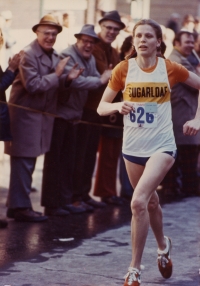
I had the opportunity to be in contact with the filmmaker, Charlotte Lettis Richardson, who created “Run Like a Girl.” If you haven’t gotten to read about Charlotte’s film take a look at the post I wrote about it or, even better, order the film here and take a look at it first hand. I believe it imperative for female athletes to learn about the history of women in sports, politics, etc, to truly understand what an amazing honor is it to be able to play sports at any level.
I got to ask Charlotte several questions about her experience a national caliber female distance runner at a time when that was a rarity. Charlotte answered all of my questions beautifully. After reading her responses I felt inspired to continue striving for my goals. I hope you have a similar experience! It isn’t every day we can speak with someone who has changed history so drastically.
__________________________________________________
What was the inspiration behind the film?
I was in film school in Portland and wanted to find an important story for my final project. I wrote of my experiences in the early 70’s when I started running, and my professors loved the stories! The stories were very colorful and they seemed to be universal stories that spoke to many women in many different careers. Other inspiration came from my coaching of young women who did not know the history of women’s running and were very interested. I was so proud of the fact that they now had options and choices to be whatever athlete they dreamed of being. I have always imagined it was a similar feeling to the early suffragettes who struggled and pushed for the vote. Ken Burns film titled “Not For Ourselves Alone: The story of Elizabeth Cady Stanton” also inspired me. These women chased and achieved the vote for the women of the future. Many of them never got to vote themselves. I wanted to make the same argument for the early pioneers of the women’s distance running. We wanted to be able to run longer distances in the Olympics, in the National Championships and fought for the women runners of the future to achieve this. Doris and many women runners like her were the Elizabeth Cady Stanton’s of running.
You seemed to have learned so much from your running experience that you share with us in the film. What did you learn through the process of creating this film?
First I learned that even though the women runners of today have many wonderful opportunities we are all the same runners inside. What motivated us 30, 40, 50 years ago still motivated runners today. The love of running, the freedom and strength it gives us, the desire to accomplish challenges and goals, are the same today. We were then and they are today, a sisterhood of distance runners. The uniforms, the shoes, the races, the opportunities may be different but the basic instinct to run fast remains. It is just the continuation of what was and what will be.
I learned that passion can take you anywhere. That if you believe in something and set goals and work very hard, you will achieve them. I worked 40 hours a week for close to 5 years making this film. I had only my passion, my film and running friends, my family, and finally at the end a little money from Nike to have original music composed for the film. All was done with friendship, passion, and love for women’s running.
I also realized how much running had done for me. Without it I would not be the person I am today. The making of the film showed me that the lessons I learned as I stepped up to that starting line again and again gave me courage in all parts of my life. Sometimes I failed and sometimes I succeeded, but every time I learned about who I was and what I was capable of achieving. The making of the film came at a time in my life that I had forgotten a bit about that strength and courage running gave me. It was a gift. It was a feeling of being reunited with my past self, a self I was proud of and wanted to know again.
When you won the race in Massachusetts, where the prize was a tiny toy chair, what was going through your head? I could imagine someone in your position would be either annoyed that they were given a gift so obviously lesser than what the male winner got, or plain excited that they won. How did you feel?
I think at the time a little embarrassed. Of course you have to realize we often felt just lucky to be able to race and be included. But at the time I think I was embarrassed and later a little angry. But I also remember we laughed a lot about it. It was so surreal! I often think that Doris’s generation was the generation that was just happy to be able to run, my generation took the next step and did not just want to run but wanted to be recognized, and finally today’s generation is the one that rightfully expects it all. To be able to compete, to have many opportunities and to be recognized. It is so wonderful to know this is how far we have come.
I’m sure in the process of making this film there were stories that you had to cut out. Can you tell us a story that didn’t make it in the film but can give us an even better sense of what being in your shoes was like?
There are so many stories. At one race, a 30-kilometer race in Massachusetts, I was running up a steep hill towards the finish line and a very drunk man came out of a bar and began to chase me. No one did anything and I remember there was a lot of laughter. They considered us “freaks” and not worthy of respect. Again, it was never the other male runners. They respected us because they knew how hard it was to train and race distance. There were also many articles written about us, and whether or not we were really females. At a international race in Mexico, a 10K, we were taken in the day before to a hospital and asked to undress so they could check to see if we were male or female. Very humiliating stuff. We were challenging the male bastion of sports.
What was the most challenging and most rewarding part about being a female athlete at the very beginning of women’s competitive distance running?
We did it for very pure reasons. There really was no recognition or rewards early on. I always wondered if it had not been for the fact that I was trying to change things if I would have been as drawn towards distance running. Once I started of course I loved it, but early on it was my way of fighting for the rights of women. It was a concrete and real way of testing the barriers and making change that we could see. And I also made so many incredible friends who were also fighting for change. Rather than seeing each other as competitors we looked forward to each race so we could run together, as sisters. The competitive part in some ways was secondary, although great!
When you with your fellow female competitors, did you discuss the fact that you were the only women in the race and, not necessarily acknowledging that you all were paving a way for future female runners (which you all did!), but recognize this very different life experience in such a “man’s world”?
Not really discussed it but again we felt like we were a team, a sisterhood of women making change happen and supporting each other. When we finally got to race in women’s only races, it was incredible!!! I remember the Mini Marathon in New York’s Central Park. We couldn’t believe our great luck of having other women to compete with. It took us almost the whole race to stop celebrating and finally make a sprint to the finish. It was so exhilarating to run with other women!! A pack of women in the front of a race together, competing!
How did you decide to end your competitive running career?
I needed to earn a living and Nike offered me a job in women’s track and field promotions. Probably the only regret I have is I stopped competing at that level too soon. Of course I continued to run and compete at a different level but it was not the same. Today I would have been able to continue running as a job, and would have stayed competitive much longer because I could have supported myself.
How did you get into coaching?
I have coached since I first started running in the early 70’s. We started a team because there was no one to train with! I took on the role of coach with my own coach at the time, and we just spread the good word! I also coached high school and college in Amherst, Massachusetts while I was still in college and running. I love coaching. It is probably the only time I am completely in the moment. Time just flies when I am coaching. I feel so wonderful! I love the contact with other women and so much enjoy watching women as they train and race and really become more confident and positive. It is what changed my life and I want to give that to others, both men and women.
I loved the part of the film where you spoke about the change in female athletes from the time you were competing to now. You pointed out that women today want to move to that next level and know that they can get funding for running in college, etc. What do you think is/are the major contributing factor(s) to the change in thinking between athletes then and athletes now?
It is more of a job but I still believe that in the core it is about passion for the sport. If I could have continued my running as a career I would have loved it. As it was I did in a sense with my job at Nike in women’s track and field promotions and my almost 40 years of coaching! I am so proud of women today and where they have taken running. It makes all that we went through worthwhile. The major contributing factor to the change is that women can now earn a living at what they love…what motivation to run well!! You can do what you love as a career!
There is still a gap between pay/sponsorship and recognition from fans between male and female distance runners (luckily it seems much better than many other sports!). As a filmmaker, athlete, and coach who has been in this involved in the running culture for some time and has seen the sport develop, what do you think are the next step to creating more balance and equality within the sport?
Running is better than other sports but sports in general are still the strong hold of men. When and if we will ever be allowed inside completely will take the work of the women today to continue to fight for opportunities. It takes courage and commitment to make change. I am now a head track and field coach for both the men and women at Lincoln High School in downtown Portland, Oregon. There are still too few women in head coaching positions and so those of us who are head coaches need to encourage more women into coaching. I believe this will change the attitude of many men. 10 years ago being a women coach to men was hard. They questioned everything. Today young men accept it as the norm and I rarely get challenged. I am probably questioned more by parents than the boys on the team. I think this is where change will come from.
What advice would you give to female athletes in high school and college who want to make it to the next level?
Decide what you want. Set goals, make a plan on how to reach those goals, and work your plan. Find a coach/mentor that can help you with a program to help you attain your goals. Be committed but not fanatic. Enjoy all aspects of your life and let running be your passion. Be smart with your training and find like-minded friends and family to surround you. But most important remember that distance running takes time to get good at. Give yourself that time and be patient.
This was fun! Thank you!
_________________________________________________
A special thanks to Charlotte for sending me her well-deserved award winning film and for answering all my questions!
Support women's sports and SHARE this story with your friends!
View Original Post at stephanieperleberg.com
View stephaniemp's Full Profile

Today on the Women's Sports Calendar:
| WNBA Game August 22: Philips Arena |
MOST POPULAR ARTICLES & POSTS
January 2, 2011 at 11:42pm
November 29, 2011 at 11:43am
August 19, 2012 at 8:53pm
October 7, 2009 at 3:14pm
LATEST ARTICLES & POSTS
Wed at 9:30am
Wed at 9:29am
Wed at 9:11am
Wed at 9:06am

Stephanie Perleberg: Believe and Run On!
I'm a student-athlete at the University of Wisconsin-La Crosse. I'm graduating in May with a BS in Organizational and Public Communication and a minor...
full profile
For more, visit stephaniemp's Full Profile

RECENT COMMENTS
Seattle Storm are just a dominant team in the WNBA and there taking on the powerhouse of Minnesota. ...more
posted 08/21/12 at 9:47pm
on Game Day: Minnesota at Seattle

CoachDaugherty - I think its safe to say that everyone will be happy for you if you build a team and...more
posted 08/21/12 at 10:54am
on USWNT: Hopefully Victory Tour Cements Pro League
Thanks Coach Daughtery-appreciate your insight and looking forward to what develops in the future!...more
posted 08/21/12 at 12:48am
on USWNT: Hopefully Victory Tour Cements Pro League

Greetings,
I'd love to chime in about this 'new league' that is starting in 2013. I'm current...more
posted 08/20/12 at 7:31pm
on USWNT: Hopefully Victory Tour Cements Pro League

If you truly believe there is enough interest in a women's pro soccer league how about if you find a...more
posted 08/20/12 at 2:04pm
on USWNT: Hopefully Victory Tour Cements Pro League
No one has commented on this yet. Be the first!