

I'm not a big Stanford fan, but at least they have a legitimate program and did it largely without t...more
posted 04/10/13 at 5:50pm
on Why Cal is my new favorite team





posted by carabyrd, a Women Talk Sports blogger
Monday, July 23, 2012 at 12:22pm EDT
About carabyrd:
Cara Hawkins is a social media community manager and graduated with her masters in advertising from University of Texas. Cara is a former DII runner competing in everything from the 4x400m to Cross C...more
Support women's sports and SHARE this story with your friends!
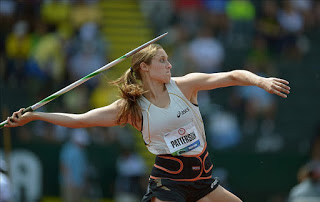 Kara Patterson made her second Olympic javelin team this year with a throw 59.79m and finishing second. She was in the lead until she hyper -extended her left knee and had to pass her next throws. Patterson is looking to improve on her 2008 Olympic performance. She failed to qualify for the final round in the 2008 games. In 2010, Patterson established a new American 2010. We caught up with her through e-mail before she leaves for the Olympic village on July 26th from her home in Chula Vista, CA.
Cara Hawkins: Walk us through the Olympic Trials. When did you know you had injured yourself?
Kara Patterson: I was really happy with my qualifying round performance at the Olympic Trials. I don’t think I had ever just taken one throw and executed my plan so well before. I’ve felt in great physical shape this whole season, but was finally happy with the way my technique was coming around at the Trials.
I was the first thrower in the order for finals, which is the same position I was in at USAs last year, so I was excited to start the competition off strong. There were a few nerves, so I didn’t hit the positions I had in qualifying, and even though I had better energy, I threw a meter or so less to start out. My third round throw was my furthest of the day, and I led the competition going into finals. In the fourth round, I tried to attack my block leg more than I had on my first three throws, but my upper body was too far forward, so I hyper-extended my left knee. I knew immediately that it hurt, but I didn’t think it’d be competition-ending. I fell on the runway and thought I’d be able to bounce right back up, but my leg didn’t want to take much pressure.
CH: How do you deal with the emotions of knowing you had qualified for the Olympics but also that you had injured yourself?
KP: The only thing that truly matters at the Olympic Trials is whether or not you make the Olympic Team, so for that reason, I’m happy. I wanted the other girls who had performed so well in the competition to enjoy their moment, so I did my best not to bring focus to my knee. I got to go home to my parents’ house in Washington that night and get some slobbery kisses from their adorable new chocolate lab puppies, and I tried to wait to feel sorry for myself until I got there!
CH: This being your second Olympics what have you done differently to prepare this season?
KP: It’s not so much what I’ve done this year to prepare, but the experiences I’ve had in the past three seasons that make me feel like I know a lot more about what I’m doing going into London. I have been really excited about my upper body technique in the past few months though, and I’m focused on carrying that feeling as far as I can take it. The 2010 season’s success mixed with 2011’s lessons in toughness mean I’m ready for big things. I’m comfortable seeing the best women in the world in competition, and I’ve proven to myself that I have what it takes to compete with them. I’ve been fairly happy with my consistency this season, and the way I felt in the qualifying round at Olympic Trials told me I was ready for big throws.
CH: What tips can you give to first time Olympians?
KP: I think remembering who you are at the Olympics is important. It’s easy to get caught up in all of the Olympic Village activities, meeting new people, having access to extra therapy, and even being in a foreign country, and those can become distractions. Sticking to your routines keeps you grounded and prepares you best for competition!
CH: Where is your training group located and what does your typical training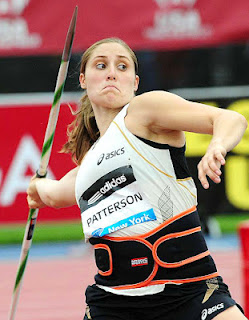 week look like?
KP: I train at the Olympic Training Center in Chula Vista, California, with Ty Sevin as my coach. Mike Hazle is my training partner, and we’ve trained with and around other throwers and pole vaulters for three years. I’m so happy to have trained here since 2009! It has been an awesome situation to transition from college to professional track and field.
In the fall, training takes up about 6 hours a day, and that decreases to about 2 hours a day during the season! Right now, I am throwing twice a week, lifting twice a week, throwing medicine balls and weighted javelin balls twice a week, and doing rehabilitation and stabilizing stuff six days a week. There are other general fitness things in there, too.
CH: You started throwing the javelin fairly early (considering some states don’t even allow it in high school). How did you get into the sport? What would you advise girls who are looking to get into the sport to do?
KP: My geometry teacher my freshman year of high school, Ron Heidenreich, was also the girls’ track coach. He saw me in class, knew I swam and played basketball, and suggested I try the javelin. If not for him, I wouldn’t be where I am today! There are quite a few track clubs for kids throughout the nation now, so I would suggest that girls who are interested in javelin look into those clubs. Even if the high school system in your state doesn’t allow the javelin, there are competitions outside of the prep season you can go to to throw it! I love seeing success from a strategy like that; it shows such dedication and specific interest. Avione Allgood grew up in Las Vegas, and Nevada doesn’t allow the javelin in their high schools, but she broke the high school national record in 2011. I’m so impressed by that.
CH: The US is sending a full javelin team this year, how do you think javelin has evolved in the US since the last Olympics?
KP: It has been so awesome to witness the improvement of U.S. women’s javelin! Really, from high school to college to professional athletes, there has been a steady incline since 2008. To see the average distances among the top 3-5 competitors in a meet improve a little bit every year has been fun. I’m looking forward to being a part of continued improvement in the next Olympic cycle. Stiffer competition always yields better results!
CH: Javelin is not as popular as the 100 meters at the Olympics. Why should people follow and tune in for the javelin?
KP: First of all, there’s more to watch in the javelin! In a typical competition, we get three attempts in preliminaries and finalists get three more attempts. The 100 meters is over faster than it takes me to walk up the stairs to my apartment! If people could watch an entire competition and understand the dynamics of it (lead changes, emotional responses from people, etc.), it would be much more popular. There’s time for really cool stories to unfold in a javelin competition.
People should be interested in the javelin because it’s such an unexpectedly complex movement. It looks simple when you watch it, but knowing that you need to do the opposite of what your body naturally wants to do to throw far makes it just amazing to witness great competitions. In order to throw far, you need to relax, and that is exactly what your body doesn’t want to do when the pressure is on. The balancing act of it is so cool to me.
Another great thing about javelin is how different each competitor’s style is. There are basic technical things that a javelin thrower needs to do to throw far, but each individual looks very different doing those things! Everyone’s approach is a different length, we all carry the javelin differently, some people take short, quick steps and others’ are long and smooth. I love that there are such unique javelin mannerisms. I like to think it makes the event more relatable; everyone can bring their own flavor to it.
CH: What are goals for the London Olympics?
KP: I can’t be satisfied with anything less than top 8. That’s a challenge, especially right now, but I know I can do it! I have absolutely not reached my potential yet.
You can watch Kara Patterson starting with the qualifying round for the women's javelin on August 7th and the finals on August 9th. Keep up with Kara on Twitter @karathrowsjav and her blog that is also on Womentalksports.
Support women's sports and SHARE this story with your friends!
This article was written by a WomenTalkSports.com contributor. Sign up here to start publishing your own women's sports content.
Today on the Women's Sports Calendar:
| The Ultimate Fighter 17 Finale April 13: The Joint at Hard Rock Hotel & Casino in Las Vegas | FC Kansas City vs. Portland Thorns FC April 13: Shawnee Mission North High School Stadium |
MOST POPULAR ARTICLES & POSTS
April 6, 2013 at 4:00pm
November 28, 2009 at 5:06pm
March 30, 2013 at 11:32am
April 10, 2013 at 3:12am
March 30, 2013 at 11:15am
April 9, 2013 at 8:54am
March 20, 2013 at 10:46am
April 12, 2013 at 9:44pm
March 9, 2013 at 11:35am
April 11, 2013 at 8:59am
LATEST ARTICLES & POSTS
Fri at 9:44pm
Fri at 9:37pm
Fri at 9:12pm
Fri at 9:09pm
Fri at 9:01pm
Fri at 8:56pm


Cara Hawkins is a social media community manager and graduated with her masters in advertising from University of Texas. Cara is a former DII runner ...
full profile
For more, visit carabyrd's Full Profile

RECENT COMMENTS
I'm not a big Stanford fan, but at least they have a legitimate program and did it largely without t...more
posted 04/10/13 at 5:50pm
on Why Cal is my new favorite team

Ooh, is that bitterness I smell wafting up from Palo Alto? It almost seems like you are bashing Cal...more
posted 04/10/13 at 4:20pm
on Why Cal is my new favorite team

Cali - I understood what you were saying the same way I understood Gottlieb when she slipped her Soc...more
posted 04/10/13 at 4:06pm
on Why Cal is my new favorite team

Crimson, I was actually responding to the points made by the author this this article, and talking a...more
posted 04/10/13 at 1:20pm
on Why Cal is my new favorite team

We'll see. Stanford is certainly over the novelty of Cal at this point. That's a given. The Cardi...more
posted 04/10/13 at 8:42am
on Why Cal is my new favorite team

Women Talk Sports Podcast - March 5, 2013
In the March edition of the "Women Talk Sports" podcast, Cara and Stephanie use their running background to explain the Dayton 500 and break down the ...[Listen/Download for iTunes]
Women Talk Running Podcast - March 5, 2013
In the March edition of the "Women Talk Running" podcast, Cara and Stephanie wrap up the Millrose Games, give you more Mary Cain news, give our respon...[Listen/Download for iTunes]
Women Talk Sports Podcast - January 28, 2013
In the January 2013 episode of the Women Talk Sports podcast, Cara and Stephanie share several points that will leave you feeling hopeful about the Na...[Listen/Download for iTunes]
No one has commented on this yet. Be the first!