
Great article but really not true; there are many players involved in the NPF that are not from the ...more
posted 08/26/14 at 1:28pm
on Softball Standouts Plourde and Prezioso Represent Atlantic 10, Exemplify Mid-Major Potential at Next Level





posted by carabyrd, a Women Talk Sports blogger
today, February 1, 2013 at 8:57am EST
About carabyrd:
Cara Hawkins is a social media community manager and graduated with her masters in advertising from University of Texas. Cara is a former DII runner competing in everything from the 4x400m to Cross C...more
Support women's sports and SHARE this story with your friends!
Ladia Albertson-Junkans is back to elite running after getting her graduate degree. She had a 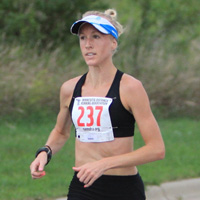 great prep career in Minnesota. She was the Minnesota State High School Cross Country champion as a sophomore and competed in a range of events at the State Track & Field Championships. She went on to compete for the University of Minnesota. Albertson-Junkans was a two-time cross country All-American and helped lead the squad to its first Big Ten championship in 2007. After a great college running career, she took two years off to garner her Master in Public Health and finished in 2011. She now works full time in child development research. Most recently, she finished seventh in the women’s team race at the BUPA Great Edinburgh International Cross Country.
“Going into the race I didn’t have many expectations. I’m still pretty new to elite post collegiate running, so I don’t usually have an idea where I fit in to these various field when I enter races. Which I think is to my advantage right now. I certainly I’m not psyching myself out by looking at the fields and determining where I should fall within a particular group of runners,” she goes on to explain, “ I was pleasantly surprised by the results.”
Albertson-Junkans also was encouraged with her fitness after recovering from a respiratory infection that lasted through November and it compromised her training. She had doubts entering club cross country and did not feel at peak fitness. She had enough base training to finish fifth overall and second on the Team USA Minnesota behind Meghan Peyton. The team won the competition with 70 points. Alberson-Junkans will be racing this Saturday at the USA Cross Country championships where the top 6 athletes earn spots on Team USA at the IAAF World Cross Country Championships in Bydgoszcz, Poland in March. Albertson-Junkans will be happy to extend her cross country season since she feels it suits her well.
“I run a lot on feel that is kind of how I train. I go out on any given day if I am feeling good I might run a little faster, push a little more and vice versa if I’m not feeling good, I’ll back off. I really think that cross country courses and distances lend themselves more to running on feel”she points out.
Albertson-Junkans also admits that she puts pressure on herself to maintain a very even pace during track races and gives herself a bit more flexibility in during cross country races to adjust to how her body is feeling. Mentally, a cross country or road race’s atmosphere does not stress her like a track race.
As Albertson-Junkans stated earlier, she is new to the elite post collegiate running scene this was due to the fact that she took the opportunity to get her masters.
“I think all throughout college I had a wide range of interest and I felt somewhat constrained by my athletic pursuit in terms of what those other interest were rather they were academic or professional. I always really had a passion for serving under privileged populations and learning how to bridge gaps in either educational outcomes or health settings” she states.
She had the opportunity to go to Ethiopia in 2008 and it opened up her eyes to a very different perspective. It especially let her truly see and understand the challenges that women her own age faced in the country. Itignited a passion in her to explore this field of study more after college. Without athletic obligations, Albertson-Junkans was able to give herself more time to explore her other interests. She continued to run throughout graduate school often juggling part time jobs and internships. She had no set running schedule and running became a bit of luxury. “I continued to realize how much a passion I did have for running and figured out a way to make it work while pursuing my other interest as well” she said.
It was not easy for Albertson-Junkans in graduate school to be a more casual runner. Her competitive spirit was still very much there. It was difficult for her to show up a race and not be able to hit the times that she once had. It was one of the reasons she went back to training competitively. After graduation she began to train harder, though there were bumps in the road. It was easy for her to run two-a-days when the week first began but by the time she hit Thursday it was much harder to get out the door.
“I just really had to play it by ear and let it run its own course. I tried to force myself to run but then I would be too exhausted and have to take three days off” she said.
She learned to adapt to her full time position and training eventually she got to the point where she could run in the morning and at night most days of the week. Albertson-Junkans would still have enough energy for work and to be social. Once she was settled into her full time job, it became easier to train.
“Once I adjusted to that full time schedule and incorporated running into that full time schedule which was about 8 months after I stared working full time, it came about pretty naturally. It just started to work. I was able to figure out how to conserve enough energy during the day to run at night and early in the morning. It just became a lot more stable and predictable” which she explains was much more conducive to high mileage training.
Soon, Albertson-Junkans had another adjustment to make to her schedule when she became a part of Team USA Minnesota.
“I had no intentions of joining a group, let alone a professionalgroup. Over the course of my summer training, I started entering higher more competitive races, got into the some US championships and was running pretty well. I was dropping very decent time and hanging with some very respectable athletes. I started to think to myself that I could compete at a higher level than I originally thought I could” she begins, “Actually, a lot of it I can thank Gabriele Anderson for because she was the one that planted the seed. She had been encouraging me to look into Team USA Minnesota for probably a year.”
Anderson is part of the team and was running often with Albertson-Junkans. This fall, Anderson convinced Albertson-Junkans to submit an application. Albertson-Junkans had several conversations with Pat Goodwin and Dennis Barker to come up how she could still do her full time job and be part of the group which would include working-out with her teammates and doing community work. Luckily, her supervisor and boss were very supportive and willing to work with her to make it possible. Two days she is able to flex her schedule so that she can meet up with teammates to work-out. It has taken some time but Albertson-Junkans has adjusted to having a full time job and being a part of a professional group. She has advice for many of us who are just trying to juggle running with a job.
“I think of the most important things is not be too hard onyourself if by Thursday for example you are feeling really tired but had plan at the start of the week to do a high intensity or high volume work-out then really listening to your body is key, at least for me and my progression. I think if I would have tried to continue pushing those first couple of months when I was adjusting to the full time workload and higher mileage training, I think I never would have fully realized all m potential because I would have been too tired all the time. At som point, it would have not been productive anymore. It would have been more destructive than anything else,” she continues, “I think not being too hard on yourself especially because I think runners tend to really want to go after it and see how tough they are. That is all well and good and that will come out plenty. But giving yourself some wiggle room, flexibility and cutting yourself some slack every now and then is going to keep you healthy” she explains.
She has adopted the mentality that it is better to show up for a race rested and slightly undertrained than really well trained and injured or mentally burned out. The real key to staying healthy and fit is balance.
Ladia Albertson-Junkans will be back in action this Saturday at the USA Cross Country championships and you can follow her on Twitter @LadiaHallie.
Support women's sports and SHARE this story with your friends!
This article was written by a WomenTalkSports.com contributor. Sign up here to start publishing your own women's sports content.
MORE ABOUT THIS AUTHOR:
Cara Hawkins is a social media community manager and graduated with her masters in advertising from University of Texas. Cara is a former DII runner ...
full profile
For more, visit carabyrd's Full Profile
LATEST ARTICLES & POSTS
Thu at 1:53pm
Thu at 1:52pm
Thu at 1:48pm
Thu at 1:47pm
Wed at 12:52pm
Wed at 12:50pm
Wed at 12:17pm
Wed at 12:16pm
RECENT COMMENTS
Great article but really not true; there are many players involved in the NPF that are not from the ...more
posted 08/26/14 at 1:28pm
on Softball Standouts Plourde and Prezioso Represent Atlantic 10, Exemplify Mid-Major Potential at Next Level

What she did I'd fantastic but she was still a good 14 seconds behind the winner and, really, the Ke...more
posted 07/22/14 at 4:04am
on 2 seconds, no finish clock picture, but satisfaction: Molly Huddle breaks her own AR

Does money make champions ! History have taught us that money does not means success overnight . Mos...more
posted 06/20/14 at 8:25pm
on Sparks need a change, but what kind?
congrats to Maria on her French Open win!!...more
posted 06/11/14 at 10:06pm
on Maria Sharapova Named The Face Of Avon Luck Fragrances
| SAUCUONY 500 MILE CHALLANGE |
| Daily Workout |

No one has commented on this yet. Be the first!