posted by WomenCANIntl, a Women Talk Sports blogger
today, July 6, 2012 at 11:55am EDT
About WomenCANIntl:
...more
Support women's sports and SHARE this story with your friends!
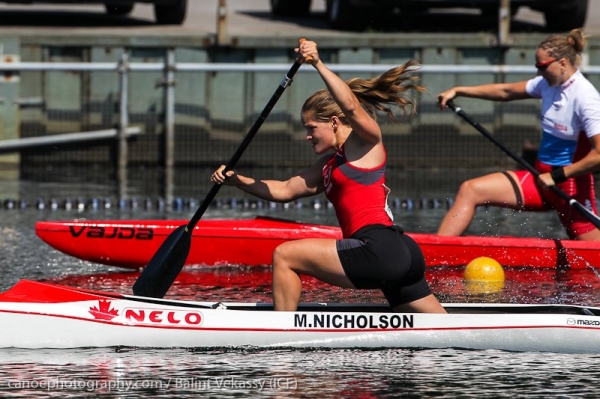
Abby Hoffman, the famous Canadian sports icon wrote the following in the Ottawa Citizen in reference to the 1996 Olympic Games:
“There is no excuse for perpetuating the blatant sexism that persists at the Games. Not only
do women compete in only 21 sports while men take part in 27, but the program of events
in most sports has fewer events for women. At the Olympics women do kayaking, but for
inexplicable reasons, they don’t canoe. Male paddlers do both.”
It’s been about 16 years since Abby Hoffman noted that women’s canoe was absent from the Olympics. And although some things for women’s sports have improved over time, much has not. Women are competing in every Olympic sport and almost every Olympic discipline – except canoe. A flawed process for inclusion, a lack of leadership at the top, varying degrees of acceptance within our sport, and incorrect perceptions of and unclear guidance for readiness all contribute to an increasingly frustrating situation for our female athletes. Unless the current process is altered, it appears that gender equality for women’s sports - women’s canoe in particular - will not come any time soon.
The Status. Several sources, including Simon Toulsen, ICF Secretary General and Richard Fox, ICF 2nd Vice President, say there is not enough momentum for inclusion of women’s canoe to the Olympic Program and that they are looking at 2020 or beyond. This is despite solid participation at the World Championships, growth of interest worldwide, and the recent inclusion by the IOC of a single women’s canoe event to the Youth Olympic Games. And although women’s canoe has been contested at the Pan American Canoe Championships since 2001, it is not currently listed on the schedule of events for the 2015 Pan American Games to be held here on our own turf.
The Flawed Process A clear pattern has emerged for women of sport. Equality wording has been inserted into charters of all levels of sporting organizations but the process for achieving that equality has not been defined. Equality, in essence means adding women’s events to the schedule. Extra events translate into time added to the schedule and extra expense for the increased participation. When women start asking for equal events the process begins to break down. Rules for most organizations state that in order to add an event there must be a motion put forward and a member vote. When the motion is presented, predictably a lively debate ensues that alternates between lack of available money or time on the schedule and quantity and/or quality of competitors. The result generally does not turn out in favour of the women. Often the motion doesn’t even reach the floor in anticipation of lack of support. This is the scenario that plays out year after year, quadrennial after quadrennial for women of sport - particularly at the International Federation level. Equality wording in charters is powerless and meaningless when the members can simply continue to vote against full inclusion for as long as it suits them.
Leadership. Equality means for every men’s event there is a corresponding women’s event. A look at the Olympic Programme Commission report will show that there is no in depth consideration of equality at the event level despite politically correct equality wording in the Olympic Charter. International Federations(IFs) are expected to sort out gender equality issues in light of the Olympic caps and quotas all on their own and that places them in a very difficult position. IFs are reluctant to complain because there is a perception of a constant threat of being ‘tossed’ out of the popular summer games. Our sport in particular is heavily dependent upon Olympic funding. At the same time, tension is generated within the sport as the caps and quotas imply that in order to satisfy the women’s equality issue, men will have to lose events. Ski jumping, however, has yet to see the loss of a men’s event after the women’s event was added in 2011 for the 2014 Winter Olympics. In sports like canoe/kayak that are already underrepresented at the Olympics for events and distances as compared to what is raced at worlds, this creates a dilemma. The lack of leadership by the IOC to define equality in addition to event caps and athlete quotas seems to be at the heart of the problem.
Acceptance. Many in our own sport don’t see the potential value of women’s canoe. Sprint canoe/kayak debuted at the 1924 Olympics as an exhibition sport with an 3 events each. But of the 12 events now in the Olympics, 9 are kayak events and only 3 are canoe events, all three of which are men’s. Is it conceivable that the diminished status of canoe as opposed to kayak might be a natural result of not having a women’s component? With its differing techniques and coach specialization, it would make sense that cash strapped countries would choose to focus their resources on kayak which holds 75% of the medals. Some countries have gone so far as to suggest getting rid of canoe altogether. Adding women’s canoe to the Olympics should help to balance canoe versus kayak events and help to grow our sport.
Readiness. Despite being only recently supported and promoted by the ICF, women’s canoe is in a very healthy state worldwide. ICF support and a solid grassroots initiative brought 11 countries together at the 2009 Worlds for exhibition C1 and C2 events. When WC1 200m was announced as a full medal event for 2010 the participation doubled 21 countries. In 2011, 22 countries participated and at least 3 more did not send their female canoeists due to lack of funding. Competition has become increasingly tighter both at the Senior level and especially at Junior Worlds with Canada not experiencing the total dominance it had early on. Women have demonstrated that they are more than ready to compete on the world stage but are scrutinized as to readiness whereas men’s canoe and both men’s and women’s kayak were added to the Olympics with minimal participation.
Solutions. If gender equality is to ever become a reality, then the current ‘flawed process’ where members with their own personal agendas vote to include or exclude women’s events must be changed. Holding such votes seems to contradict charters that have already promised equality. It has been demonstrated that the single fastest way to develop high level competitive athletes is to provide high level competition. Voting to add events sets up a vicious cycle of lack of participation because of lack of events and funding because of lack of participation and it is the most significant roadblock to inclusion. If sports are serious about equality then votes should be held to add events – not men’s events or women’s events - simply events with the expectation that both men and women will compete when participation meets the defined levels. A situation of having equal events in place is like affirmative action. It forces people to do the right thing until they are conditioned to do the right thing. The IOC needs to be called out by not just our sport, but by all sports on their caps and quotas if a sport can’t be gender equal and fully represented at the same time.
Adding women’s events is not ever going to become less expensive or less time consuming. We are repeatedly told to “be patient”, that “change is slow.” Change doesn’t need to be slow. Unlike paracanoe, which was added to the 2016 program in 2010 with barely enough participation levels at the time, change for women’s canoe is allowed to be slow. Until our sport leadership puts a process in place that enforces equality, I’m afraid that there is no guarantee that women’s canoe will ever make it to the Olympics. And if it does, it is likely to be a single event added to give the appearance of equality.
Respectfully submitted,
WomenCAN International
Abby Hoffman, the famous Canadian sports icon wrote the following in the Ottawa Citizen in reference to the 1996 Olympic Games:
“There is no excuse for perpetuating the blatant sexism that persists at the Games. Not only do women compete in only 21 sports while men take part in 27, but the program of events in most sports has fewer events for women. At the Olympics women do kayaking, but for inexplicable reasons, they don’t canoe. Male paddlers do both.”
It’s been about 16 years since Abby Hoffman noted that women’s canoe was absent from the Olympics. And although some things for women’s sports have improved over time, much has not. Women are competing in every Olympic sport and almost every Olympic discipline – except canoe. A flawed process for inclusion, a lack of leadership at the top, varying degrees of acceptance within our sport, and incorrect perceptions of and unclear guidance for readiness all contribute to an increasingly frustrating situation for our female athletes. Unless the current process is altered, it appears that gender equality for women’s sports – women’s canoe in particular – will not come any time soon. Or can it?
Read more: http://womencanintl.com/wordpress/2012/07/05/why-isnt-womens-canoe-in-the-olympics/
Support women's sports and SHARE this story with your friends!
Filed Under:
This article was written by a WomenTalkSports.com contributor. Sign up here to start publishing your own women's sports content.
View WomenCANIntl's Full Profile








There is 1 comment on this post. Join the discussion!
it is so weird - they have this new "more women into watersports" policy...but so often you feel unwelcome, underestimated, pushed down, intimidated, bullied...oh yes, not to forget swear language and lots of trash talk...Canoeing? they can't behave in kayaking lol))) Come on guys, be MEN, be nice!
or are they just afraid girls would beat them up to records lol?)))
Thursday, July 19, 2012 at 8:23pm EDT