








March Madness seeding biased
|
posted by Draft Day Suit A (usually) humorous look at sports written by popular parent bloggers and some of their friends. |

|

|
Is there automatic bias in the selection process for the NCAA Tournament brackets? Faye Merrideth says there is.
And she has statistics to back it up.
Using the SAS Analytics-powered “Dance Card” formula developed by Jay Coleman of the University of North Florida, Mike DuMond of Charles River Associates, and Allen Lynch of Mercer University, these professors uncovered selection committee bias in favor of particular conferences, as well as bias in favor of the teams with some representation on the NCAA men’s basketball selection committee itself. Bias in the seeding process appears to be even more pronounced than bias in the at-large selections… Although many have surmised over the years that these types of biases exist, no study before this one has comprehensively examined the range of biases in both processes.
Crazy, right? But in the back of your mind you are thinking I KNEW IT!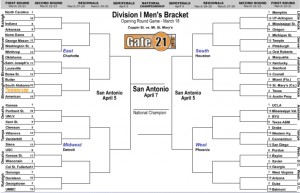
I couldn’t stop looking at this study. I was fascinated, but I’m not that good at math so I got on the phone with one of the authors of The Dance Card formula, Dr. B. Jay Coleman.
Coleman and Allen Lynch developed the Dance Card formula in 1994. Since then they have updated and modified it (you should go look now, he updated it this morning) and they have about a 93 percent accuracy rate predicting the selections of the NCAA brackets.
It is the other seven percent that is so interesting, though.
Dr. Coleman said that he, DuMond and Lynch found evidence of biases based on conference affiliations and membership on the selection committee.
We’re looking at you PAC 10.
Dr. Coleman also mentioned that having a conference commissioner on the selection committee made it statistically more likely to give a team a higher seed.
I love this because it gives mathematical credence to what I’ve long suspected: SHENANIGANS!
Of course Coleman insists that they are only accusing the people of being human. It is just like the AP Polls in NCAA football. You vote for teams in your state because they are the teams you know, the teams you see, the teams you think about. The authors of the paper don’t think this is nefarious, just a reflection of human biases. This is sad for my conspiracy theories, but good for humanity.
Either way, it is a compelling study that helps to explains what everyone already knows – rooting for the home team isn’t just a line from a baseball song.
~GoonSquadSarah
View Original Post at draftdaysuit.com
|
|
|
- Filed Under:
- Basketball, Sports










No one has commented on this yet. Be the first!