

Ms. Buzuvis and WTS - I've intentionally not responded to most of the Title IX Blog cross-posts here...more
posted 08/31/12 at 8:34pm
on Federal Court Enjoins Nonvoluntary Single-Sex Classes in West Virginia





posted by One Sport Voice
Tuesday, February 21, 2012 at 2:49am EST
Dr. Nicole M. LaVoi: This blog reflects my critical eye and voice on all things sport. I am a critical thinker, scholar, and researcher in girls & women in sport, youth sport, and coach & sport parent education.
Support women's sports and SHARE this story with your friends!
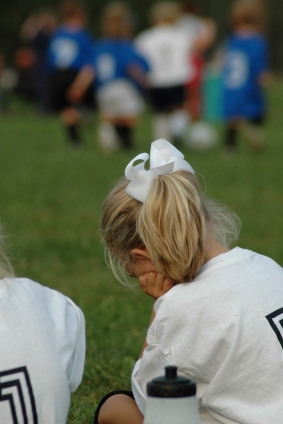 I have written previously about my thoughts on playing time, click here to read them.
When I tell coaches and parents that I believe all youth sports should have equal playing up until age 12, regardless of competitive level, it is not a popular idea. Especially when I say I really think the age should be 14! I thought of a few more facets of this complex and contested idea in youth sports that is worth discussing.
As adults who play recreational, but competitive sports, equal playing time is almost always the norm. If playing time isn’t equal, problems, resentments, and hard feelings arise. For example, I play on a recreational women’s ice hockey team. We have 10 skaters, which means 2 lines. We all pay the same fee to play. Everyone plays equal ice time. When one line takes a long shift and the other line gets shorted, people get upset because it is supposed to be equal. We don’t put special lines out on the power play or penaltly kill, whomever is up or feels like she has legs, they go. We all have different strengths and weaknesses, which we work with together. We try (and like to) to win, are competitive, and strive to win every game (which we don’t). We enjoy being active, doing something we love, battling to win, hanging with friends and enjoy camaraderie with other teams.
Do we think this is different for kids?
So why is it that as adults in our own sport endeavors we structure equal playing time, but when adults run and control youth sport recreational, competitive programs….we justify unequal playing time. (NOTE: recreational teams are just as competitive and want to win just as much as travel teams, the skill level is just different). As adults we don’t like sitting on the bench, we want to play, think unequal time is unfair, unjust and annoying, makes us not feel poorly about ourselves, and is not fun or enjoyable.
Do we think this is different for kids? What is the rational for unequal playing time in youth sports before age 12? I’d like to hear it…seriously…I want to hear from you. I think this conversation is worth having.
I say equal playing time at ALL competitive levels because if you have a kid on a team where he/she doesn’t play much, if at all, then he/she shouldn’t be ON that team. Move that kid down a team so they DO play and have the opportunity to play, learn, and develop skills in competitive contexts. No kid should be on an elite travel team, pay high fees to play and then not play equally…that seems wrong. As adults we’d NEVER put up with that policy would we? (I understand parents and kids “choose” to be on that team, I also understand that some kids want to play with their friends even if it means not playing, but those are different blogs on the broken system of youth sports).
If equal playing time is what we prefer and what we like and enjoy as adults why should it be different for kids?
Support women's sports and SHARE this story with your friends!
Today on the Women's Sports Calendar:
| U.S. Open Aug 27 - Sep 9: Louis Armstrong Stadium | WNBA Games September 1: Prudential Center |
MOST POPULAR ARTICLES & POSTS
August 29, 2012 at 8:53am
August 29, 2012 at 8:49am
August 28, 2012 at 8:35am
August 30, 2012 at 7:51am
August 30, 2012 at 8:01am
October 4, 2010 at 1:40pm
LATEST ARTICLES & POSTS
Fri at 5:49pm
Fri at 3:33pm
Fri at 3:22pm
Fri at 8:42am

Dr. Nicole M. LaVoi: This blog reflects my critical eye and voice on all things sport. I am a critical thinker, scholar, and researcher in girls & wom...
full profile
For more, visit Dr. Nicole M. LaVoi's Full Profile

RECENT COMMENTS
Ms. Buzuvis and WTS - I've intentionally not responded to most of the Title IX Blog cross-posts here...more
posted 08/31/12 at 8:34pm
on Federal Court Enjoins Nonvoluntary Single-Sex Classes in West Virginia

I WANT MY MOMMIE N MY MAYPO!!!!...more
posted 08/30/12 at 1:55pm
on Liz Cambage (sort of) explains herself

THEN SEND BACK ALL UR PAYCHECKS CAUSE THATS WHAT THEY PAY U FOR, IT IS NOT A GAME IT IS A BUSINESS.....more
posted 08/30/12 at 1:54pm
on Liz Cambage (sort of) explains herself
Regardless of the athlete's gender most of us have dreamed about going pro at some point. As you no...more
posted 08/28/12 at 2:55pm
on NO WINNER at the 2012 NPF Championships: A Disappointing Finish

From the sounds of it, Crimson, it looks like you agree (you can say it... don't be shy!).
Ge...more
posted 08/28/12 at 1:28pm
on NO WINNER at the 2012 NPF Championships: A Disappointing Finish
No one has commented on this yet. Be the first!