


@ Cheryl - "interesting, entertaining and newsworthy" that's true, although I know when you are invo...more
posted 04/05/11 at 5:10pm
on Women's sport and the media
| Donate to the RedCross Japan Relief Fund | March Madness is in full effect! Follow the Women Talk Sports Bracket Challenge HERE and catch all the coverage HERE. |





posted by mhueter, a Women Talk Sports blogger
Tuesday, March 22, 2011 at 12:46pm EDT
About mhueter:
I'm one of the co-founders of WomenTalkSports.com. I'm also a full-time digital public relations professional at Catalyst Public Relations in New York. I played basketball my entire life, and am a pro...more
 Following is an exclusive interview with Pat Griffin, professor emeritus at the University of Massachusetts Amherst in Social Justice Education. Pat is the woman behind Pat Griffin's LGBT Sport Blog. In a former life, Pat was a high school field hockey and basketball coach and coached swimming and diving at UMass. Pat is now the Project Director for Changing the Game: The GLSEN Sports Project (sports.glsen.org), which just launched in mid-March.
Pat conducted this interview with me as part of a promotional series on homophobia in women's basketball, brought to you by The Fling, an event taking place on Saturday, April 2nd in Indianapolis, which seeks to bring together fans of women's sports and combat homophobia.
1) Why do you support The Fling, and what are you looking forward to about this event?
I have supported the Fling last year and this year. I do it because I think lesbian fans should be treated well. They are loyal and educated fans who follow women’s basketball closely. They deserve to have events planned for them at the Final Four. Plus, it is a smart business opportunity. Lesbians go to the Final Four in great numbers. Unfortunately I am not going to the Final Four this year. It’s the first time in awhile that I will not be there, but I will be watching the games on TV.
2) You've been spending a good amount of your life advocating for social justice in sport as it relates to gender and sexuality. Why is this such an important issue to you?
Partly because of my own experience as a woman coach and athlete and my experience as a lesbian coach and athlete. I think my experiences are a major motivation. I decided that I wanted to be a leader in making sports more accessible to women and wanted to do something about the discrimination and prejudice against lesbians in sport. Also, I have always been committed to addressing a broad range of social justice issues in and out of sport. Sport is just my thing so that is where I focus my energies.
3) Would you say that homophobia a big issue in women's basketball? If so, how? If not, why not?
YES, it is a big thing in women’s basketball. When you only have one publicly out lesbian coach in D1 women’s basketball, that is a big thing (It’s Sherri Murrell at Portland State, by the way). Negative recruiting in women’s sports, particularly women’s basketball, is still an unethical practice that plays on the homophobia of high school athletes and their parents that is way more prevalent than many people realize. Negative recruiting is discouraging an athlete and her parents from going to a rival school by telling them there are lesbians in that program. Penn State’s former coach, Rene Portland, was the poster child for discrimination against lesbians, but there are other coaches still in the game who do the same thing. We still need to get schools to stand up to this kind of discrimination.
4) What do you think about the movie Training Rules? Was Jennifer Harris wrong for accusing her coach, Rene Portland, of discrimination? How do you think the Penn State coach handled the issue? (Training Rules trailer below, for reference)
Well, I was featured in Training Rules as a talking head expert so my feelings are perhaps skewed, but I thought it was a terrific documentary that told a story that needed to be made public. It wasn’t just about Jennifer Harris, it was about all of the young women, several of whom spoke up in the movie, about how Portland discriminated against them because she thought they were lesbians. Jennifer Harris and her parents were absolutely right in being the discrimination lawsuit against Penn State and Portland. It took a lot of courage for a young woman like Jen to challenge Portland and Penn State. Portland denied the charges to the end, despite several of her players speaking up to tell about how the same thing that happened to Jen also happened to them. I think it was the best thing for Portland to leave and I am sure Penn State encouraged it in the end. I’m really happy that Penn State got into the tournament this year. I think they are finally coming back under new coach Coquese Washington.
5) Since the time of the movie Training Rules, have you seen any other issues of discrimination arise? Do you think homophobia has gotten better or worse?
Yes, there have been lawsuits at several schools since Training Rules. I think one thing that has changed is that women athletes and coaches who are discriminated against because of their perceived or actual sexual orientation are more likely to challenge it with a lawsuit. The athletes more often have the support of their parents which is a crucial factor in their ability to stand up. Plus, there are more resource available to help them. More athletes are out too. I actually think that the athletes are way ahead of their coaches on this issue. Athletes are more comfortable with lesbian (and gay) teammates than their coaches are. So I do think things are better, but we still have a serious battle on our hands to do away with homophobia and anti-gay discrimination in sport.
6) Are you a WNBA fan? Would you say the WNBA is inclusive or exclusive of the gay and lesbian population?
I am a fan of any women’s professional sport. However, I must say I am more of a big fan of NCAA women’s basketball in that I watch more of it and keep up with the college teams more. I think the WNBA has gotten a lot better. In the beginning the WNBA leadership was very uncomfortable with the “lesbian image” of the league. I think the players themselves are much more comfortable with each other. It’s all about the image. I think that is also why so few players have come out publicly. You have to take each franchise individually when you talk about how inclusive they are. Some have really embraced their lesbian fans and others, not so much.
7) Would you say that the media has done a good or bad job covering the issue of homophobia in women's sports?
I think the media is getting better on this. Most of the mainstream media does a pretty good job when they decide to do stories on this topic. I do think that most sports writers (who are men) are much more fixated on gay men in sport. I think many of them see the topic of lesbians in sport as less interesting and less controversial because they believe it is not news that there are lesbians in sport. It is an extension of the sexism we see in the lack of coverage of women’s sports in general in the mainstream sports media. It’s interesting to me that it seems like a lot more male heterosexual pros are speaking up against homophobia in and out of sport than female heterosexual pros. I am not sure what this is about. It could be a result of the homophobia in women’s sports and how it also affects straight women too and makes them less secure about speaking up.
8) What's the one thing you wish the women's basketball community could do to help the gay and transgender community?
I would love for more individual coaches and the WBCA as an organization would stand up and take a more forceful and public stand against discrimination on the basis of sexual orientation and gender identity/expression. Unfortunately too many coaches who do not necessarily discriminate themselves are still silent about the discrimination that goes on around them. When a critical mass of coaches speak up and the WBCA begins taking a more aggressive stance, the coaches who are the problems will not be able to get away with what they do now.
9) What is Changing the Game : The GLSEN Sports Project? Why is it important?
Changing the Game is an education and advocacy project focused on making K-12 Athletics and Physical Education respectful and inclusive for students of all sexual orientations and gender identities/expressions. The project is an initiative of GLSEN, the Gay Lesbian Straight Education Network. We have a great web site – sports.glsen.org – where coaches, teachers, students, parents and anyone interested in our mission can find resources and activities. We have a Team Respect Challenge in which we challenge school teams to commit themselves to being leaders of respect on their teams and in their schools and other similar activities. I think the project taps into the social justice instincts that many young people have and provides them with a way to change their schools and their teams. We have a spectacular All-Star Team of sports leaders who are supporting us – Billie Jean King, Martina Navratilova, John Amaechi, Jessical Mendoza, Scott Fujita, Lauren Lappin, Billy Bean, Brian and Patrick Burke, Candice Wiggins, Lin Dunn, Hudson Taylor, LZ Granderson, Ben Cohen, Helen Carroll to name several.
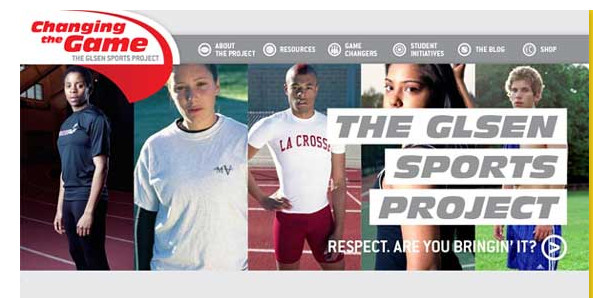
I think the Sports Project is important because sports and physical activity are important for all students, including lesbian, gay, bisexual and transgender students. Yet the gym and the locker room are often perceived as unsafe places for LGBT students. Homophobia and transphobia in sports are problems that we need a lot more work to eliminate. Changing the Game will provide schools with the resources they need to make sure that sports and physical education are great experiences for all students.
10) How can readers get involved in GLSEN?
The best way for the WomenTalkSports Network to get involved right now is to tweet, retweet, blog, and Facebook about the Sports Project. Follow the GLSEN Sports Project on Twitter, “Like” us on Facebook. If you have contacts in schools, send them our web site.
You can also make a Game Changer video to be posted on our web site (You’ll find the direction there too). If you coach, see if your team is interested in taking the Team Respect Challenge. Finally, let me know what kind of resources you would like to see on the web site.
Right now I’d love to hear from more LGBT and ally high school women athletes and coaches. We’d like to do profiles of them and their schools. Helping me to spread the word on this would be great also.
Filed Under:
View Original Post at womentalksports.com | View mhueter's Full Profile
MOST POPULAR POSTS
posted by Women Undefined
07/31/10 at 10:26pm
posted by anngaff
04/03/11 at 10:34pm
posted by HoopFeed.com
04/04/11 at 10:45pm
posted by HoopFeed.com
04/03/11 at 7:04pm
posted by C and R's Stanford Women's Basketball Blog
04/01/11 at 1:23am
posted by HoopFeed.com
02/11/11 at 12:10am
posted by MarQFPR
04/04/11 at 4:53am
posted by Title IX Blog
04/02/11 at 5:54pm
posted by MsAkiba
10/11/09 at 2:40pm
posted by Swish Appeal
04/03/11 at 10:27am
LATEST WTS POSTS
posted by anngaff
Tue at 11:17pm
posted by Pretty Tough
Tue at 8:09pm
posted by Women in Sport International
Tue at 2:39pm
posted by Fair Game News
Tue at 2:33pm
posted by Sarah Stanley Inspired
Tue at 2:29pm
posted by Softball Performance Blog
Tue at 2:18pm
posted by Byline to Finish Line
Tue at 2:13pm
posted by The First Line
Tue at 2:07pm
posted by After Atalanta
Tue at 2:05pm
I'm one of the co-founders of WomenTalkSports.com. I'm also a full-time digital public relations professional at Catalyst Public Relations in New York...
full profile
For more, visit mhueter's Full Profile
RECENT COMMENTS
@ Cheryl - "interesting, entertaining and newsworthy" that's true, although I know when you are invo...more
posted 04/05/11 at 5:10pm
on Women's sport and the media
@ No Apologies - I suppose that's why sites like this are so useful, eventually someone will listen!...more
posted 04/05/11 at 5:07pm
on Women's sport and the media

What I find most valuable about spending time online is the opportunity to focus on one topic with l...more
posted 04/05/11 at 11:34am
on Women's sport and the media
It's a shame really that women's sport is not given enough coverage especially when you realise that...more
posted 04/05/11 at 10:44am
on Women's sport and the media
Really? French cut? hmm seems like she got robbed. Ahh well, WNY has plenty of talent. ...more
posted 04/02/11 at 1:23pm
on WPS Wallchart � 04/01/11 Update


No one has commented on this yet. Be the first!