
Great article but really not true; there are many players involved in the NPF that are not from the ...more
posted 08/26/14 at 1:28pm
on Softball Standouts Plourde and Prezioso Represent Atlantic 10, Exemplify Mid-Major Potential at Next Level




posted by Byline to Finish Line
Tuesday, November 16, 2010 at 9:06pm EST
A chronicle of a sports reporter who ditched the sideline to discover her own power and strength by taking up endurance sports in her 30's.
Support women's sports and SHARE this story with your friends!
There are times when it’s not easy being a female athlete.
There are times when you’re criticized for being too muscular, too aggressive, acting and playing too much like a guy.
Ah, but go too far the other way, emphasize your femininity, and you’re not a real athlete, not to be taken seriously, only using sex to sell your sport which nobody cares about in the first place.
The sporting landscape can be difficult enough to negotiate in traditional male-female gender roles.
Now, add transgendered athletes to the mix and it gets that much more complicated.
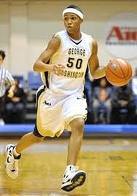 One of the biggest media spotlights hitting women’s basketball this season is on the story of Kye Allums, a junior at George Washington. Kye was formerly known as Kay-Kay. But Allums has come out as a transgendered man playing women’s basketball. All references to Allums are made in male pronouns and the school supports his decision.
According to an article in the New York Times, Allums told his coach, Mike Bozeman in June. Bozeman said in a statement: “George Washington University women’s basketball program, including myself, support Kye’s right to make this decision.”
In talking with others in the women’s basketball community, the question is not about supporting Allums to make that decision. It’s whether he can play on a woman’s basketball team.
The NCAA has cleared Allums to play for the women’s team since he has not begun taking hormones to make the physical transition from female body to male body.
It’s another piece of the complicated puzzle we call gender.
Generally, we see gender as a social construction. Society tells us what defines a man, what defines a woman, and how both should act and interact. But as long as we’ve had social living, we’ve had men and women who have challenged the norms. Sometimes it’s in the pursuit of political or economic freedom. Sometimes, it’s in the pursuit of right of self-determination. The key in it all is the pursuit of freedom — having the opportunity to be oneself. Isn’t that the most basic right of all?
But even if you support an individual’s right to live their life in the way they see fit, there still is the task of merging individuals and a traditionally gender-divided world.
Where should Allums play basketball? On the women’s team? Does he need to go to the men’s team? What about competitive advantage, particularly for transgendered women (that is, athletes born male but identify as female)?
To help address those questions, the report On The Team: Equal Opportunity for Transgendered Student-Athletes was released in October. The work, co-sponsored by the Women’s Sport Foundation and the National Center for Lesbian Rights, offers an overview of the issues policy recommendations along with suggestions for best practices, definitions, terminology and additional resources.
From my view, I’m not qualified to give a decisive answer. I don’t even feel particularly qualified to give an informed opinion. While at times it is frustrating to be a woman in athletics, I’ve never questioned my gender or sexual orientation. I don’t know what it’s like to feel outcast from my own body and put myself in a situation where I am likely to be ostracized from a community that I not only call home, but a sports community in which I live an important part of my identity.
What I do believe is that Allums is brave to play women’s basketball as a transgendered male. (And I do mean brave. Let’s face it, 18-22 year olds aren’t always the most welcoming people on the planet, especially those who “cheer” at collegiate sporting events.) And I believe he helps all of us have a conversation about gender, identity and opportunity.
Facing up to ideas and issues and realities that make us uncomfortable, forging new solutions and finding new sources of courage — that’s the true beauty of organized athletics, both for the individual and for the community.
Support women's sports and SHARE this story with your friends!
MORE ABOUT THIS AUTHOR:
A chronicle of a sports reporter who ditched the sideline to discover her own power and strength by taking up endurance sports in her 30's....
full profile
For more, visit Amy Moritz's Full Profile
LATEST ARTICLES & POSTS
Sat at 8:02pm
Sat at 7:58pm
Sat at 7:56pm
Sat at 7:53pm
Sat at 7:50pm
RECENT COMMENTS
Great article but really not true; there are many players involved in the NPF that are not from the ...more
posted 08/26/14 at 1:28pm
on Softball Standouts Plourde and Prezioso Represent Atlantic 10, Exemplify Mid-Major Potential at Next Level

What she did I'd fantastic but she was still a good 14 seconds behind the winner and, really, the Ke...more
posted 07/22/14 at 4:04am
on 2 seconds, no finish clock picture, but satisfaction: Molly Huddle breaks her own AR

Does money make champions ! History have taught us that money does not means success overnight . Mos...more
posted 06/20/14 at 8:25pm
on Sparks need a change, but what kind?
congrats to Maria on her French Open win!!...more
posted 06/11/14 at 10:06pm
on Maria Sharapova Named The Face Of Avon Luck Fragrances

http://allezweitagediat.de/...more
posted 03/07/14 at 3:29am
on USWNT: USA Draws With Japan in Algarve Opener
| SAUCUONY 500 MILE CHALLANGE |
| Daily Workout |
No one has commented on this yet. Be the first!