
Great article but really not true; there are many players involved in the NPF that are not from the ...more
posted 08/26/14 at 1:28pm
on Softball Standouts Plourde and Prezioso Represent Atlantic 10, Exemplify Mid-Major Potential at Next Level





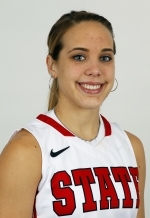
posted by Marissa Kastanek, a Women Talk Sports blogger
Saturday, October 26, 2013 at 9:47am EDT
About Marissa Kastanek:
I was born and raised in Nebraska, USA where I played soccer, volleyball, track and field, and basketball. I played competitive basketball with the Cornhusker Shooting Stars for eight years. I won a N...more
Support women's sports and SHARE this story with your friends!
I am taking a break from talking about women of the game for this post because as basketball season is quickly approaching I feel that goal setting is important to talk about. There are two different types of goals: short-term and long-term. Long-term goals are good for big picture ideas. They are good to keep in the back of your head to remind you why you are doing the things you are doing. If what you are doing does not benefit the long-term goal then you should probably rethink your actions. Long-term goals equal the destination.
Then there are short-term goals, which are the key to any success. Short-term goals allow the athlete or coach to see progress frequently and allow them to adjust more often if certain actions are not favoring the desired outcome. Short-term goals equal the steps that must be taken to reach the destination.
Goal setting has a formula to help with the commitment process. I took a course at NCSU my freshman year called Maximizing Academic Growth In College (MAGIC) that discussed topics that incoming freshman usually have issues with during the transition from high school to college. In this class they introduced me to making SMART goals. Ensuring that athletes set SMART goals helps them to be accountable to their goals and assists them in achieving the goal from the start.
Specific: The goal must be defined and not up for interpretation.
Measureable: There must be a method of calculation to see progress.
Attainable: The goal should be set in the parameters of possibility.
Realistic: The goal should be based on current talents, resources, and attitude.
Timely: The goal needs to have a starting and stopping point.
Just because the goal is perfectly written using the SMART formula that does not mean that it will be reached. A big part of goal setting is knowing that there will be a chance that the goal is not reached. To some that means failure but true failure comes when a person quits. In athletics there will be times when achieving goals can be hard but quitting is easy, pushing through the failures is what makes a true competitor and complete athlete.
Some important things to keep in mind while setting goals:
“You can’t let praise or criticism get to you. It’s a weakness to get caught up in either one.” – John Wooden
I have been alive now for 23 years and goal setting for me started when I was 11 years old. I set goals for everything that I do from reading to band to basketball. I was always trying to get better than I was the day before. I will demonstrate my goal setting process for basketball.
There was a select basketball team called the Cornhusker Shooting Stars and they were really good. They had all the best players in Nebraska and I needed to be on that team to improve my skills. I went to tryouts and did my best. I made the team.
As I started to realize that I was pretty good at basketball I decided that I wanted to continue to play and I wanted to make the Varsity team in high school in my first year. I started.
As I kept improving I decided that I wanted to receive a college scholarship for basketball. A lot of people said that it was going to be very difficult for someone my size from a small town to get a full-ride to a big school but I did not care I just wanted to play in college. I got my first full-ride scholarship offer in the middle of my freshman year.
As the offers started rolling in I decided that I wanted to play at the highest level in NCAA basketball. I wanted to play in the ACC! In the beginning none of the ACC teams were interested in me so I was looking closer to home but one day I got a letter from North Carolina State University. They offered me a scholarship and I accepted.
I was a junior in high school and so far I was “accomplished” but I wanted more. I wanted to make an impact as a freshman for the Lady Wolfpack. At the end of my freshman season in Raleigh I was named the ACC Rookie of the Year. I made an impact.
I wanted more. I wanted to play for Team USA. I knew this was a stretch because of all the great talent in the country. It was a goal I had that reached the very top of the scale of realistic but thanks be to God, my coaches, and my work ethic I was asked to play for Team USA in the Pan America games in 2011. I have a USA jersey with my name on it.
When I got the ACC Rookie of the Year award I decided that I wanted to push that even further and be named the ACC Player of the Year. Again, this may have superseded the scale of the realistic category of the SMART goal but I wanted to give it a shot. At the end of four years I never received that award but I did make it onto the All-ACC Team my senior year.
In college I also had the goal of playing professionally in the WNBA and in Europe. At the end of my senior year of college I hired an agent and unfortunately no WNBA team wanted me. I was hurt but I understood that there was still a chance that a team in Europe would want to hire me. After a few months of uncertainty I got a call that I was wanted in Sweden. I became a professional athlete.
Currently my goals are as follows:
It is important to understand that to achieve each of these goals I had to put in countless hours of preparation. I was committed 100% to doing all that I could to get where I am. There were days that I failed in getting closer to my goal but there were also days that propelled me forward. It is a constant journey and a fun one if you can create the right environment for yourself. Good luck!!
Here I am at graduation as a Valedictorian with a 4.0 and many other honors. I set a goal before I started school that I wanted to graduate with a 4.0 because I knew it would help me with my job search. I couldn't have done any of this without God and a supporting cast of family, friends, coaches, and adivsors.
Support women's sports and SHARE this story with your friends!
This article was written by a WomenTalkSports.com contributor. Sign up here to start publishing your own women's sports content.
MORE ABOUT THIS AUTHOR:
I was born and raised in Nebraska, USA where I played soccer, volleyball, track and field, and basketball. I played competitive basketball with the Co...
full profile
For more, visit Marissa Kastanek's Full Profile
LATEST ARTICLES & POSTS
Wed at 3:42pm
Wed at 12:17pm
Wed at 12:08pm
Tue at 3:07pm
Tue at 2:57pm
Tue at 2:55pm
Tue at 2:50pm
RECENT COMMENTS
Great article but really not true; there are many players involved in the NPF that are not from the ...more
posted 08/26/14 at 1:28pm
on Softball Standouts Plourde and Prezioso Represent Atlantic 10, Exemplify Mid-Major Potential at Next Level

What she did I'd fantastic but she was still a good 14 seconds behind the winner and, really, the Ke...more
posted 07/22/14 at 4:04am
on 2 seconds, no finish clock picture, but satisfaction: Molly Huddle breaks her own AR

Does money make champions ! History have taught us that money does not means success overnight . Mos...more
posted 06/20/14 at 8:25pm
on Sparks need a change, but what kind?
congrats to Maria on her French Open win!!...more
posted 06/11/14 at 10:06pm
on Maria Sharapova Named The Face Of Avon Luck Fragrances
| SAUCUONY 500 MILE CHALLANGE |
| Daily Workout |

There is 1 comment on this post. Join the discussion!
Congratulations on setting and achieving all your SMART goals!
Monday, October 28, 2013 at 3:03pm EDT