
What she did I'd fantastic but she was still a good 14 seconds behind the winner and, really, the Ke...more
posted 07/22/14 at 4:04am
on 2 seconds, no finish clock picture, but satisfaction: Molly Huddle breaks her own AR




posted by Fair Game News
Thursday, April 12, 2012 at 5:21pm EDT
Seeking equality on -- and off -- the field. The strong connection between organized athletics and power (political, economic, social) means sports have consequences far beyond the game. FairGameNews.com aims to challenge sex-stereotyped assumptions and practices that dominate sports -- and recognize that sports can be a tool for seeking equal treatment and fair play.
Support women's sports and SHARE this story with your friends!
By Mariah Philips
After an hour-long 6 a.m. lift, I can feel my hands shaking, residual adrenaline pumping through my veins. Sweat trickles down the side of my temple. My muscles are limp from exhaustion. But the most prominent thing I feel when I walk out of the weight room is pride, satisfaction in the exertion I have just put forth. It is empowering to feel strong.
Being strong – lifting in particular – has been important to my growth as a college softball player and because I’m at Wellesley College, lifting happens in an all-women’s weight room.
But elsewhere, in co-ed weight rooms, there’s an unspoken edge: As a woman, you are not free to lift without being judged. I have been the girl with the 40-pound dumbbells, standing beside the man lifting less – and feeling a wash of shame. I’m an athlete. I need to be strong. Yet, I catch the glances and the scrutiny by male and female members of the gym. What’s more, I hear the same stress expressed by other female athletes (including one who has a planned apology: “Sorry, I’m a man.”)
It may now be OK for women to be strong. But how strong? Why does it remain socially prickly for women to lift large amounts of weight? Why must women struggle to preserve socially condoned images of femininity while they try to honor an athletic identity that challenges those gender norms?
This unspoken weight room phenomenon has not gone unnoticed by sports psychologists.
“Essentially it can be felt as a threat to the male’s self-image to lift next to females,” says Dr. Amy Baltzell, Coordinator of the Sport Psychology Specialization at Boston University. “And then for some women, it can feel like a struggle between their athletic goals and how they perceive they should be compared to males. This, too, can cause a discomfort in the weight room for the female athlete.”
Athletes need to lift, whether you are a 300-pound lineman, a 140-pound wrestler — or a 140-pound field hockey player. It ‘s time to grab the steel (or the med ball) and leave gender expectations and stereotypes out of it.
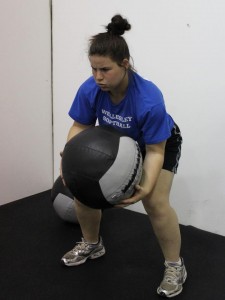
Softball player Jen Migliore lifts/photo by Alex Hatem
Support women's sports and SHARE this story with your friends!
MORE ABOUT THIS AUTHOR:
Seeking equality on -- and off -- the field. The strong connection between organized athletics and power (political, economic, social) means sports ha...
full profile
For more, visit FGN's Full Profile
LATEST ARTICLES & POSTS
Tue at 2:46pm
Tue at 2:43pm
Tue at 2:42pm
Mon at 9:46pm
Mon at 9:42pm
Mon at 9:34pm
RECENT COMMENTS
What she did I'd fantastic but she was still a good 14 seconds behind the winner and, really, the Ke...more
posted 07/22/14 at 4:04am
on 2 seconds, no finish clock picture, but satisfaction: Molly Huddle breaks her own AR

Does money make champions ! History have taught us that money does not means success overnight . Mos...more
posted 06/20/14 at 8:25pm
on Sparks need a change, but what kind?

congrats to Maria on her French Open win!!...more
posted 06/11/14 at 10:06pm
on Maria Sharapova Named The Face Of Avon Luck Fragrances

http://allezweitagediat.de/...more
posted 03/07/14 at 3:29am
on USWNT: USA Draws With Japan in Algarve Opener
| SAUCUONY 500 MILE CHALLANGE |
| Daily Workout |

No one has commented on this yet. Be the first!