
She is one of the best player in basket ball and is really good.
http://www.coomberlaw.com/bu...more
posted 04/30/13 at 3:56am
on The Chicago Sky Selects Elena Delle Donne Second Overall in 2013 WNBA Draft




posted by Fair Game News
Thursday, June 25, 2009 at 12:08pm EDT
Seeking equality on -- and off -- the field. The strong connection between organized athletics and power (political, economic, social) means sports have consequences far beyond the game. FairGameNews.com aims to challenge sex-stereotyped assumptions and practices that dominate sports -- and recognize that sports can be a tool for seeking equal treatment and fair play.
Support women's sports and SHARE this story with your friends!
By Laura Pappano
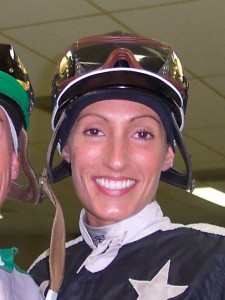
Just two days before filly Rachel Alexandra made a splash by beating the boys at the Preakness Stakes, another female athlete tore up the racetrack – from in the saddle.
On May 14, 24-year-old Jenna Joubert became one of the few jockeys (ever) to ride three different horses to victory at three different racetracks in three different states – in a single day. She rode Chloe’s Song in the second race of the afternoon at Pimlico in Baltimore, Prove Meguilty in the first race of the evening at Penn National in Grantsville, Pa., and (at 11:06 p.m.) Cover My Six at Charles Town Races in Charles Town, W. Va.
I spoke with Joubert, who rides for Dane Kobiskie at PTK stables, LLC in Maryland, as she headed to Colonial Downs in New Kent, Virginia. Fortunately, this day, all her races were scheduled for the same track.
FGN: How did you become interested in being a jockey?
JJ: When I was little, I didn’t know women could be jockeys. Then I met Paula Bacon. When I was about 8 or 9, my family moved from the city to a rural farm, my parents got into the racing business and I was like, “I want to be a jockey when I grow up.” When I got older I started galloping race horses (that’s like exercising horses in the morning). I loved it. I love riding horses, figuring out their personalities and how to get along with them.
FGN: What sorts of personalities do horses have?
JJ: It’s like with people, every single horse is different. Some you have to be aggressive with, a lot you have to make them happy. You may need to have soft hands or light hands. Having light hands, you play with the bit in their mouth to get them to settle down. Race horses can be kind of flighty – they are athletes – so some need to settle while some need to move all the time if they are standing around waiting. Otherwise they get antsy.
FGN: How is racing different from simply riding?
JJ: The race experience is something that you can’t exactly train for. You can work hundreds of horses and practice and you can be as fit as you possibly can, but when you race, there is nothing to compare it to. It is very common for most riders not to know their horses. Because I ride primarily for one stable, PTK LLC, I know those horses incredibly well. Some horses get claustrophobic. Some have no problem running between horses. It’s important to know how your horse likes to run.
Joubert riding to victory at Colonial Downs
FGN: You spoke about being “fit.” Aren’t the horses the ones getting the exercise?
JJ: As a jockey, you use every muscle – you can’t even target all the muscles in a gym! The other evening I rode five races and it’s summer and it’s hot so I drank two bottles of water and every race you have to re-check your weight [and if you are sweating a lot] they have to add lead to your saddle to make your weight. [Jenna explains that every race has weight requirements based on each horse’s age, gender, and recent track success.]
FGN: Why do we see so few female jockeys?
JJ: Horse racing is considered a man’s sport, but it is definitely changing. Especially on the East Coast there are a lot more female riders. When I rode in the Midwest, it was harder to get my career going because you are dealing with the “old cowboy way” where they are not so inclined to ride you in the races. On the East Coast, there has been a lot more opportunity.
FGN: How much do size and strength matter? JJ: A jockey is 110 lbs. and a horse is 1,200 lbs. You cannot muscle a horse. There is a lot of finesse. Some trainers believe it is all about strength, but if a filly is high-strung, they may try a female rider to settle her down.
FGN: How much do jockeys get paid for racing?
JJ: Jockeys receive 10 percent of the owner’s winnings. The owners received 60 percent of the total purse. For each race we ride that we don’t win, we receive a flat fee, which varies from track to track but is usually between $45 and $100.
FGN: How special was Rachel Alexandra’s win in the Preakness?
JJ: It is uncommon for a filly to beat the boys at such a high-quality level in racing. Those horses in the Preakness are the top in the country and it was amazing to watch her win! It is not uncommon, however, for young female horses to race against males and be competitive and win. You often find two-year-old fillies running with colts because there really isn’t a lot of difference at that age. I’ve ridden fillies in boy-races and won before. When the horses are older, or they’ve won multiple races, you tend not to see it as much — but it does happen!
Support women's sports and SHARE this story with your friends!
Today on the Women's Sports Calendar:
| NCAA DI Tennis Championships May 16 - 27: Khan Outdoor Tennis Complex |
MOST POPULAR ARTICLES & POSTS
LATEST ARTICLES & POSTS
Fri at 8:44pm
Fri at 8:41pm
Thu at 10:23pm


Seeking equality on -- and off -- the field. The strong connection between organized athletics and power (political, economic, social) means sports ha...
full profile
For more, visit FGN's Full Profile

RECENT COMMENTS
She is one of the best player in basket ball and is really good.
http://www.coomberlaw.com/bu...more
posted 04/30/13 at 3:56am
on The Chicago Sky Selects Elena Delle Donne Second Overall in 2013 WNBA Draft

The worst kept secret in all of professional sports is that the majority of WNBA ballers are lesbian...more
posted 04/24/13 at 11:41am
on Brittney Griner's way of coming out is progress in the sports world
In terms of sport figures, I'm sure a Pat Summitt statue is in the works.
...more
posted 04/15/13 at 10:11pm
on Statues of Female Leaders?

I'm not a big Stanford fan, but at least they have a legitimate program and did it largely without t...more
posted 04/10/13 at 5:50pm
on Why Cal is my new favorite team

Ooh, is that bitterness I smell wafting up from Palo Alto? It almost seems like you are bashing Cal...more
posted 04/10/13 at 4:20pm
on Why Cal is my new favorite team

Women Talk Sports Podcast - March 5, 2013
In the March edition of the "Women Talk Sports" podcast, Cara and Stephanie use their running background to explain the Dayton 500 and break down the ...[Listen/Download for iTunes]
Women Talk Running Podcast - March 5, 2013
In the March edition of the "Women Talk Running" podcast, Cara and Stephanie wrap up the Millrose Games, give you more Mary Cain news, give our respon...[Listen/Download for iTunes]
Women Talk Sports Podcast - January 28, 2013
In the January 2013 episode of the Women Talk Sports podcast, Cara and Stephanie share several points that will leave you feeling hopeful about the Na...[Listen/Download for iTunes]
No one has commented on this yet. Be the first!