
Great game, really thought Germany was going to put one through in a last minute flourish. Either wa...more
posted 07/10/11 at 1:25am
on Germany 0, Japan 1: Not Quite the Hosts with the Most




posted by Fair Game News
Tuesday, May 31, 2011 at 1:47pm EDT
Seeking equality on -- and off -- the field. The strong connection between organized athletics and power (political, economic, social) means sports have consequences far beyond the game. FairGameNews.com aims to challenge sex-stereotyped assumptions and practices that dominate sports -- and recognize that sports can be a tool for seeking equal treatment and fair play.
Support women's sports and SHARE this story with your friends!
By Laura Pappano
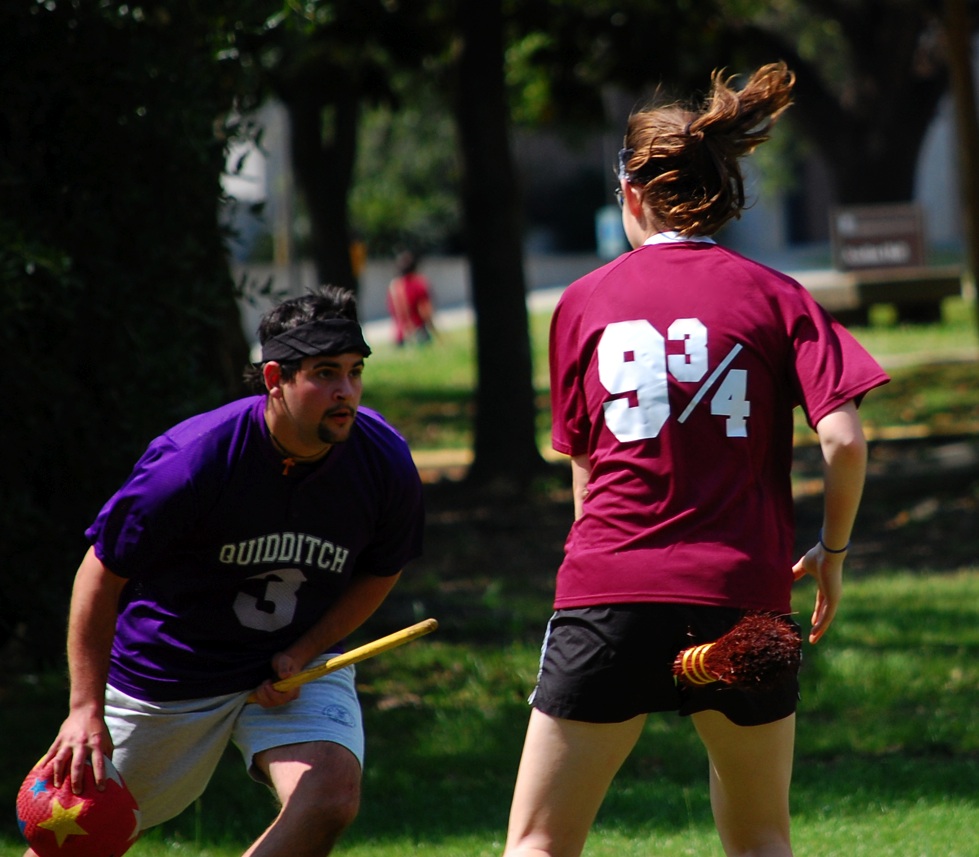
It may look like an excuse for college students to gather in a festival atmosphere. And on the surface, Quidditch, the Harry-Potter-inspired sport in which players ride on brooms (ok, run with them between their legs), is a reach.
But, then, basketball probably looked odd to those who first spotted boys at the YMCA in Springfield, MA in 1891 hoisting soccer balls into peach baskets.
Like basketball, Quidditch is not merely about the physical challenge of play and competition, but also reflects a social goal. Basketball, invented to occupy boys indoors during winter, embraced the late 1800’s belief in “Muscular Christianity.” Strengthen (men’s) bodies to insure they were vigorous, manly vessels for godly values.
Is Quidditch, then, a means for countering Voldemort? Well, no, it’s actually more reflective of 21st Century sport values, including gender equity.
Aimee Howarth, outreach director and member of the board of directors of the International Quidditch Association, spoke with FGN about the rising popularity of this campus sport – and it’s co-ed, gender fair karma.
FGN: How is the Quidditch you play, which has 7 players per team (3 Chasers, 2 Beaters, 1 Keeper and 1 Seeker), different from the Harry Potter books?
AH: The main difference is that we run instead of fly and the snitch is a person – we call them a snitch runner – dressed in gold or yellow. The goal is to knock people off their brooms. If you get hit by a bludger (we use dodgeballs) if you get hit by one of those have to run back to your goal post and you have to drop the quaffle [if you have it] or another bludger. The game ends when the snitch is caught. You get 10 points for getting the quaffle through the opposite goal posts (the quaffle is usually a volleyball or soccer ball slightly deflated so you can grab it).
FGN: Isn’t it hard to run with a broom?
AH: You get used to it. The hardest thing about running on a broom is you only have one hand for catching and throwing. Most people don’t even really notice it.
FGN: Can you use any kind of broom?
AH: We are working on getting an official broom. For the World Cup, we use Alivan’s brooms.
FGN: Where is the World Cup? How big an event is it?
AH: This year it will be November 12-13 at Randall’s Island in NYC. Last year we had 40,000 viewers and 46 teams competing. This year, we are expecting 80 teams.
FGN: How is this sport categorized on college campuses?
AH: We are a club sport. It’s not NCAA or anything like that. We are trying not to go in that direction because some of the uniqueness of our sport could be taken away.
FGN: You mentioned to me that this sport supports gender fair play? How?
AH: As a league we are co-ed and require at least two players [excluding the Seeker] to be of another gender. It is one of the only sports I’ve seen that makes that a rule. We don’t have any rule where if a woman or girl scores its like 2 points that you see in some leagues. We are thinking of requiring each position to be coed.
FGN: Why is that?
AH: We typically see more women players in the Beater position [defense] and more male players in the Chaser position [offense]. From a feminist standpoint that goes along with the Chaser being a more valued position because they score. That is not always the case, but its is something that we kind of noticed. So we are thinking of having offense and defense mixed sex. The board as a whole is committed to this [gender fairness].
FGN: You say this is a competitive sport. Do you have injuries?
AH: It is super competitive. Even though it is seen as a kind of a joke to people on the outside, it is super physical. The most common injuries? We have a lot of broken collarbones. We have had concussions. We haven’t had serious, serious injuries. Most often it is the shoulders, arms.
FGN: And after competition?
AH: Yes, after the World Cup everyone goes to get Butterbeer, which is actually beer with butterscotch in it, I think.
Support women's sports and SHARE this story with your friends!
MOST POPULAR POSTS
posted by Wombat Sports
07/09/11 at 9:48am
posted by From A Left Wing
06/27/11 at 8:06pm
posted by Women Undefined
07/31/10 at 10:26pm
posted by brookebean
07/06/11 at 3:33pm
posted by brookebean
06/01/11 at 12:18am
posted by All White Kit
07/07/11 at 9:09am
posted by Women in Sport International
07/06/11 at 9:03am
posted by MsAkiba
10/11/09 at 2:40pm
posted by All White Kit
06/08/11 at 1:39am
posted by MarQFPR
02/13/11 at 12:29am
LATEST WTS POSTS
posted by Swish Appeal
Today at 10:43am
posted by All White Kit
Today at 10:22am
posted by Swish Appeal
Today at 10:19am
posted by The Track & Field Superblog
Today at 12:18am
posted by From A Left Wing
Today at 12:14am
posted by All White Kit
Today at 12:12am
posted by Loren Fogelman
Today at 12:10am
posted by MMARising.com
Sat at 1:53pm
posted by Swish Appeal
Sat at 1:45pm
posted by All White Kit
Sat at 1:41pm
Seeking equality on -- and off -- the field. The strong connection between organized athletics and power (political, economic, social) means sports ha...
full profile
For more, visit FGN's Full Profile
RECENT COMMENTS
Great game, really thought Germany was going to put one through in a last minute flourish. Either wa...more
posted 07/10/11 at 1:25am
on Germany 0, Japan 1: Not Quite the Hosts with the Most
Gee this photoshot has cause mass attention and all in favor of this young lady. She is a worthy can...more
posted 07/08/11 at 5:34am
on Vonn Watch: Sports Illustrated Cover is Predictable
I agree with Ann. I think the Dunlop advertisement is silly. Naked in the woods with butterflies and...more
posted 07/07/11 at 1:40pm
on A Women's Sports Marketing Win?: My Thoughts on the WTA Strong is Beautiful Campaign

That one is a little much for me. She's not playing the sport, she's naked among some flowers.She lo...more
posted 07/06/11 at 11:24pm
on A Women's Sports Marketing Win?: My Thoughts on the WTA Strong is Beautiful Campaign

Any thoughts about this Dunlop ad featuring tennis player Dominika Cibulkova more
posted 07/06/11 at 10:10pm
on A Women's Sports Marketing Win?: My Thoughts on the WTA Strong is Beautiful Campaign


No one has commented on this yet. Be the first!