.jpg)


You had me going until that ignorant use of the word Homophobia.
Being opposed to people stea...more
posted 05/26/13 at 3:08am
on Scary Lesbian Kisses Threaten WNBA Viability




posted by All White Kit
Thursday, September 15, 2011 at 10:47am EDT
All White Kit offers coverage of women's soccer around the world from a fan's perspective. AWK will feature the latest news, analysis, and commentary on the women's game. Match reports, scores, schedules, standings and opinion pieces will be on share. We aim to become a resource for any follower of women's soccer.
Support women's sports and SHARE this story with your friends!
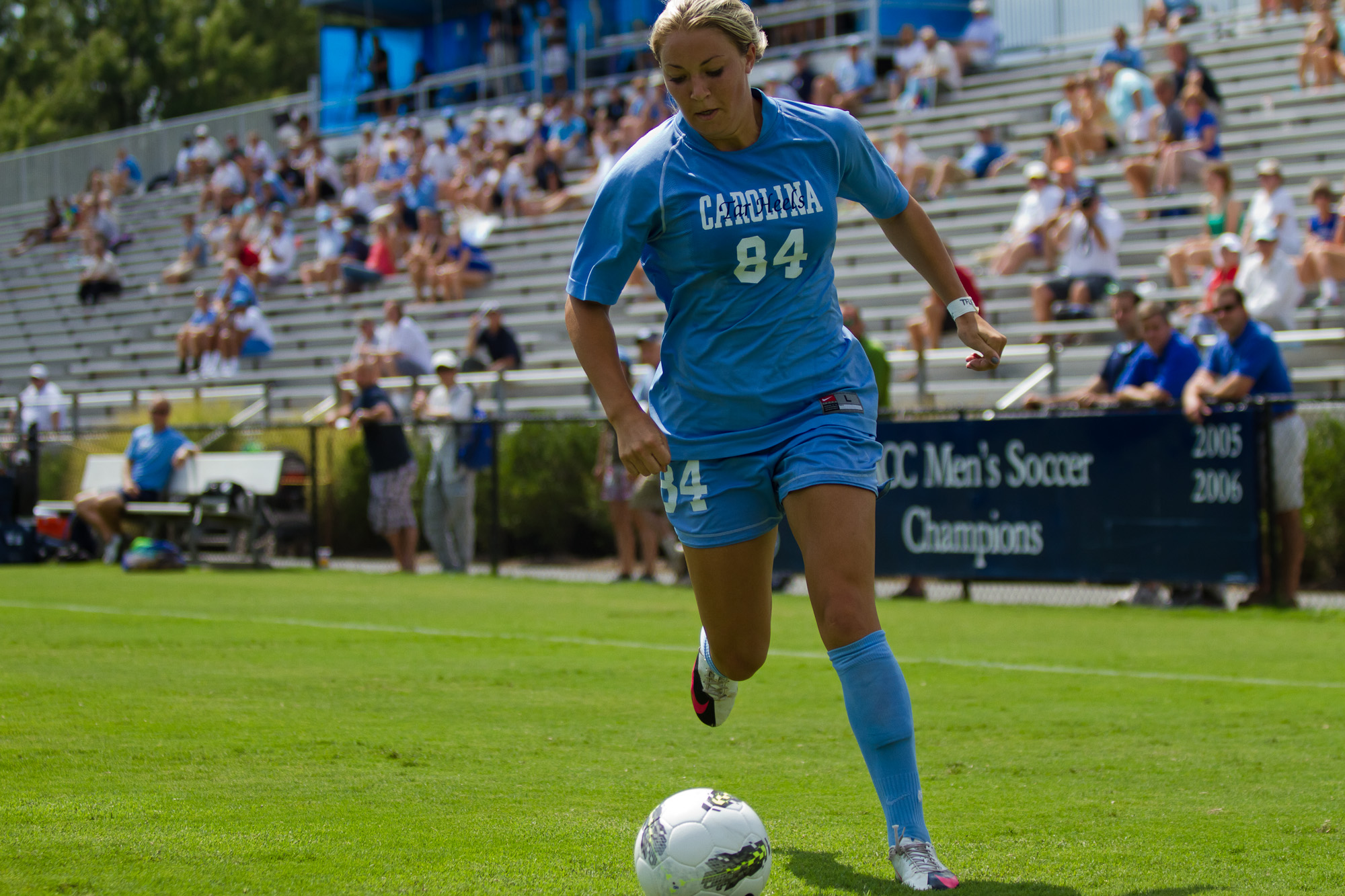
Top Gun - North Carolina's Courtney Jones Looks To Fire The Heels To Another Title in 2011
The ACC’s a rough jungle. Just ask the three dearly departed coaches who left their posts in the offseason, either on their own terms or booted out the door by hungry administrators, desperate for success. Virginia Tech’s Kelly Cagle was able to do the former, stepping away for family reasons but not before she had helped turn the Hokies into viable contenders in the cutthroat league. It was a no brainer to promote Charles “Chugger” Adair, the team’s associate head coach, to the lead chair. The message was clear with Cagle’s departure though: this league’s a pressure cooker that takes its toll on even the successful coaches.
The unsuccessful ones? Well, you just have to look towards Clemson for how that particular tale goes. The Tigers were jilted by Todd Bramble leaving for Alabama a few seasons ago and had a big decision to make for a replacement. They chose poorly. Hershey Strosberg, as you will read about below, was an unmitigated disaster after coming over from being an assistant at Virginia’s successful program. The team probably hired better with UNC Greensboro coach Eddie Radwanski, who made his name off of beating ACC schools with SoCon talent, but there’s no telling when Clemson will be contending for the postseason again in the league.
The postseason inevitably spelled the end of the line in Miami for Tricia Taliaferro. The former Illinois boss was the ACC Coach of the Year as recently as 2007 and had qualified for the NCAA Tournament in both 2007 and 2008 and had beaten North Carolina in 2009. But the Hurricanes had quite cruelly missed out on the eight-team ACC Tournament the past two seasons and had somewhat spuriously been left out of the NCAA Tournament because of that failure in all likelihood the past two seasons as well. Miami probably would’ve been NCAA Tournament bound had they been in any other conference in the country.
C’est la vie in the ACC. It’s cruel, it’s cutthroat, and at times, the degree of difficulty may not seem fair. But it’s also exciting as hell, competitive, and almost assuredly the nation’s top college soccer conference again this season. The league may have lost stars like Klingenberg, DaCosta, and Farrelly among others but still has shining lights like Dunn, Mewis, and McCarty to fall back on. And that’s not counting the new breed of talent coming in this season such as Jamia Fields (FSU), Kelly Cobb (Duke), and Morgan Brian (Virginia). Life is hard in the ACC, but we wouldn’t have it any other way.
(Teams listed in order of final RPI ranking of 2010.)
[In season annotations marked in brackets.]
If you’re reading this preview then you probably don’t need to be reminded of the might of the NORTH CAROLINA Tar Heels soccer program. There’s the twenty NCAA titles (along with 1 AIAW before the NCAA sponsored soccer). There’s the sheer and utter domination in the ACC, winning all but four league titles and all but three ACC Tournament titles. There are the legends who’ve all walked onto Fetzer Field in Carolina Blue. Heinrichs. Lilly. Hamm. Parlow. Fair. Whitehill. Tarpley. O’Reilly. Overbeck. There was the 2003 team that went 27-0-0 who many believe is the best team to have ever taken the field in a single season in NCAA play.
And at the center of it all is Anson Dorrance, a complicated, brilliant man about whom much has been written and about whom much is still to be written if recent seasons are any indication. Taking command of the North Carolina soccer program in 1979, Dorrance would lead the Tar Heels to four national titles from 1981-1984, racking up more titles than losses combined in those four seasons. After a surprising defeat in the title game to George Mason in 1985, Carolina would kick off a decade of dominance, winning six of eight league titles, six of seven conference tournament titles, and a stunning nine national titles in a row. Mixed into that incredible run was four straight undefeated seasons from 1986-1989 and three perfect seasons from 1991-1993.
It’s safe to say we’re never going to see such a run of dominance from any one team again, but Carolina has still reigned supreme in most seasons since. UNC still managed to win four out of five national titles from 1996-2000 before a two year national title drought in 2001 and 2002 (and they still reached the College Cup in each year). The season after the “perfect team” of 2003 would bring a real shock as a team that had gone undefeated in the regular season was eliminated by Santa Clara in the Sweet Sixteen. It was the earliest the team had ever exited the NCAA Tournament and the first time ever that UNC had not reached the College Cup.
The Heels would also be shot down in the Elite Eight the season after before regaining their crown in 2006 with another treble. 2007 brought another Sweet Sixteen exit, this time to Notre Dame, and four losses, the most in a single season in program history. But those grey skies would clear up over Chapel Hill in a hurry as the program won two more national titles in 2008 and 2009, giving UNC three titles in four years. The 2009 triumph must have been extra fulfilling considering the team had finished third in the league, the lowest ACC finish ever for the program.
But entering into 2010, Carolina, despite the #1 ranking in many polls, was a team in flux. Gone were names like Heath, Engen, Washington, Nogueira, Harris, and McDonald from the ranks, leaving massive questions all over the team. Making matters worse was how much of the team resembled a M*A*S*H unit for large parts of the season. Key players like influential midfielder Ali Hawkins missed large chunks of the season, while others were far from a hundred percent effective. Despite all the adversity, North Carolina was positively scintillating at the beginning of the 2010 season. A major showdown with Texas A&M; in the opener turned into a Carolina rout, and UNC won eight of their first nine, the only blip coming in a 2-2 draw with Stanford in a rematch of the 2009 College Cup final.
The team’s first loss came in the ACC opener against a motivated Boston College side, but UNC would rebound to win six in a row, including gutsy 1-0 triumphs over Virginia and Florida State. A 2-1 loss to Maryland was an eyebrow raiser though, and though UNC would wrap up another league title with wins over Duke and Wake Forest, there were suspicions that the Heels were far from bulletproof. Carolina would be stopped at the ACC Tournament after penalties by Wake Forest in the semi-finals, marking the first time that the program had ever failed to reach the ACC Tournament final in its history. Further concerns were raised in the NCAA Tournament second round when the Heels struggled with James Madison a little more than they would have liked.
It set up a Sweet Sixteen matchup with Notre Dame that had eerie parallels to the 2007 encounter, with the Heels hosting a criminally underseeded Irish side. What followed was a historic beating. Carolina gave up four goals, the most since November 16, 1980 against Harvard. The 4-1 defeat was the first time they had lost by multiple goals since the 1985 title game against George Mason, an unbelievable six hundred and seven matches ago. While the shockwaves over UNC’s untimely defeat resonated for quite some time in the college soccer world, most know that after such a loss the empire usually strikes back. Hard.
The goal as always for the Tar Heels is to be the last team standing come December, and unsurprisingly, they’ve got a team that has the potential to do just that. Carolina scored goals at a fairly ridiculous pace at times last season and could top themselves again this year with just about all the critical pieces from the frontline returning for duty for the Heels. Leading the charge this season for North Carolina up front should be senior Courtney Jones.
Jones busted onto the scene as a freshman in 2008 with a stunning thirteen goals, putting her in line for almost every rookie award in the nation as the Heels won a national title. A down season followed in 2009 with just six goals, though four of those strikes were match winners. Last season, as the surest thing up front, Jones roared to life once again with eleven goals to go with a very impressive fourteen assists as Jones turned into a top notch distributor to go along with her supreme scoring ways. Jones was a monster in ACC play with eight goals and six assists in league play. Like almost every Carolina forward, Jones has great pace but has exhibited some questionable shot selection in the past. Despite that, Jones is still a striker to be feared leading this lie and has a chance for fifteen goals and ten assists at least in her final season in Carolina blue.
She’ll be playing alongside perhaps the team’s next great striker in sophomore Kealia Ohai. Thought of as the top recruit in the country by some at one time, Ohai definitely lived up to expectations as a freshman with fourteen goals and nine assists in a dazzling debut for the Tar Heels. Finishing on top of the team in points with Jones, she also tied the senior with four game winning goals. Ohai’s finishing rate was also phenomenal as she scored on nearly a quarter of her shots taken and put sixty percent of her shots on frame. The sophomore has electric pace and is surely one of the quickest players in Division I, much to the chagrin of many opposing defenders. If Ohai can avoid a sophomore slump, she has the capacity to continue on her path towards being one of the program’s top attackers ever.
The big question is who fills the other slot for Dorrance at the top of the team’s 3-4-3 formation. The favorite on paper would certainly appear to be junior Alyssa Rich, who was a constant in the lineup over the first half of the season before becoming yet another victim of UNC’s injury curse last season. Rich had nineteen points in nine games before the maladies hit, and that dazzling form makes her a contender for a breakout season if she stays healthy. Rich did make it back later in the season but only for limited minutes and her scoring production sagged.
Depth could potentially be an issue for the Heels on the frontline though. The team lost Brittani Bartok late last season to a serious injury, and the senior to be is on the staff as an undergraduate assistant coach but won’t be on the playing field. Options off the bench include sophomore Elizabeth Burchenal, who struggled through injuries to post four goals and five assists in 2010, and senior Emmalie Pfankuch, a Swiss army knife on the pitch who can play many positions but who has only scored five goals in her Tar Heel career thus far.
While the starting frontline looks solid, the team has a whale of a task on its hand in reshaping the midfield after the losses of Meghan Klingenberg and Ali Hawkins to graduation. Klingenberg was a ceaseless source of energy on the left flank in her four seasons in Chapel Hill and saved much of her best for last as a senior. A terror in getting up and down the line, Klingenberg was a key part in helping the offense flow as she set up teammates in front of goal, collecting twelve assists last season in the process. The energetic Klingenberg was a fantastic defensive asset as well and could revert back to her left-back position she played at in the U.S. youth international setup as she edges closer to the full USWNT. Klingenberg will try to imbue some of her fighting spirit into the Heels this year as a member of the UNC coaching staff.
Also departing is center midfielder Ali Hawkins, who unfortunately endured a senior season marred by injuries. Called “one of the greatest leaders he’s ever coached” by Dorrance, Hawkins was the muscle in the middle that enabled the Heels to control the midfield so effectively. The California native was also a terror on set pieces who was limited to just three starts and thirteen appearances last year for UNC.
Klingenberg’s spot should be filled by another tenacious and tireless Tar Heel in the form of sophomore Crystal Dunn. The top freshman in America last season, Dunn’s season was nothing short of breathtaking. Making her college debut by helping completely erase Texas A&M;’s offense off the map in College Station, Dunn would continue to excel in every role Dorrance threw at her, whether it was leading the line defensively, showing off her tremendous workrate in midfield, or attacking the goal up front. A player with sizzling speed and unceasing drive, Dunn scored nine goals, added eight assists, and pulled down the ACC’s Defensive Player of the Year award as a freshman, an unheard of feat in the best soccer league in the country. The only dilemma now is what to do with one of the top weapons in college soccer. Dunn was tried out up front and on the left wing in the spring, and the latter is where she figures to end up, at least at the start of the new year.
The other wing is likely to be manned by Kelly McFarlane, a sophomore who surprisingly won the right winger job as a rookie last year late in the season and never let go down the stretch. McFarlane recorded a hatful of assists against Missouri and also assisted on Crystal Dunn’s winner against Virginia later in the season. McFarlane has even more potential to be tapped in all likelihood and could grow into a nice diamond in the rough finding for the Heels.
The favorite for the attacking midfield role for the Heels is Canadian junior Ranee Premji. Premji was almost exclusively a reserve in her first season in Chapel Hill but then blossomed into a starter last season and often played many, many minutes for the club, including all one hundred ten in the ACC Tournament semi-final against Wake Forest. Premji had four assists on the season and also showed a flair for the dramatic with the winner against Florida State. The main perceived weakness of the junior is Premji’s lack of size, which can be an issue in the air or in physical battles, though Dorrance seems quite happy to roll with Premji in midfield despite her small stature based on last year’s evidence.
The team’s more withdrawn center midfielder, junior Amber Brooks, has fewer size issues standing at 5’6″ and looks like this team’s veteran leader for the foreseeable future. A fixture in the U.S. U23 team in recent months and also capable on the backline or out wide, Brooks is the heartbeat of this Tar Heel team and plenty capable of scoring despite her withdrawn position. With seven goals last year and no degree of shyness when presented with an opportunity to shoot, Brooks is another key cog in the Tar Heel machine. Brooks’ most valuable asset this year might be her leadership abilities though, as there’s a bit of a vacuum in that department with Klingenberg and Hawkins departing.
Other returnees who are candidates for playing time in midfield include junior Maria Lubrano, who started twelve games in 2009 but who has missed two of the last three seasons through injury, and senior Rebecca Crabb, who went from team manager to key reserve last season, playing in twenty-four games off the bench in 2010. Added into UNC’s competitive cauldron in midfield this season is U.S. U17 international Kat Nigro, who also happens to be the two time reigning Gatorade State Player of the Year from Tennessee, as well as Canadian Teresa Anania, who can play in the center, out wide, or up top when on the pitch.
As anyone who watched last season’s heavy defeat to Notre Dame in the NCAA Tournament or even the loss to Maryland in ACC play can attest to, the defense had some rocky moments in 2010. Playing with three at the back can be an adventure at times though Carolina certainly has made it work for them over the past few decades. This unit was behind the 8-Ball for much of the season when Rachel Givan, one of the team’s best defenders, was another victim of the injury bug and missed over half the season. The team’s left-back for two seasons during the team’s national title triumphs, Givan’s absence was painfully apparent in the Tar Heel backline.
The star of the unit looks to be sophomore Meg Morris. Morris, tipped to be a superstar after some impressive performances in the U.S. youth international teams, didn’t quite reach the level of play that Dunn hit last year, but she still turned in a fine season despite missing a handful of games through injury in the middle of the season. Morris is as strong as an ox despite her 5’2″ frame and has a massive amount of upside to tap into this season.
On the right should be junior Megan Brigman who went from playing in just three matches as a freshman in 2009 to being a full-time starter last season. Brgiman’s a big target on set pieces but still quick as well and still has a lot of room to grow in her next two seasons in Chapel Hill. Junior Rachel Wood is the other main returnee in the back who missed all of 2009 for medical reasons before getting back in the mix last season as the team’s anchor in the middle of the defense. Obviously a threat to get on the end of set pieces thanks to being six feet tall, Wood’s shown tremendous heart in fighting through her health problems and should again be in contention for a starting spot on the backline.
The Heels also add in a pair of top defensive recruits in the form of Satara Murray and Taylor Ramirez. Murray comes into Chapel Hill with the reputation as a lockdown defender who could contend immediately for a starting spot in the back three. Murray was impressive in ECNL action for Lonestar SC and should at the very least provide great depth for the Heels in defense. Ramirez has gone from near obscurity to being one of the country’s most intriguing freshmen in very short order. As word about the Anaheim native who could leap like a gazelle made its way around soccer circles, it seemed like Dorrance and UNC had found a real gem, especially when Ramirez was called up to U18 and U20 camps in the summer. She’s still rough around the edges, but Ramirez could well develop into another great UNC defender.
Great defense also means great goalkeeping, and there are also questions in this department this year. Rolling with a freshman and a sophomore after the graduation of Ashlyn Harris, North Carolina certainly didn’t find themselves immune to the inevitable jitters of goalkeepers with little or no starting experience. Hannah Daly was the team’s designated starting keeper for much of the season and usually played a half in goal before giving way to Anna Sieloff. After starting twice as a freshman in 2009, Daly saw extended minutes in goal last season, and it was a case of the good (some spectacular saves), the bad (some wildly inconsistent moments), and the ugly (the Notre Dame game where she was lifted early for Sieloff after conceding softly).
The coaches will be hoping Daly can make a breakthrough and perform a little more consistently in between the pipes this season. [Note: Daly was knocked out for the season by injury after a few games of the 2011 season.] Sieloff was usually used in relief duty, though she did manage four starts for the Heels last year. She could’ve featured in more than fourteen matches had she not busted up her hand before the Miami game. Undaunted by the injury, the freshman keeper suited up as a field player instead and was actually not half bad in the reserve role. Sieloff did return in goal for much of the Notre Dame match, though it was far from a happy experience in the end. Back healthy again, Sieloff and Daly should battle again for the starting job in goal this year.
Senior Adelaide Gay, a transfer from Yale last year, saw action in six matches and figures to be in the mix if injuries strike any of UNC’s keepers this year. There’s a lot of raw potential in goal, no matter who’s donning the gloves for UNC, but the question is whether that potential can be converted to production when the pressure is most intense late in the season.
It’s a question that certainly applies to more than just the goalkeeping situation in Chapel Hill. There’s no doubting some of the star power with this UNC team, especially in the attack where the Heels could knock a small planet off its axis with the firepower available. Questions lingering everywhere but the frontline will need answers though if this team is to get back to the glory of 2008 and 2009. The Carolina mystique was dented a bit by the big loss at Fetzer Field to Notre Dame, something that can’t sit well with this UNC team. The Heels will get a shot at that revenge early this season in non-conference play, while the always brutal ACC promises to test this team further.
Inevitably, North Carolina is high on the shortlist of teams favored to get to Kennesaw and the College Cup and certainly has a very good shot of conquering all again and sitting on top of the mountain come the end of 2011. But it isn’t written into stone, and there are still plenty of issues and rivals that could yet extend the title drought in Chapel Hill to multiple seasons, a quite unpalatable thought to Dorrance and the UNC faithful.
It was a magical, frustrating, thrilling, and ultimately fulfilling type of year for Alison Foley’s BOSTON COLLEGE Eagles side in 2010. A crazy, up and down season ended up with BC in the College Cup, a destination the program has been aching to reach for years. The Eagles have been a program seemingly on the cusp of greatness for the longest time now. For a while, BC was nothing but a program in what looked like a deep slumber. After making every NCAA Tournament from 1982-1985, the Eagles didn’t make another appearance in the Big Dance until 1999, in the third year of Foley’s stint in charge. That season, Boston College would go from virtual unknowns to the Sweet Sixteen in a stunning turnaround.
The problem was that BC wasn’t performing on the biggest stage with any type of consistency. The team missed out on their ticket to the Big Dance in 2000 and 2002 while being bounced in the first round in both 2001 and 2003. But the Eagles’ brass’ patience began to bear fruit in 2004 as the program began a string of seven straight NCAA Tournament appearances. It was also the last season in the Big East for the Eagles who bowed out with another Sweet Sixteen appearance before moving to the ACC before the 2005 season. To the shock of few, it took a little while for the Eagles to acclimate to their new, much more difficult home, though the process perhaps didn’t take as long as some might have feared.
Foley had the Eagles nestled comfortably in mid-table in those early ACC years, though postseason success was limited to three Sweet Sixteen appearances. Just as some may have started wondering if the Eagles had plateaued, they began to turn the corner, ascending further up the national ranks. BC finished in a creditable third in the league in 2008 and picked up their first ACC Tournament victory as they reached the semi-finals before falling to North Carolina. The real progress would be seen in 2009 though, as the Eagles soared to a league title, remarkably, the first major trophy in program history. Their wings would be clipped just short of the College Cup though, as Foley’s side bowed out at the Elite Eight in their first trip to the national quarterfinals.
But with many of the same pieces returning for the 2010 campaign, hopes were even higher for the Eagles. They rose even higher throughout the first half of the season. A opening night draw with Stanford was a sign of things to come as BC brutalized the teams put in front of them, though you might accuse the Eagles of not exactly shying away from mid-majors. But there were still massively impressive wins, such as the 5-0 mauling of a Hofstra team that would turn out to be very good at the end of the year.
The true test would come in the crucible of the ACC though, and Boston College appeared to be in a good position to ace it after beating North Carolina in Chapel Hill in the league opener, 3-2. But after a perfunctory win over NC State, the Eagles suffered a staggering loss of form, losing four of their next five, with the only win coming over a hopeless Clemson team. BC plummeted down the polls and, more importantly, the ACC standings, to the point that with three matches left, some wondered if BC was even going to make the ACC Tournament at all! But the Eagles rounded into form at just the right time, beating Wake Forest and Miami (FL) to secure their spot in the postseason.
A payback win over Virginia, the club who had started the Eagles’ downward spiral must have felt good, though BC went out in the ACC Tournament semi-finals, again losing to Maryland. Nobody had much of a clue as to how the Eagles would fare in the Big Dance, but Foley’s squad battled past Boston University and Hofstra to reach the Sweet Sixteen for the third straight season. It was there that Boston College put on their best performance of the season, obliterating a very good West Virginia side to the tune of a 4-0 scoreline.
They’d meet a Cinderella Washington side in the Elite Eight and would be pushed to the limit but would prevail in extra time to send themselves to a first College Cup. Stanford awaited in a rematch of the season opener. But though they fought hard, they were ultimately outclassed by the Cardinal on the night and fell to a 2-0 defeat. The season may have ended, but the sense that these Eagles could be capable of something special hasn’t waned a bit.
A year on, Boston College will likely harbor aspirations of getting back to the College Cup and challenging for the program’s first national title. On its face, the Eagles would seem to have a decent shot, with all of the program’s “Big Three” returning from last year’s squad. But digging a little deeper, you begin to see that this BC team has some serious holes to fill if they’re to make it to Kennesaw in December. On paper at least, the midfield looks like the strength of this Boston College team. There, the Eagles are led by one of the brightest prospects in the college game today in junior Kristie Mewis.
A playmaker extraordinaire with all the measurables and a million dollar left foot, Mewis looks to be creeping closer and closer to a call-up to the full USWNT with two seasons left of college eligibility. Mewis was transcendent last season pulling the strings for BC with ten goals and fourteen assists, with five of those goals and three assists coming in league play. Mewis also led the league in shots, showing she’s not shy about pulling the trigger, and with her long-range shooting ability, why would she be? She’s a threat again to crack double digits in goals and assists and should be on the shortlist of Hermann Trophy contenders again.
Mewis’ teammates in the midfield aren’t half bad either. Senior Julia Bouchelle figures to play in a more withdrawn role in the middle of the park but still has the ability to score as her twelve goals combined in 2008 and 2009 show. Bouchelle’s scoring totals dipped last season to just two goals and three assists, but both of those goals were in the NCAA Tournament, showing the senior has a tendency to strike when it matters most. Despite not being too terribly big at 5’5″, Bouchelle is strong in the air and has great vision as well to help keep the BC offense ticking over.
Despite the return of both Mewis and Bouchelle, the Eagles must still replaced Amy Caldwell and Natalie Crutchfield from the starting lineup this year. An attacker capable of playing up top or in midfield, Caldwell started twenty-two games last year and saw her goals total rise every season of her college career, ending last year with a four goal, seven assist campaign to wrap up a nice career for the Eagles. Crutchfield had been a key reserve for three years until breaking out last year to start thirteen matches for the Eagles. She was never really a prolific scorer and only totaled one goal last year in fact, but Crutchfield’s veteran experience was invaluable to the run to the College Cup.
One contender to inherit a starting spot is a sophomore who already gained valuable starting experience last year in Patrice Vettori. Vettori started thirteen matches as a rookie, including eleven in a row at one point, and could feature prominently despite middling offensive production last year. Also in contention for time in the midfield are junior Alicia Blose and senior Marissa Mello, who both saw limited minutes off the bench last year for BC.
Up front for the Eagles, it’s all about the latest member of the DiMartino clan to take the college soccer world by storm, Victoria. Another seemingly in the frame for a future call-up to the USWNT, DiMartino came into the team with a fair share of hype behind her, having won the silver boot at the 2008 U17 World Cup for the U.S. DiMartino didn’t disappoint, being named ACC and Soccer America Freshman of the Year along with being named a NSCAA second team All-American after fourteen goals and six assists. DiMartino also came through with a nice encore last year with fourteen more goals along with eight assists to her name, including nine goals and five assists in a seven game run in the middle of the season. Another blessed with a magnificent left foot, DiMartino is simply one of the best forwards in America and a candidate for the Hermann Trophy once again. Keeping their top gun firing in pristine condition will be key if BC wants to return to the College Cup this year.
The team also has to replace departed forward Brooke Knowlton and her seven goals from a season ago. Knowlton led the team in game winning goals with four, including a stretch of three in a row in the middle of September. The New York native finished with twenty-nine goals for her career, good enough for fourth in program history. Senior Stephanie Wirth has been tipped to take a big step forward in her final season with BC, the senior having been one of the team’s top reserves for the past three seasons. Wirth had three goals and two assists off the bench last season and could post career bests in both categories should she get the starting nod this year.
There may also be opportunities up front for returning sophomore midfielders Gibby Wagner, a U.S. youth international who was one of the team’s top reserves last season, and Kate McCarthy, who was a key member of the team’s run to the College Cup, starting all five of the team’s NCAA Tournament games last year. There should also be room for some serious minutes for freshman starlet Stephanie McCaffrey, a recent call-up to the U.S. U20 team this summer who shined brightly for Stars of Massachusetts in ECNL action this year. With little settled in who will help partner DiMartino up top this year in attack, the young rookie could find herself in line for time in the starting lineup if she can impress early on.
The last member of the “Big Three” for Boston College is also the elder stateswoman of the group, goalkeeper Jillian Mastroianni. Mastroianni started last season with a bang in a ten save performance against Stanford and continued from there in another sparkling season. A starter between the pipes since she stepped foot on campus, Mastroianni is more than capable of taking over matches when she’s on top of her game and is unquestionably one of the top keepers in the country. Another great season between the pipes will likely see the BC keeper selected in the first half of the 2012 WPS Draft, and she could very well be a dark horse to watch in the battle for the starting goalkeeping job for the USWNT in the future.
The backups are sophomore Jessica Mickelson, who saw brief mop-up duty in two games last season, and true freshman Alexandra Johnson. It’s safe to say that we shouldn’t expect to see much of either in the lineup this year if all is going according to plan for the Eagles.
Part of that plan though is finding replacements for a pair of starting defenders in Hannah Cerrone and Chelsea Regan. A pitbull at full-back for the Eagles, Cerrone was a cult favorite and ended her career as the program’s all-time games played leader with ninety-one appearances, all of them starts. Impressively for a defender, Cerrone ended her career with twenty-three assists, good for fifth all-time in program history. But more than her offensive contributions, Cerrone was a warrior defensively, never afraid to put in a crunching tackle, sometimes to her own detriment as she was booked for her aggressive play on more than one occasion. Cerrone will go down as a club legend for another reason as well, having scored the golden goal against Washington that took the team to its first College Cup in her senior season.
A little less celebrated but no less important to BC’s cause was Regan, a solid and steady defender who started every match her last two seasons and slipped back into defense in 2010 after playing as a defensive midfielder a season before. Thankfully for Foley, she does get back a pair of strong performers from last season’s defense.
Captain Alyssa Pember has been a major part of the defense since her freshman season and has started for almost the entirety of her three seasons with the squad. Pember’s also good for the odd goal here and there and had a pair of strikes last season, with one against Clemson and the other against Hofstra at the start of the year. The other constant on the backline is another senior, Alaina Beyar. Beyar came into Boston College as a forward but was switched to defense after her freshman season and was a natural in the backline. Beyar averaged nearly eighty-seven minutes a match last season and may have only scored one goal last year, but she made it count: an equalizer against defending national champions North Carolina in ACC play. Pember and Beyar should lock down the left side of the pitch while also being capable of making surging runs forward if need be.
Sophomore Zoe Lombard, a big body in the back, really came into her own when pressed into duty in the NCAA Tournament, scoring against Hofstra in the process, and should be one of the favorites to seal a starting spot on the remade backline. Other returnees, Morgan Hiler and Jackie Vaccari could also be in line for increased minutes this season. The main hope though could be Pennsylvania native Casey Morrison, another gifted freshman who could make an immediate impact. A U17 international, Morrison comes in with the potential to become another great defender at a program that’s produced more than a few of them. Californian Mariah Winters is another rookie who could be slotted in for major minutes right off the bat after being tipped for big things following a fine club career out on the west coast.
The return of Mewis, DiMartino, and Mastroianni’s enough to make Boston College a threat again to defeat just about anyone that crosses their path in 2011. The trio could all feature in the USWNT in the future and have been simply sensational for BC in college and are a big reason for the Eagles’ rise into the national consciousness over the past few seasons. Around them though, things get a little dicier. The Eagles lose a whole lot of lesser known talent that nonetheless adds up to a lot of holes to fill at the beginning of the new campaign.
BC does bring in some great talent this year and has some more young blood waiting to prove themselves from last year’s class, but it remains to be seen as to whether the youngest members of this team are ready for primetime right now. Boston College certainly has the capacity to win a lot of games this year, but despite their goal of a national title, this group may yet find it a challenge to get back to Kennesaw for a chance at lifting the big prize.
You’d forgive MARYLAND Head Coach Brian Pensky for hoping for a reprieve from penalty shootouts for a while after 2010. In his sixth season in charge in College Park, Pensky managed to lead the Terps to eighteen wins, the second most in program history, but couldn’t lead UM to prevail in either of two shootouts that saw Maryland fall to Wake Forest in the ACC Tournament final and then Georgetown in the NCAA Tournament Second Round. Though it took a little while to get the ball rolling again in College Park, Pensky finally has Maryland looking like a true national contender again after two excellent seasons.
It hasn’t quite been so rosy for the Terps over the years in the ACC. Maryland were the league’s early punching bags, finishing on bottom in their first six seasons in the still embryonic ACC. In fact, Maryland wouldn’t win a single league game until that fateful seventh year in 1994 when they managed to escape the basement, although only just. Once out of that basement though, it was a quick ride to contender status and a few accomplished years on the national stage. April Heinrichs’ final season in charge in 1995 saw the Terps finish third in the league and reach the Elite Eight in the program’s very first NCAA Tournament appearance.
With Heinrichs gone to Virginia the following season, SMU Head Coach Alan Kirkup, fresh off a 23-1-1 season with the Mustangs, came in and kept the music going with another Elite Eight appearance. Kirkup only stayed for three seasons before moving to Arkansas though, and things were never quite the same in College Park after his fantastic first season.
Shannon Higgins-Cirovski took over, and the four-time national champion as a player with North Carolina made the NCAA Tournament in five of her six seasons but never rose above mid-table in the league after her first season and only advanced past the second round of the Big Dance in her final season at the helm. Maryland went the unconventional route in hiring their new coach, keeping it within the family. Sort of. Brian Pensky was an assistant with the Terps’ very successful men’s team but had never been a head coach at the collegiate level before, making the hiring somewhat risky. Pensky had had extensive experience as an assistant for successful women’s sides at Loyola (MD) and George Washington though, meaning he wasn’t a total neophyte.
It quickly became apparent though that Pensky had stepped into a large scale rebuilding job in College Park. Pensky’s arrival coincided with Maryland’s four year NCAA Tournament streak being snapped, and the Terps had to scramble to just make the ACC Tournament. Three years in the wilderness followed, with Maryland spending each season under .500 and likely leaving many wondering if Pensky’s hire hadn’t been a costly mistake. With momentum in the RPI going backwards from 2006-2008, it looked like Pensky faced a critical season going into 2009. At long last, the Terps came together into a well-oiled machine in the ACC.
Maryland went a perfect 8-0-0 in non-conference play, though there were still doubters with most of the wins coming against lesser sides, though the victory over Santa Clara was an eye opener. A tough opening draw in league play stymied much of that momentum though, with Maryland only winning one of their first four league matches. That one win, a 4-0 pasting of Duke, turned out to be a big one though, the catalyst for a six match unbeaten run with four wins that all but assured them of a spot in the NCAA Tournament for the first time since 2004. Defeats at the end of the regular season to Wake Forest and North Carolina dropped them to sixth in the league, but they still seemed dangerous quarry in the ACC Tournament.
Unfortunately, they drew a hungry Tar Heels team in the quarterfinals and were unceremoniously dumped out, 3-0. Maryland would get a third crack at UNC though, winning their regional by beating Monmouth and Washington State to earn another shot at the Heels in the Sweet Sixteen. The third encounter in 2009 was more akin to the regular season meeting, but Maryland still came up just a little short, falling to the eventual national champions by a 1-0 margin. The spectacular improvement had raised expectations going into 2010 though, and it was up to Pensky and the Terps to show that they were no one hit wonder.
Running the table in non-conference play was a good start, but wins over Missouri and Tennessee perhaps didn’t have as much heft as Maryland would have liked come the end of the season. There would be no more doubts as league play kicked into gear. The Terps drew with Duke and upset Virginia in the first weekend of ACC play before dropping a close decision on the road to Virginia Tech. From that point on, Pensky’s side would go on an absolute tear in the league, winning six of their last seven including topping Boston College and North Carolina on the road in addition to a home win over Florida State on the final weekend of the season.
It all added up to a second place finish in the league as Maryland finished level on points with Virginia and Florida State, two points behind champions North Carolina. It also made the Terps one of the hot favorites to pull an upset and lift the first major trophy in their history at the ACC Tournament. Maryland outlasted both Duke and Boston College in the first two rounds with 1-0 wins to earn their shot at history in the final with Wake Forest, who were also looking for their first major trophy. Despite taking a lead in the fifth minute, Maryland were pegged back about a quarter of an hour later. The match would remain even at 1-1 and head to penalties where the Terps would be unlucky, falling to the Demon Deacons and a brilliant performance by Wake keeper Aubrey Bledsoe.
Despite the disappointment in the tournament final, Maryland was rewarded for their excellent regular season with a #1 seed in the NCAA Tournament. The Terps would roll right over High Point in the first round before meeting up with local rivals Georgetown in a tasty derby in round two. Amazingly, it was the first time in the history of the two programs that they had met for a competitive fixture. UM would find the Hoyas to be more than their equal on the afternoon, the Terps only managing two shots on goal in a physical affair, not helped by much of the Maryland squad, including many starters, struggling with a stomach virus. After a 1-1 draw through one hundred ten minutes, the match went to penalties, where Pensky’s side would emerge second best again, providing a shocking end to what had been a brilliant season up to that point.
Though obviously a bit shellshocked from the upset exit at the hands of Georgetown in the second round of the NCAA Tournament, Maryland had succeeded in showing they weren’t just a relative flash in the pan. Now the challenge is in recovering from that stinging ouster by the Hoyas to push on towards contending on all fronts. Pensky will have an experienced, explosive offense with which to work with this season. Up front, the focus is likely to be on 5’1″ senior lightning bolt Jasmyne Spencer, a Fourth Team All-American last season.
Not recruited by the big guns out of high school, Spencer has blossomed into one of the country’s most dangerous forwards heading into her senior year with the Terps. With twenty goals and ten assists combined over the past two seasons, it’s safe to say that stopping Spencer will be first and foremost in the gameplan of many an opponent this season. Spencer tied for the team lead with ten goals last season and led the team in ACC points with ten and could very easily lead the Terps from the front again this year.
Partnering her up front should be another player who wasn’t recruited by powerhouses out of high school in fellow senior Ashley Grove. Grove has been a rising force in the ACC over the course of the last three seasons and looks set for a potentially fantastic finale in College Park this year. The Rochester, New York product has seen her points total increase in each of her three collegiate seasons so far, and her nine goals and six assists last season may be topped by this year’s haul with the partnership with Spencer looking like a very fruitful one.
There are plenty of options available to Pensky off the bench as well, as it looks like Maryland may have one of the deepest striking corps in the country. Many eyes will undoubtedly be focused on senior Sade Ayinde, one of the most potentially intriguing players in the 2012 WPS Draft. Ayinde was a shock inclusion in U20 coach Jill Ellis’ initial roster for the U20 World Cup last year and showed why she had made the cut before being ruled out by injury during the 2010 season. The veteran led the Terps in scoring with ten goals and eight assists, quite remarkable when you consider that Ayinde missed three matches and didn’t start a single game for Maryland!
A converted center-back with no small degree of brute strength and a cannon of a shot that makes her a threat on set pieces, Ayinde has the potential to become an intimidating X-Factor off the bench for the Terps this year. Just ask North Carolina who were done in by a pair of late Ayinde goals off the bench in the regular season last year. It remains to be seen though whether Ayinde will slot into her super sub role again this year or if she’ll find herself in the starting lineup immediately for UM.
Pensky’s side is also boosted by a big group of transfers who could all come in and immediately be factors for the Terps. Hayley Brock looked like a big time prospect when she signed with Penn State coming out of high school and had been a member of the U.S. U17 World Cup team of 2008. The Acton, Massachusetts native enjoyed a fairly successful freshman season with the Nitany Lions, tallying six goals and three assists, including assists in both of Penn State’s NCAA Tournament games last year. Picking her up looks like a major coup for Pensky, and the sophomore could be in the mix for a starting spot for Maryland sooner rather than later.
Another sophomore transfer who looks set to make waves early on in her Terrapin career is ex-UNC Greensboro attacker Kristen Schmidbauer. Schmidbauer was the lead gun on an explosive Greensboro team last year with ten goals and six assists to help UNCG’s cause in a double winning season. The sophomore looked like becoming a contender for one of the SoCon’s top players but decided to leave the program after the coaching change following the 2010 season. The step up in class to the ACC is a big one, but Schmidbauer certainly has enough talent to be a contributor, even if it is as key reserve while she acclimates to her tougher surroundings.
A third transfer, Alex Reed of Loyola (MD) will likely battle it out with some of the freshmen for what remaining minutes are available this season. Cory Ryan, Alex Doody, and Marisa Kresge all come into College Park highly regarded, though the road to immediate playing time is a difficult one. Ryan is a dangerous 1v1 player with great crossing ability, while Kresge comes touted with a hammer of a shot in her arsenal. But with plenty of talent on hand at Maryland already, the freshmen may find opportunities for expansive playing time at a premium. A wild card in the mix is senior Annesia Faulkner, who has missed the past two seasons through injury but who has shown offensive skill before, leading the team in assists with six in 2008. Faulkner might also see time in the backline, seeing as how the frontline is stacked with talent.
The midfield is led by tenacious junior Domenica Hodak. A snappy defensive midfielder who really began to come into her own last season, Hodak is a tough tackling player in the center of midfield who helps balance out the Terps’ strong attacking instincts going forward. Though she’s hardly a threat in front of goal, Hodak nonetheless remains an important ingredient in how Maryland operates. The rest of the midfield returns mostly intact, with the sole big loss being that of Molly Dreska. After an injury plagued first half of her collegiate career, Dreska blossomed into a big contributor for the Terps in her junior and senior seasons. Dreska started every match for UM last year and nabbed game winning goals against Clemson and Duke last season.
Returning junior midfielder Danielle Hubka is quickly turning into one of the league’s better midfielders and was consistently excellent for Maryland once more last year. An option off the bench at the beginning of the season, Hubka still found a way to make an impact with the game winning goal against Virginia in ACC play. Hubka also scored the winning goal in the ACC Tournament semi-final against Boston College and could also see time up front his year as one of the club’s most versatile attackers.
There are a slew of contenders for the starting spot vacated by Dreska. The early favorite could be towering senior Amy O’Sullivan, who went from reserve in her first two seasons in College Park, to part-time starter last season for the Terps. The tireless O’Sullivan, a big target for set pieces, scored a pair of goals and added a pair of assists last season in twelve starts and will be looking to build on her breakthrough in her senior season. Other contenders include junior Olivia Wagner, a key reserve last season who was third in team assists with six despite not starting a single match, and utility midfielder Becky Kaplan, another key reserve with great pace who played a key role off the bench in 2008 and 2009 who redshirted last season. Schmidbauer, Ryan, and Doody are also capable of playing in midfield, giving Pensky a whole lot of flexibility and options in attack.
While it looks like Maryland’s offense may be able to call upon limitless reserves in depth this season, the defense could be another story entirely. Gone from the backline are a pair of proven starters, including the team’s best defender in Caitlin McDowell. McDowell leaves the Maryland program as the school’s third leading assister in program history after dishing out twelve last year, the second best single season mark in program history. Pensky’s decision to move McDowell to left-back after three years of playing in the midfield proved to be an absolute masterstroke, as the senior thrived at her new position and also put up five of those twelve assists in league play.
Also gone is massive defender Colleen Deegan who stepped up into a major role in defense after barely playing her first two seasons in College Park and being one of the top reserves as a junior. Deegan blossomed last year in her new starting role on the backline and had a very memorable goal, scoring the match winning header against Boston College in the dying seconds of their regular season encounter.
The most sure thing returning for Maryland in defense this season looks to be senior Mallory Baker. A player who has struggled with injury throughout her career, Baker finally looks to be healthy and has been a key cog in the back over the past two seasons. Though she’s not a great threat in front of goal, Baker’s leadership will be crucial as Pensky tries to craft a cohesive backline this season.
The solution to the team’s left-back vacancy could be midfielder and former U.S. U18 international Lydia Hastings who returns, hoping for a little more consistency in what has been an up and down career thus far in College Park. After an impressive freshman season in 2008 that saw her tally fourteen points in eighteen matches, Hastings moved back to midfield from forward and was held without a goal in a frustrating sophomore season. Hastings got back on the scoresheet last season though with four goals and four assists while starting all but one match for the Terps and figures to be an important piece of the puzzle in defense this year as a marauding full-back.
Also likely to start is another senior, Skyy Anderson, who Pensky will be hoping to keep the off the training table this season after the Cambridge, Massachusetts product has missed chunks of the past two seasons through injury. Anderson showed what she was capable of when healthy though with four assists in seventeen matches and could slot in at either center-back or right-back. Odds are that given the losses to the Maryland defense, the Terps will need more than ten starts out of her if this season is to be a success. Also likely to lock down a starting spot in defense this year is junior Megan Gibbons.
After being a seldom used sub in her freshman year, Gibbons saw much more action last year in the back for the Terps. The junior full-back, who had four assists last season, also saw time as a winger for Maryland last year, but considering the Terps’ likely paucity in defensive depth this year, it seems more likely she’ll be deployed in defense in 2011. One to watch is freshman Shade Pratt, a local product from Germantown who has buckets and buckets of pace and also ran track in high school. She could be fighting to make her way into a deep midfield rotation, but her sheer speed makes her an intriguing option off the bench to run at tired legs from a full-back spot.
The battle for remaining minutes will likely be between Purdue transfer Remi Kriz and freshman Amanda Gerlitz. Kriz started eleven matches for the Boilermakers in 2009 at both defender and forward but did not play at all last season and could be rusty going into the new season. Gerlitz is a highly touted newcomer who figures to slot in at full-back for Maryland this season. The freshman is capable going forward but also tenacious and tough in the tackle and figures to make an impact sooner rather than later for the Terps on defense. Senior Kristen McAfee and junior Bailey Bodell could also find themselves in the rotation this year.
Maryland’s situation in goal also bears some watching this year. Presumptive starter Yewande Balogun has certainly enjoyed a star-crossed career thus far at Maryland. The senior came into College Park as one of the very top goalkeeping recruits in the country and was a U20 international as of her freshman season in 2007. But she soon lost her job to Mary Casey and was relegated to a backup role in 2008 before redshirting in 2009. With Casey graduating in 2010, Balogun won the job back and made her first start since early 2008 against Iona.
Lightly tested throughout most of the non-conference season thanks to a stout defense in front of her, Balogun nonetheless was strong in goal for the Terps. Balogun also showed off her tremendous kicking ability against North Carolina, drilling a monster goal kick over the UNC back line, letting Ayinde run onto it and score the tying goal, giving the keeper an assist in the process. Balogun also came up big in the ACC Tournament, winning ACC All-Tournament Team honors after two clean sheets to help lead the Terps in to the final.
While it does appear that Balogun’s career arc is back on the up as she enters her final season, she faces a stern challenge from within this season in the form of true freshman Rachelle Beanlands. Beanlands is one of the rapidly rising young stars in Canadian soccer and rose out of nearly nowhere to win a spot as an alternate on Canada’s 2010 World Cup squad. The multi-talented freshman has also competed in cross country, Nordic skiing, and track and field in her youth and is looked upon as a potential future #1 in the Canadian goal.
Beanlands clearly looks to be the future in goal for Maryland, but is she also the present? The young Canadian could very well push Balogun to the limit for the starting spot, and the veteran could very well be looking over her shoulder in the early weeks of the season. Then again, Beanlands could be busy with international duty as a hopeful for Canada’s U20 World Cup qualifying effort and might be in for a redshirt season. If that’s the case, understudy duties likely fall to sophomore Shannon Zickler, who only saw fourteen minutes of action in one match last year.
After a campaign filled with giddy highs that unfortunately ended on a rather sour note, Maryland will be looking to make a bigger impact in the NCAA Tournament. Some questioned as to whether the Terps really merited a #1 seed last season, and UM likely felt the burn of adding fuel to the critics’ fire with their early exit. If anything though, that second round defeat will be enough incentive for Maryland to once again rise up the ACC ranks and earn another shot at a long run in November and December. The offense certainly looks up to the task with a prolific, deep set of forwards and midfielders ready to light up opposing defenses far and wide. The combo of Spencer, Grove, and Ayinde could be one of the country’s deadliest, and the options off the bench don’t look half bad either.
But there are more than a few worries on the other side of the ball. There aren’t any star figures on defense and the team as a whole looks to be lacking a great deal of depth in the rearguard. Injuries or underperformance from that group could very well scuttle a promising season, meaning strong play in goal from either Balogun or Beanlands will be vital. With the questions in defense balancing out the powerful offense, Maryland’s likely looking at another top-half finish in the ACC, though troubling the title hopefuls looks like a stretch. They should have a chance to progress past the second round of the NCAA Tournament, going at least one better than last year, but further progress may be difficult to come by.
Some supporters may have expected it to have taken a few seasons for VIRGINIA to truly rise to elite status when Steve Swanson took over from April Heinrichs at the turn of the millennium. Those supporters probably didn’t expect to still be waiting over a decade later. It’s been an all too familiar tune in Charlottesville over the past eleven years of Swanson’s reign. The Cavs have often thrilled with slick, passing football and a smothering defense in the regular season but have also fallen flat on their faces in the postseason just as it seemed they were ready to make the leap towards the College Cup. The Wahoos celebrated their lone trip to college soccer’s Final Four way back in 1991 during Lauren Gregg’s tenure with the club.
Some twenty years and two more coaches later, and Virginia is still looking to return to college soccer’s showpiece event. Swanson lit a fire under the program after arriving in 2000, and in his second season in charge, Swanson had UVA in the Elite Eight for the first time since 1992. The Cavs would narrowly fall to Santa Clara that season and would slide backwards over the course of the next few seasons. As you might imagine, claiming major trophies in a league you share with North Carolina isn’t an easy task, which made Virginia’s first, the ACC Tournament title in 2004, so special. The Cavs would be bounced from the Big Dance early though that season, marking the second straight year the program had failed to escape regional play.
2005 would be quite the rebound year for Virginia though as the Wahoos finished second in the league behind UNC and made their deepest run in the NCAA Tournament in a while. After disposing of Cal State Fullerton in the Sweet Sixteen, Virginia would have a chance to get back to the College Cup but ran headlong into frequent nemesis UCLA and were beaten soundly, 5-0. It’s been a battle with heightened expectations since then as Virginia has repeatedly failed to get over the hump. Entering into last season, the Cavs hadn’t been title threats in the ACC for a while, usually good enough for the top half of the league but seldom challenging the order at the peak of the league.
2009 had been a small nightmare though, as UVA had slipped all the way to a tie for sixth in the notoriously difficult league. More worrying was the team’s overall lack of progress in the NCAA Tournament despite having some undeniably talented teams. From 2006-2009, the Cavs would continually be tripped up in the Sweet Sixteen, twice by Pac-10 nemesis UCLA and once by ACC rivals Duke in 2008 in an especially disappointing loss considering UVA had handled the Blue Devils with reasonable ease in the regular season. Hope sprang eternal once again in Charlottesville in 2010 though with a senior laden squad returning for the new season and what looked like a wide open race for the ACC title.
There was the belief that, finally, 2010 could be the season the Cavs broke through and returned to the College Cup. Virginia started out the season on fire, blitzing many overmatched teams while also recording a draw with Penn State away in a rematch of 2009′s infamous NCAA Tournament encounter. More impressive was a stretch that saw the Cavs rip through Texas and Boston University, winning 4-0 and 3-0 respectively against their talented opponents. Just as Virginia seemed to be rolling right into ACC play though, Swanson’s side hit a big speed bump with a loss on the road to West Virginia. The setback might have lingered a bit with the Cavs who then lost two of their first four in league play with close defeats to Maryland and North Carolina.
UVA would charge down the stretch though, going 5-0-1 in their final six matches in the league to finish in a three-way tie for second place, two points behind champions UNC. There’d be ACC Tournament disappointment though as the Cavs came up against a dangerous Boston College team in the quarterfinals and fell to the Eagles, 1-0. Which meant nothing going into the NCAA Tournament in all honesty. Virginia still looked to have a squad that could have made plenty of noise in the Big Dance. Swanson’s team looked to be a real serious threat to the normal order of things after two rounds as well. After a reasonably easy win over minnows Lehigh, Virginia impressed in powering right past SEC Tournament runners-up South Carolina in a 3-0 victory.
With upsets reigning supreme around the bracket, the Cavs looked like they had a straight shot into the College Cup, especially with a mercurial and untested Ohio State coming to town. But Virginia would be caught flat and were unfathomably down by three goals at the hour mark to the Buckeyes. The Cavs would fight back doggedly in the final half-hour to drag it back to 3-2 but could not find an equalizer. It was a stunning defeat and one that arguably ranked right up there with the most devastating losses in program history considering the stakes involved.
For better or for worse, the end of 2010 also effectively marked the end of an era for Virginia who enter the new season being slammed by graduation of no fewer than five starters. The offense in particular takes some major hits, including the loss of three players currently plying their trade in the WPS. The biggest of which is undoubtedly midfield superstar Sinead Farrelly. Farrelly, the second overall pick in January’s WPS Draft, made a habit of ripping teams up as an attacking midfielder for the Cavs. The U.S. U23 international really started to breakout as a junior with eight goals and eight assists but saved her best for her senior season in which she hit double digits in goals for the first time with twelve tallies and added seven assists as well.
The UVA midfielder finished fifth in the league in ACC points with fourteen and nabbed five game winning goals, second on the team. The all-action midfielder nabbed ACC Offensive Player of the Year and First Team All-America honors in her senior season, and her loss cannot be understated for this Virginia team. In addition to the flair and style of Farrelly, the team also loses the rest of its starting midfield with the departures of Colleen Flanagan and Lindsey Miller. An unflinching defensive midfielder who played much bigger than her size, Flanagan was hardly shy about putting in a hard tackle or two for the cause and was a three year starter in Charlottesville.
A U.S. U23 international, Flanagan signed a free agent contract with the WPS’ Atlanta Beat in the offseason. The third midfielder to depart is Lindsey Miller who, like Flanagan, seldom saw her contributions show up in the final box score, but was nonetheless an invaluable contributor to the Virginia cause. Miller spent much of her sophomore and junior seasons as one of the Cavaliers’ key reserves before stepping up into a full-time starting role last season. Miller made the most of her new starting role, tallying career highs in goals (three) and points (eight) in her senior year.
Filling all those gaps will unsurprisingly be at the top of Swanson’s to-do list in preseason camp, and he might just have the tools on hand to do it. Of the returnees, junior Julia Roberts could be best prepared to take a big step forward and contend for a starring role in Virginia’s midfield this year. Roberts came into Charlottesville as one of the top recruits in the country but has struggled in part to live up to those lofty expectations. Roberts actually lost her starting job last season but may have been better off in a sense as she saw her production increase in a super sub role. Roberts scored five goals in her sophomore season, good enough for fourth on the team and second among returnees. The Frederick, Maryland native will be expected to step up into a starting role this season and finally cash in on her vast potential.
Key reserves this season for Virginia include Kate Norbo and Amber Fry who both saw time in the rotation for almost all of last season. There could also be increased minutes for sophomore Shasta Fisher, a utility player who could also see time in defense after playing in eleven matches off the bench last year as a rookie. While the returnees all figure to play a part, Virginia’s new crop of talent may quickly rise to the top of the heap.
The very top of that heap could soon be occupied by the crown jewel of Virginia’s recruiting class, Morgan Brian. Seemingly the “next big thing” in U.S. Soccer for a little less than an eternity, Brian is a newly minted U20 international and tipped to rise even higher in the coming months. A veteran of the 2008 U17 World Cup and the doomed 2010 U17 World Cup hopefuls, Brian is one of the most promising center midfielders to emerge from the youth ranks in years and will certainly be involved in the U.S. U20 World Cup effort in 2012.
A dangerous predator both roaming forward and attacking goal or picking out teammates with slide rule passes, Brian has displayed tremendous skill with both country and her Ponte Vedra Storm club side. Originally committed to Georgia, Brian reneged with the Spring 2010 coaching change in Athens and set her sights on Charlottesville. Virginia fans will be hoping for the evolutionary version of Farrelly, but Brian’s upside could be even higher than the departed All-American’s.
Yet another standout midfielder coming to Charlottesville in 2011 is New Jersey native Danielle Colaprico. Colaprico has enjoyed playmaker responsibilities at club and high school level but is also more than capable as a goalscorer with a fearsome and accurate shot. With Virginia also needing some punch up front, Colaprico may be one of the many players tried out on the frontline this season.
The parade of freshman riches doesn’t quite end there though as Swanson also brings in Rye, New York’s Lia Bellizzi, a flying winger who could inject some electricity into Virginia’s attack. Though she was utilized as a bombs away full-back at times at club level, Bellizzi, with her silky dribbling and attacking instincts, figures to be deployed as a wing forward or attacking midfielder capable of slashing through defenses. It’s fairly obvious that Virginia has enough midfield talent to stock the starting lineups of two teams, but the group on the whole is largely ungelled and will need time to come together as a cohesive unit. Whether any of this legion of attacking stars will be willing to do the dirty work in the middle that Flanagan did is another question that will have to be answered. In a few years this unit could be one of the best in America, but they could go through some growing pains this year even if they put together some moments of magic.
Some of that magic may be needed up front with the loss of leading striker Meghan Lenczyk. A big, powerful target forward, Lenczyk was capable of frustrating and dazzling in equal measure in her time in Charlottesville. Though she was able to catch fire and turn into a scoring machine at times (see her run of four straight match winning goals in 2008 as a sophomore), Lenczyk was also prone to fits of inconsistency that were enough to have many supporters tearing their hair out. The big striker was able to tame some of her inconsistent ways in 2010 though and responded with her best season in front of goal, scoring twelve times and adding six assists as well. Half of Lenczyk’s goals were match winners, and she managed five goals in the always difficult ACC. Lenczyk was a draft pick of the WPS’ Atlanta Beat in January, and despite her sometimes erratic ways, will be difficult to replace.
In reality, Virginia looks to have a lot of solid #2 options up front with the Cavs desperately hoping that one can make the leap forward, turning into the top scoring threat the team loses with Lenczyk gone. The leading option for such a role may come in the form of senior Lauren Alwine. A three-year starter in Charlottesville, Alwine currently looks on track to break the school’s all-time assists record this year, quite the feat considering some of the names that have passed through UVA over the years.
A U.S. U20 international, Alwine burst onto the scene as a freshman in 2008 with six goals and fourteen assists, a single season record for the Cavs. Alwine’s been consistently excellent in setting up her teammates since then and hit double digits in assists with ten last season despite missing roughly a third of the league season. The one point of worry is that Alwine’s goal total dipped down to four, and that the senior may be a lot more suited to setting up a prime scorer than becoming one herself. It’s a situation that bears watching, but Alwine figures to be heavily involved in the offense, even if she isn’t the team’s #1 scoring option.
Another in a position to shoot for that spot as a top scoring option is junior Erica Hollenberg who had a bit of a star turn in ACC play last season. Hollenberg’s three goals and three assists last season all came in league action, and she ended up starting seven of the Cavs’ ten conference games. If Hollenberg can carry that form over into 2011, she has every chance of featuring in UVA’s starting lineup, either up top or in one of the midfield slots.
One of the most intriguing options for Swanson’s Cavs this season could be sophomore Gloria Douglas, a U.S. U18 international and strong performer in her freshman season in Charlottesville. Despite just starting one match for Virginia in 2010, Douglas finished third on the team in goals with seven. More impressively, four of those goals came in ACC play, and her All-ACC Freshman Team honor was well deserved. If she can avoid a sophomore slump, she might be the answer to Virginia’s offensive questions up front.
Another to keep an eye on is junior Caroline Miller who scored six goals and had six assists as a freshman in 2009 but would miss seven matches in 2010 in league play and saw her production dip to four goals and two assists. A rebound year could see her emerge as a valuable cog in the offense. Another of Virginia’s top new freshmen will also compete for a starting spot early on, with Brian’s Ponte Vedra teammate Kaili Torres set to make an impact. Another of the 2010 U17 World Cup Qualifying veterans, Torres is a bit unique in that she was initially playing for Puerto Rico’s U17 side before getting noticed and making the switch to the U.S. Torres played on the right side of midfield with the U.S. U17 team but could make more of an impact up top with Virginia this season as a center forward or wing forward. Bellizzi and Colaprico should also be in the mix up front as well if they aren’t locking down minutes in the midfield for the Cavs in their freshman season.
With the litany of changes in offense for Virginia, perhaps it’s a good thing that the defense looks a good ways more settled going into the new season. The only starting loss for the Cavs is Kika Toulouse, a two-year starter who made a successful step up into the starting lineup as a junior after two seasons as a dependable reserve. Not flashy in the least, Toulouse was again a full-time starter for UVA last year and got a call into the U.S. U23 team after the conclusion of the 2010 campaign.
Also among the U23 call-ups after the 2010 season was junior Morgan Stith. Despite not seeing her name in the headlines as often as some of the other big name defenders in the ACC, Stith has seen her star rise exponentially over the course of the last calendar year, and the Montclair, New Jersey native seems now to be firmly entrenched in the U23 setup. Stith started every match as a freshman in 2009 and almost repeated the feat in 2010, starting nineteen of Virginia’s matches last year. Stith doesn’t seem likely to fill up the scoresheet any time soon (zero points in two seasons), but she is a strong defender whose great work for the Cavs’ stalwart defense hasn’t gone unnoticed. With Toulouse’s graduation, Stith looks like one of the team’s new leaders in defense.
Another returning starter in defense is the muscle of the group in senior Maggie Kistner, the tallest starting defender at 5’8″. A U.S. U17 international, Kistner broke into the starting lineup on a full-time basis in 2009 and hasn’t really looked back. She did miss three matches last season though, and considering the general lack of depth in the rearguard corps this year, her presence at the back will be needed desperately. The last returning starter to this year’s team from the defense is junior Emily Carrollo. Carrollo is another player who, after flirting with a full-time starting position in 2009, stepped up to claim a starting job in 2010 for the Cavs. Carrollo played in every game as a sophomore and started nineteen of them and should be set for more starting duty once more this season.
Sophomore Molly Menchel, a versatile player capable of playing just about anywhere on the pitch, also figures to see serious minutes, as a reserve at the very least, after appearing in every match for the Cavs last season. Virginia may also turn to another one of their top reserves who has been on the brink of sealing a starting spot for a few years now in senior Amanda Fancher. A starter in thirteen matches a few years ago, Fancher saw her starting assignments drop last year to seven, but the senior also may have been the team’s most effective offensive threat on the backline with four assists. Fancher has a lot of potential having been named the W-League’s Defender of the Year this past summer with the Ottawa Fury. To wit, the rest of the Virginia starting defense combined for just two goals and three assists last season.
If Fancher or one of the others can’t make the step up to full-time starter, Olivia Brannon figures to get one of the first looks at a starting role. A Michigan native with size and pace, Brannon is one of this class’ top players and will be fighting right alongside Brian and many of the other freshmen for a starting spot. Brannon was the 2010-11 Gatorade State Player of the Year for Michigan and figures to also get a look at midfielder. This group is very much a “safety first” unit though, and any offense at all from the starting four, whoever they may be, would be seen as a real bonus. Toulouse’s loss hurts, but the return of the bulk of the starters should see any decline as minimal, though depth isn’t as strong as in many other areas on the team.
There are no questions in goal for the Cavs in 2010 though, where senior Chantel Jones will be the undisputed leading lady for UVA. A representative of the U.S. at nearly every youth international level in her career thus far, Jones is coming off a junior year in which she was named a Fourth Team All-American for Virginia. If Jones seems like she’s been around forever in the college game, it’s because she kind of has been, having redshirted in 2006 and been away on U20 World Cup duty in 2008.
Despite only having played three seasons so far, Jones is already the club’s all-time leader in career shutouts and will be looking to impress WPS scouts in what looks like a loaded class of potential professional goalkeepers. A big keeper capable of making some stunning saves, Jones needs a more consistent kicking game and some better decision making to fully stamp her place as one of the the nation’s top senior goalkeeping prospects but certainly has the potential to make those strides in her final season with Virginia. Jones figures to see almost all of the minutes in goal this year with her collection of backups highly inexperienced. The second option that Swanson hopes not to have to use this year is likely sophomore Danielle DeLisle who made one start last season and appeared in three matches but only totaled forty-one minutes in those appearances.
Someone with a glass half-empty mindset might see Virginia in the midst of a bit of a rebuilding project in 2011 after some serious losses to the lineup including multiple players now playing professionally. But after yet another frustrating postseason implosion, some might also see the Cavs’ in dire need of the shakeup that will be in the cards with the new cache of talented recruits making their way to Charlottesville this season. There’s no doubt that Virginia’s talented newcomers will get their goals, it’s just a matter of when and not if. But learning on the job in a league as tough and unforgiving as the ACC isn’t a formula without frustration, and the Cavs figure to take their knocks at times this season.
Indeed, with all the new hands in midfield and up front, Virginia may be heavily dependent on the form of Jones and the backline in front of her to keep them in many a game this Fall. Inevitably, it means that while the Cavs could claim a few scalps of bigger teams this year, eclipsing last season’s upper mid-table finish in the ACC and Sweet Sixteen NCAA Tournament appearance could be a very big ask.
Oh, FLORIDA STATE, where do we even begin when trying to describe their 2010 season? Ironically, the fact that the Seminoles made it to the Elite Eight last year might be the least remembered aspect of FSU’s season in the minds of most. It wasn’t always this way in Tallahassee. The team in Garnet and Gold were ACC makeweights for much of their early history, finishing bottom of the league in their first three seasons in the conference. The Noles really didn’t start breaking through into unchartered territory until the turn of the millennium as they slowly climbed the rigorous ACC ladder. Their first forays into the NCAA Tournament in the early part of the decade were fruitful, with a couple of Sweet Sixteens before breaking through with the club’s first College Cup trip in 2003.
But current Head Coach Mark Krikorian inherited a team somewhat in flux after a shocking elimination in the first round of the NCAA Tournament in 2004. The Noles were still looking for a way to break North Carolina’s stranglehold on ACC silverware and hoped the former coaching star at Franklin Pierce, Hartford, and the WUSA’s Philadelphia Charge would be able to lead FSU towards trophies and an elusive national title. Krikorian made an immediate impression, for better or for worse in Tallahassee. On the one hand, the Noles got to the College Cup in Krikorian’s first season with the club and won twenty games in the process, a record that still stands to this day for FSU.
On the other hand, internationals from far and wide across Europe and Asia were suddenly showing up on the team. And let’s just say when a member of the German World Cup winning side of 2003 and ex-member of German professional club Turbine Potsdam shows up, some eyebrows tend to get raised. Viola Odebrecht enjoyed a very fruitful first (and only) season with Florida State, while Krikorian effectively laid down a marker for future Seminole teams. With the talent of some of these internationals like Sel Kuralay, Katrin Schmidt, and Hermann Trophy award winner Mami Yamaguchi combined with a cache of outstanding young American prospects such as India Trotter and Sarah Wagenfuhr, Florida State managed to make it to three straight College Cups from 2005-2007 and looked odds on to lift the biggest prize in 2007 when they fell victim to an upstart USC team in the final.
It’s been a battle to get back to that point ever since. FSU enjoyed another very good season in 2008 but were felled at the Elite Eight to miss out on their first College Cup since 2004. The Noles rebounded by winning the ACC title in 2009, remarkably, their first every major trophy. But there was disappointment again in the Big Dance as FSU were knocked out at the last hurdle before the College Cup for the second consecutive season. With eyes on retaining their ACC title and getting back to the College Cup at long last, Florida State approached the 2010 campaign with optimism.
It wouldn’t take long for that optimism to take some serious dents. Though FSU had grown less reliant on foreign talent in recent seasons, there was still the odd European star that showed up in Tallahassee. Finnish international defender Tuija Hyyrynen was expected to come in and add to what already looked like a solid defense for the Noles but failed to play a minute for Krikorian’s team, with problems getting NCAA clearance rumored to be at fault (Hyyrynen is currently a member of Swedish professional side Umea).
If that wasn’t bad enough, Florida State would soon be rocked by two massive season ending maladies. Superstar forwards Jessica Price (ACL) and Tiffany McCarty (benign tumor) were both ruled out for the entirety of 2010, sapping the Seminoles of a massive part of their offensive arsenal. The losses meant that a squad some had tipped for a national title challenge before the season had much to prove coming into the new season. A win on the road to open up against Washington State looked good on paper given the Cougars’ 2009 form but would look less so later on as Wazzu struggled mightily in 2010. The Noles’ first setback in 2010 on the pitch would be a stunning one, a 3-2 loss at Auburn, a team that Florida State had traditionally dominated in recent seasons.
A loss a week later at home against Florida had FSU reeling, a rare occurrence for a Krikorian coached team. The Seminoles would answer the bell soon enough though, getting revenge for 2009′s defeat against UCF with a 3-1 win, the catalyst for a six match winning streak that included ACC wins over contenders Wake Forest and Duke. A rematch of 2009′s classic 3-2 win over North Carolina resulted in a narrow 1-0 loss in Chapel Hill to the Tar Heels, denting FSU’s title hopes. The Noles would finish the ACC season in relatively strong fashion, going 3-1-1 down the stretch to finish in second place, two points behind the champion Tar Heels.
And then came the controversy. Never a real fan of conference tournaments, Krikorian took the unprecedented step of sending, for all intents and purposes, a reserve team to Cary to play in the ACC Tournament. To put a finer point on matters, Krikorian also didn’t even bring many of his starters to Cary, resulting in the rather peculiar pictures of a mostly deserted Florida State bench in the team’s 3-1 quarterfinal loss to Wake Forest. To the surprise of just about no one, ACC officials were livid with Krikorian’s decision and threw the book at the FSU coach despite widespread support among many of his coaching peers. Krikorian was suspended for the team’s NCAA Tournament first round game, while the university was fined $25,000 and lost $15,000 in reimbursement money for travel costs.
With increased scrutiny coming down the pipe, the pressure was on for Florida State to deliver the goods in the Big Dance. For the most part, they came through. After winning without Krikorian against Middle Tennessee State, the Noles handled South Florida in a heated state derby in the second round, advancing to the Sweet Sixteen for the sixth straight season. There they whacked a very good Marquette team, 3-0, to earn yet another trip to the Elite Eight. They drew an exceedingly tough assignment, running headlong into a Stanford juggernaut in Palo Alto. The result was a bloodbath of the highest order, with Florida State being dissected in brutal fashion, losing 5-0, a number that could have been much higher had goalkeeper Kelsey Wys not made some excellent saves. By contrast, her opposite number didn’t have to make any, as FSU failed to put a shot on goal. It was a painful end to a season that had actually been quite a success given the depth of the turmoil throughout the 2010 campaign.
The bar for the Seminoles coming into 2011 should be much, much higher. Getting two potential All-American forwards back tends to do that for expectations. Though Florida State’s offense didn’t collapse completely last season, you could tell they missed the contributions of McCarty and Price dearly. The good news is that both look set to return to action for FSU his season, which should send a shiver down the spine of every ACC defender. McCarty has been a superstar for Florida State in her two healthy seasons in Tallahassee thus far.
2008′s ACC Freshman of the Year, McCarty debuted with eleven goals and six assists in her first year at the school, with a sensational two goal, one assist performance early in the season on the road at Penn State. The year after, McCarty raked in ACC Offensive Player of the Year and First Team All-America honors after a stunning sophomore campaign that saw the Laurel, Maryland native tally seventeen goals and seven assists for FSU. McCarty was only the second player in ACC history, after UNC’s Lindsay Tarpley, to win Offensive Player of the Year honors a season after being named Freshman of the Year. McCarty also moved to the top of the school’s ACC points chart after just two seasons with the club, an amazing feat considering some of the players who have took the field for the Noles over the years.
Needless to say, her loss last season was a massive blow for FSU, and a healthy McCarty running at defenses is a terrorizing proposition for opponents. McCarty, along with some of her FSU teammates, has been going full throttle in W-League games in the summer and should once again push for All-America honors as she leads the line. Right beside her should be Price, who looks set to make a successful return to the lineup after recovering from a second ACL injury.
After a season as one of the key reserves on FSU’s 2008 team, Price busted out in a big way in 2009. Sixteen goals and ten assists put her tops among ACC players in points on the season, and Price might’ve garnered more All-America attention had it not been for the presence of her fellow prolific scorer McCarty right beside her. Price’s feat of double digit goals and assists was only the second time that had happened at FSU after Mami Yamaguchi pulled it off in 2007. Price also showed an amazing sense of clutch scoring, nabbing all three of FSU’s match winning goals in that season’s NCAA Tournament and eight overall on the year, a school record. Like McCarty, if Price is healthy, she’s one of the most dangerous forwards in America, and together, the two form a scintillating combination that’s sure to light up scoreboards across the country this season.
If the spring season is to be taken into consideration, that duo might become a trio, as Florida State experimented with a 4-3-3 formation at times. Who could join Price and McCarty up front should remain a topic of much discussion through the preseason, although Krikorian suffers from no shortage of options. Besides the vast array of midfielders that can also double as forwards, Krikorian may opt to give a run out to freshman Jamia Fields. Fields is yet another highly rated forward prospect to come into Tallahassee in recent seasons and has the potential to be just as dangerous as McCarty and Price in the coming years.
Having already enrolled at Florida State in the Spring to help with the acclimation and transition process, Fields was by most accounts very impressive in the team’s exhibition slate in the early months of 2011 and may just be a major factor for FSU right off the bat as a freshman. The athletic, two-footed forward was also called into one the Summer’s U.S. U20 camps, which should only help with her development.
The only losses for the Seminoles from their starting unit last season come in the midfield. The biggest of which is captain Amanda DaCosta, a U.S. U23 international and two time All-American for the Seminoles. DaCosta exits Tallahassee as the only FSU player in school history to have taken All-ACC honors four times, in a tie for the program lead in game-winning assists, and third overall in career assists. DaCosta may have finished with a pedestrian looking four goals and two assists in her senior season, but three of those goals were match winners, and the New York native’s invaluable grit and intelligence don’t show up in box scores.
Replacing the Noles’ midfield talisman is an unenviable task, but one that must be undertaken nonetheless if FSU hopes to challenge for honors this season. Also gone from the midfield is Rachel Lim, a constant for the Noles over the past four years, first as one of the top reserves in 2007 and 2008 before coming into more of a starting role in her final two seasons in Tallahassee. Lim never really set the scoreboard on fire but did manage some timely offense in each of her seasons with the Noles, including a game winning goal over Penn State in 2009 and another winner against Wake Forest last season, one of her three goals in fourteen starts for FSU.
The new leader of the pack in midfield for the Noles is senior Tori Huster, a whirling dervish of activity in the center of the park that makes things happen both offensively and defensively for Krikorian’s side. An all-action midfielder equally capable of playing up front as she did at times last season when the Noles were short on numbers in attack, Huster blossomed as a scoring threat as a junior in 2010. Huster finished with six goals and seven assists last season to end up as the team’s second leading scorer on the season. With more firepower up front this year, Huster’s numbers may dip a bit, but her contributions to the team as a whole should be as important as ever. Make no mistake about it, Huster is the engine that makes this team go, and a great senior season from the U.S. U23 mainstay will likely mean great things for FSU this year.
The reinforcements up front also makes it likely that Belgian international Janice Cayman could be shifted back to midfield for her senior season. Cayman winning another year of eligibility for the Noles is a big boost, as the Belgian attacker was previously thought to have been a senior last year but was granted another season in the Spring. It took a little while for Florida State’s latest international attacking star to get rolling last year, but six goals and three assists in ACC play showed her quality in spades. Cayman led the team with twenty-three points last season and will only add to the attacking riches in Tallahassee this Fall.
The team does face a rather unexpected blow though with the ACL injury to senior Casey Short, who had been one of the fast rising talents in the college ranks in recent months. Short had looked to be playing her way into contention both at U23 level for the U.S. and as a potential draft pick in 2012′s WPS Draft. After impressing as a freshman, Short found her 2009 season’s production curtailed by injury, leaving the Naperville, Illinois native with much to prove entering her junior season. Short responded with a fine season, tallying five goals and three assists on the season. Short was responsible for a pair of goals in the team’s NCAA Tournament win over Middle Tennessee State but was crucially on hand to deliver assists against Florida and Maryland in the regular season for FSU. Early indications are though that Short will seek a redshirt and return for the 2012 season for the Noles.
With all of the potential attacking verve, Krikorian’s side needs a little defensive balance in the midfield, and they should get it in the form of another U23 international, Ella Stephan. Also more than capable of playing on the backline, Stephan figures to see most of her time as a midfield fulcrum this year considering just how meshed the current starting defense looks. After missing half of her sophomore season in 2009 to injury, Stephan was more involved in 2010 with eighteen starts in twenty matches played. Stephan’s not a tremendous threat in front of net, but when she scores, it’s often on a big stage. Just ask North Carolina, done in by Stephan in the regular season in 2009 in extra time or Marquette in the 2010 NCAA Tournament Sweet Sixteen, Stephan’s only goal last season.
The midfield is probably weakest in overall depth past the starters, but can still call upon a handful of experienced reserves, including Katya Gokhman, CC Cobb, and Jordan Johnson, who all saw significant time off the bench last year with the occasional spot start. The midfield also boasts some very intriguing additions from overseas as well. Big midfielder Dagny Brynjarsdottir has thirteen caps with the Icelandic WNT and played club ball with Valur back in her homeland. Brynjarsdottir’s lengthy pedigree could ensure that she’s Krikorian’s next great international find, and the rookie could find herself in FSU’s starting lineup sooner rather than later.
More unknown commodities from outside the U.S. include Japanese freshman Hikaru Murakami, who has a nice Youtube highlight reel but little else in the way of a bio, and Marta Bakowska-Mathews, a Brit who played a good deal of club ball in Canada for much of the past half decade. Another intriguing transfer addition is graduate student Katie Riley, once a promising prospect at Stanford who saw injuries wreck her career. After not playing last year, Riley’s back to give it a final go in Tallahassee and could add important depth in midfield or in defense.
With the injuries up front last season, FSU relied heavily on its defense to get it done, and the backline obliged, going down as the conference’s top unit, not something to be sneezed at in such a fiercely competitive league. The unquestioned leader of the Noles at the back is the best center-back in the college ranks right now, in towering senior Toni Pressley. Coming into Tallahassee as a rampaging target forward, Pressley has made the successful transition to dominating center-back with great aplomb. A Fourth Team All-American in 2010, Pressley was also named to the MAC Hermann Trophy Watch List before the season and was an imposing presence at the back once again for FSU.
Pressley is composed at the back and a serious threat on set pieces and from the penalty spot, with three of her four goals last year coming from the mark. Barring something unbelievable happening, Pressley will be the first defender taken in the 2012 WPS Draft and looks like a future USWNT player on the backline. Before that though, the senior will be looking to marshal a defense that has every chance to lead the Noles to silverware this season.
Beside her at center-back is another budding defensive star for the Seminoles in the form of sophomore Kassey Kallman. Another big, physical central defender who just happens to be the sister of another excellent defender, former Minnesota star Kylie Kallman, Kassey Kallman was one of the top freshman defenders in the country last season and is already one of the league’s top backs. Kallman led the team in minutes played last season and has already shown a knack for scoring clutch goals, scoring the equalizer against Florida late in their derby game, while also scoring the match winner against UCF. Kallman can also distribute fairly well, with game winning assists against Miami (FL) and Marquette in her freshman season. With Pressley and Kallman, the Noles figure to have one of the very best central defense tandems in all the land.
With a fair dose of American steel composing the spine of the defense, Krikorian’s team benefits from a touch of European flair in the form of French full-back Ines Jaurena. A major part of the French youth international system in recent seasons including being a starter on the 2010 U20 World Cup squad, Jaurena has adapted well to the college game and looks likely to continue her ascent into the rank elite defenders at this level in her remaining two seasons in Tallahassee. Jaurena looks good for a handful of assists for the Noles this year and could also feature as a flying winger, given her propensity for going forward for both club and country.
The other starting full-back is fellow junior Tiana Brockway, an iron woman as a freshman in 2009 and almost as prolific at the back for the Noles last year. Brockway is by far the least heralded of the FSU defenders but is still a solid member of the rearguard and handles corner kick duties for the Noles, giving her many opportunities for assists considering Florida State’s legion of big bodies with great heading ability. Depth will be provided by Stephan and Riley, both accomplished defenders in their own right, and freshman Kristin Grubka, another big mauler type who could also see time up front as a target forward for the Noles in her first season in Tallahassee.
The situation that bears most watching early on in the 2011 season for FSU likely centers around the starting goalkeeper job. U.S. U20 international keeper Kelsey Wys finally wrested the starting job from Erin McNulty last season after redshirting in 2009 as a freshman. The Coral Springs native was alternately brilliant and maddeningly inconsistent in her first season as a starter i.e. she was your typical first-year college goalkeeper. While you could chalk up a lot of that up and down form to growing pains and learning at the deep end, Wys still looked to be the unquestioned starter heading into 2011.
And then came the news that Florida State would be the landing spot for Louisville transfer Taylor Vancil. At one time supposedly the next big thing among young U.S. goalkeeping prospects, Vancil’s career had essentially plateaued in her stint with the Cardinals. The 2008 U17 World Cup Golden Glove winner somewhat astonishingly (and naively you might argue) signed with Louisville and boasted expectations of a national title. Unsurprisingly, the Cardinals never quite met those expectations nor got anywhere close. You can bet that Vancil didn’t transfer to Florida State to sit on the bench, and the former goalkeeping starlet probably wasn’t brought in by the coaches to be a backup either. The somewhat unsettled situation in goal might be the only real hint of weakness throughout this Florida State team, and that’s only because neither Wys nor Vancil have really played up to their potential yet. If one or both manage it this season, Florida State will be sitting pretty in goal too.
Sitting pretty is just where Krikorian and Florida State seem to be at the beginning of this season. If McCarty and Price are fit and on form, the Noles will likely have one of the deadliest attacks in the country, especially considering the midfield support from Cayman and Huster, along with the addition of Fields up front. The defense which was the best in the ACC during the regular season returns entirely intact and could be even better with another season of experience. The lone bug-a-boo could be in goal, but both Wys and Vancil still have great potential and the winner of the starting job could be in line for a breakout season, especially behind that backline.
The goal in Tallahassee under Krikorian is always to bring home a national title. With the squad Florida State brings into battle this year, they’ll certainly have a great shot of reaching the program’s first College Cup since 2007 and winning that elusive first national title.
In the aftermath of WAKE FOREST‘s match on September 26th against Clemson, a dominating 4-0 win against the woeful Tigers, few could have expected the Demon Deacons to be lifting the first major trophy in their history nearly a month and a half later. Though Head Coach Tony Da Luz’s side had sealed their second straight win to open up ACC play, it had come at a heavy price, specifically losing hotshot freshman Rachel Nuzzolese for the season with a torn ACL.
It was a stomach punch to a program that had been looking to establish itself as a formidable force in the ACC after a long and tortured existence of being the league’s “almost” team. Wake had largely been inhabitants of mid-table in the ACC for much of their history, although a third place finish and subsequent runner-up finish in 2006 and 2007 respectively had some thinking that the Demon Deacons might be ready for their big break. Though Wake had certainly been competitive up to the beginning of the 2010 season, they had also struggled to make an impact in the postseason. The Demon Deacons had only advanced to one ACC Tournament final in their history before 2010 and had also generally been home by the end of the first weekend of the NCAA Tournament.
Going into 2009, Wake had only advanced into the Sweet Sixteen on one occasion and had never won more than a single game in the Big Dance. But the 2009 season had brought a breakthrough as Wake conjured up a stirring run to the Elite Eight, which included a 3-0 demolition of West Virginia in the second round and a last second victory, literally, in the Sweet Sixteen against South Carolina. Though WF fell short in the Elite Eight to North Carolina, there was a general sense in Winston-Salem that a corner might have been turned.
da Luz’s team may have lost some big time talent going into 2010, they were also bringing in some hot new prospects to fill the gaps, including goalkeeper Aubrey Bledsoe and forwards Nuzzolese and Katie Stengel. The season certainly started off in semi-promising fashion as the Demon Deacons scored goals in bunches against creditable teams like East Carolina, LSU, and Kentucky, even if their one match against a NCAA Tournament calibre team, UNC Greensboro, had resulted in a 2-1 defeat. A 3-2 loss to Big East strugglers Villanova raised a few eyebrows though, and a defeat to South Carolina at home a week later in a 2009 Sweet Sixteen rematch had some pensive going into the always rough and tumble ACC season.
Two wins, including a triumph at Duke, to open up the league campaign eased those fears a bit, but the news that Nuzzolese had been lost for the season had some expecting some struggles. After an expected loss to Florida State, da Luz’s side rebounded with two must win matches over NC State and Miami (FL) before drawing Virginia Tech in Blacksburg. A murderous finishing kick to ACC play saw WF have to face off against the league’s heavyweights in rapid succession, but an upset win in Winston-Salem over Maryland managed to lock up a creditable fifth place for Wake, not a bad finish for a side that had lost so many players from a year ago and had seen one of its top scoring threats go down at the beginning of the league campaign.
The Demon Deacons would get a gift in the ACC Tournament, facing and beating Florida State’s reserves in a controversial quarterfinal and earning a date with North Carolina in the semi-final. da Luz’s team would fight the defending national champs to a 1-1 draw and then pull the stunner, topping UNC on penalties to advance to their second ACC Tournament final. It’d be a case of deja vu in the final as Wake and Maryland played to another 1-1 draw before Bledsoe would work her magic in the shootout, leading the Demon Deacons to glory and their first ever major trophy.
Usually confident in earning hosting duties on Selection Monday, Wake were in for a nasty shock when the brackets were released, as they were shipped out to the West Coast to a regional hosted by UC Irvine. It was not a favorable development for a team that had just played three matches, two of them having gone to penalties, in five days. They didn’t even get an easy first round match, being drawn against da Luz’s former side, San Diego, in a matchup that surely had some tongues wagging. Wake Forest gritted out a 1-0 win to earn a second round match with hosts UC Irvine.
It was a hot blooded affair, with six bookings between the two teams, but the exhausted Demon Deacons’ and their offense fell quiet, going down early and then falling into a deeper hole with twenty minutes to play. Despite playing with a man advantage for the last twenty minutes, Wake couldn’t hit the target and saw their season end in disappointing fashion. But considering this was supposed to be something of a transition year as Wake blooded a new crop of youngsters into the team, coming up with the program’s first major trophy and a second round appearance in the NCAA Tournament (the team’s fifth straight season with at least one NCAA win) wasn’t such a bad result.
A season after getting hammered by graduation, Wake Forest are much better off heading into 2011. Particularly exciting for Wake Forest fans is the potential of a full season from their deadly sophomore duo of Stengel and Nuzzolese in the attack. Big things were expected of Stengel right out of high school as the Melbourne native entered college with an array of accolades to her name and a call-up to the U.S. U18 team for the La Manga Tournament in her pocket. Saying she exceeded expectations would be a profound understatement as Stengel obliterated the Wake Forest single season scoring records.
Sixteen goals and five assists was a stunning haul, placing the first-year Stengel near the top of the national scoring charts. Seven goals and three assists in league play also put Stengel in a tie for second in scoring in the uber-tough ACC, a quite impressive feat. Given the fact that Stengel was the offense for Wake after Nuzzolese went down with injury, her continued ability to score with frequency was a true testament to the talent flowing through her veins. There are few questions as to whether Stengel will get her bucketful of goals this season, it seems like you can pencil in at least twelve to fifteen for the second-year striker, and that might be a conservative estimate.
Instead, the questions up front for the Demon Deacons likely have to do with the health of her strike partner, Rachel Nuzzolese. Incredibly, Nuzzolese came into Winston-Salem arguably more touted than Stengel and was actually scoring at a better clip too, with nine goals and five assists through eleven matches when she went down. ACL’s are not simple injuries to recover from, and da Luz will desperately be hoping that his sophomore can answer the bell in 2011. The fact that Nuzzolese still made the ACC All-Freshman team despite missing more than half the season shows how much respect the ACC coaches had for her. If she’s back healthy and on form, Wake will have one of the nation’s most frightening duos in attack this season and beyond.
If Nuzzolese struggles, it might be a one woman show on offense because beyond her and Stengel, there wasn’t a lot of offense with nobody scoring more than three goals. There don’t seem to be any prolific scoring newcomers either, so da Luz will pin his hopes on Stengel and Nuzzolese and hope for the best. The best other hope perhaps would be junior India Winford, used almost exclusively off the bench in her first season with WF after a transfer from Charlotte.
The area hardest hit by graduation this season is the midfield which loses influential starters Bianca D’Agostino and Casey Luckhurst. D’Agostino, a U.S. U23 international currently plying her trade with the WPS’ Atlanta Beat, turned into a midfield constant for the Demon Deacons after transferring from Penn State after her freshman season. Something of a jack-of-all-trades in midfield for Wake, D’Agostino thrived as a senior with two super strikers to feed with her passes. da Luz’s midfield engine enjoyed her finest season as a college player with nine assists and a pair of goals for the Demon Deacons. Also gone is Casey Luckhurst, who hammered down a starting spot for herself as a senior after flitting in and out of the first XI in her first three seasons in Winston-Salem. A more defensive presence in midfield, Luckhurst nonetheless scored three goals last year and is another veteran that will be hard to replace.
The midfield is more functional than anything else but brings experience and solidarity to the table. Junior Kristen Meier has significant starting experience and scored a pair of goals and added two assists last season while starting twenty matches, while Jackie McSally scored three goals in the ACC Tournament and could be the offensive presence in midfield da Luz’s team has been craving. Marisa Park is another to watch after the junior tallied three goals and five assists despite only starting ten matches last year, while senior Jordan Feger adds depth off the bench.
Added to the mix are freshman Riley Ridgik, a solid passer from the Real So Cal club who can also be a presence in the air, and Florida transfer Annick McBryar, once a highly touted prospect who had been frozen out in Gainesville after previously being a U.S. U20 team member. Wake will also be hoping that junior Ally Berry can get back in the lineup after scoring two goals and three assists as a rookie in 2009 but missing all of last season through injury.
Defensively, Wake wobbled a bit more than da Luz probably would have liked, but the unit looks likely to improve with most of the core pieces returning. The lone loss is right-back Victoria Delbono, who stepped up nicely as a senior after being a reserve for much of her Demon Deacon career. The centerpiece of the defense is junior Jackie Logue, one of the best backs in the country and the anchor of this unit. Logue, besides being a lockdown defender can also contribute to the team’s offense and tied for second in team assists last year with four. da Luz spoke of possibly shifting Logue over to right-back to replace the departed Delbono, although that remains mere speculation at this point.
Massive center-back Alisha Woodson also returns after starting every match for Wake last season and could also factor in in the midfield if need be for the defending ACC Tournament champs. Junior Caralee Keppler was also a preeminent presence in the defense a year after her transfer from West Virginia, but Keppler’s injury proneness also made the trip down to North Carolina with her, with the transfer missing a good chunk of the ACC season with a high ankle sprain. If she can stay healthy, she’s a solid ACC defender for Wake Forest.
Senior Amanda Howell could also feature on the backline after starting twenty-three times last season and forty-five times in her three year college career to this point. The Texan could also see starting time in the midfield as a versatile and talented member of this WF squad. SoCal Blues teammates Jessica Mandarich, a left-back with great size, and Kim Marshall, another defender with great size and aerial ability, make the cross-country trek to Winston-Salem together and could immediately feature on the backline for da Luz’s side. Wake were in the middle of the ACC pack in defense last season but should improve with all that experience and talent coming back along with a few promising recruits bolstering the ranks.
In goal, Aubrey Bledsoe displaced Amanda Barasha from the starting spot right from the beginning of the season and proceeded to dazzle in her freshman season. The former U.S. U18 international’s lightning reflexes held her in good stead through the entire year, especially in the ACC Tournament penalty shootouts in the semi-finals and final. Bledsoe saved three penalties against Maryland in the final to help Wake lift the trophy in one of the greatest individual shootout efforts by a keeper in recent memory. The sophomore’s stock soared after last season’s performance, resulting in a call-up to the U.S. U23 squad in recent months, affirming her status as one of the nation’s most promising young keepers. Adding depth this season is another California import, Lindsey Luke. Luke’s another U.S. U18 international and should create a competitive training atmosphere, but it’s very hard to see Bledsoe ceding many minutes in goal this season.
The Demon Deacons look very much like a program on the up at the moment with an Elite Eight appearance two seasons ago followed by their first major piece of silverware last season. The young trinity of Stengel, Nuzzolese, and Bledsoe are as talented as any young trio in the country and should form the core of Wake Forest for the next three seasons if Nuzzolese’s health holds up. The rest of the team isn’t littered with superstars but with solid, dependable ACC players that probably won’t let da Luz down and should keep Wake near the top of the league this year. A title challenge might still be a year off for these Demon Deacons, but Bledsoe makes them a threat in any one-off match, and the Stengel-Nuzzolese duo can fire Wake a long way. They should challenge for a spot in the top tier of the league and have a very good chance of going better than their second round NCAA Tournament appearance of last season.
For much of current Head Coach Robbie Church’s reign, DUKE have been the consummate unseeded team you don’t want to see in your bracket come Selection Monday. Though the Blue Devils have almost always seen trophies elude them, much to their chagrin considering the success of the Noisy Neighbors in Chapel Hill, Duke have nonetheless made a habit of overachieving in the NCAA Tournament and dumping more highly thought of teams out in recent seasons. But make no mistake about it, the Blue Devils might just be building something big in Durham. Odds are they might not be sneaking up on anyone for some time to come if Church’s master plan comes to fruition.
Before the turn of the millennium, the Blue Devils were big players on the national stage under the leadership of current Colorado Head Coach Bill Hempen. Duke made it all the way to the College Cup final in a seventeen win season in 1992 before being rudely greeted by North Carolina in a 9-1 defeat. The Blue Devils would lift their only major trophy to date a few seasons later, wresting the ACC title from Carolina’s grasp in 1994 and advancing to the Elite Eight in the same season. Duke would begin to fade back a bit towards the end of Hempen’s tenure in Durham, failing to get to the Sweet Sixteen after 1996 and even suffering through a losing season in 1998.
When Church was brought in as a replacement after Hempen headed to Boulder after the 2000 season, there might have been a little trepidation from the Blue Devil faithful. Church had achieved his fair share of success with Charlotte in the mid to late nineties but had hardly set the SEC alight in two seasons with Vanderbilt before jumping ship to Durham. His first few seasons in the ACC weren’t much to write home about either, with a pair of non-winning seasons, even if Duke did advance to the NCAA Tournament in 2001 despite a losing record. But things started to click in 2003, and the Blue Devils have made eight straight NCAA Tournaments and enjoyed six double digit win seasons in that span, not an automatic feat in the rough and tumble ACC.
The Blue Devils would reach their first Sweet Sixteen in eight years in 2004 and then would begin their current roles as giant killers in 2007 with a stirring run to the Elite Eight after being thought of as dicey to just make the NCAA Tournament field. There’d be nothing surprising about Duke’s follow-up run to the Elite Eight a season later, save for the way they handled much fancied Virginia in the Sweet Sixteen en route to the quarterfinals. After something of a rebuilding year in 2009 where Duke were again questionable to make the Big Dance come Selection Monday and failed to win a match in the NCAA Tournament they qualified for for the first time since 1997, the Blue Devils looked like a team bubbling with potential going into 2010. Duke had been young in 2009 and would be young again in 2010 but were immensely talented and were adding some big name recruits for the new campaign.
The kids certainly proved to be alright early on, as they handled Georgia with reasonable ease on the road before disposing of Missouri at a neutral site. A testament to Duke’s talent was shown a few days after that win as they pushed Stanford hard before eventually falling 2-1. A couple of blowout wins against opponents Duke should have never really been playing followed before a mysterious scoreless draw against Florida International. The Blue Devils wouldn’t be down long though, topping Yale before securing a last gasp draw with Florida at home and a 1-0 win over Sun Belt Tournament champs Middle Tennessee State. ACC play would be a whole different animal for Church’s young side though, as they only managed to win one of their first six, that against lowly Clemson.
Duke were looking increasingly likely to be in severe danger of missing out on the ACC Tournament given their form but then secured three huge victories on the trot, beating Virginia Tech and NC State in must win matches and also throwing in a blowout win over Boston College into the mix to increase their standing in the RPI. Duke even gave North Carolina fits in the final regular season match before falling 5-3 in a wildly entertaining match. The late season surge meant the Blue Devils qualified for the ACC Tournament and were near mortal locks for the NCAA Tournament despite an early exit to Maryland in the conference tourney.
The selection committee didn’t seem to do Church’s side any favors when forming the bracket with a tough first round match against Alex Morgan’s Cal before a likely second round encounter with Florida. Despite going into the half shocked by a last second goal, Duke held their nerve and dominated the second half, scoring two goals within thirty-two seconds to upset the apple cart and advance. Against the host Gators in the second round, Duke played another great game, stymieing the Florida attack and dragging the home side to penalties. They would prevail and earn their third trip to the Sweet Sixteen in four seasons.
Despite a valiant effort in Stillwater, the Blue Devils would come up short, losing to Oklahoma State, 2-0, to end their season. Considering that this youthful Duke team wasn’t supposed to contend for major honors for a few seasons yet, a Sweet Sixteen berth was a promising sign of things to come for Church and Blue Devils supporters.
With that in mind, 2011 might be time for a big leap forward in the development of Duke’s youngsters. The Blue Devils return almost all of their key talent from last season, a scary fact considering this was a Sweet Sixteen team a season ago. Church’s team has a potentially explosive offense at their disposal going forward with a pair of last season’s most impressive freshman forwards returning for more this year. Local product Mollie Pathman entered college with no small degree of hype to her name as one of the best players the program had signed in their recent history.
2010′s Gatorade National High School Player of the Year, Pathman was also a member of last year’s U20 World Cup squad and has been a youth international fixture for the U.S. for quite a while. The youngster didn’t disappoint last year at Duke either, hitting for eight goals and four assists as a freshman despite missing two matches. Pathman did a good deal of her damage in league play as well, netting five times in ACC action, including tabling a brace against rivals North Carolina. The little speedster is versatile as well, capable of playing up top, wide on the flanks, and has even been tried out at full-back at youth international level. Pathman figures to only get better as she grows as a collegiate player and is a threat for double digits in goals this year.
Pathman’s partner in crime up top last season, Laura Weinberg, also entered as a promising first-year player last year, although her CV wasn’t as distinguished as Pathman’s. She quickly showed she was a force to be reckoned with in her own right though, hitting double digits in her first season in Durham with ten goals, including five in ACC play. The decisive win over Boston College might have been Weinberg’s finest hour, as the freshman scored twice and assisted on Duke’s other goal in the big win. If that was enough goalscoring muscle for the Blue Devils, they also add in one of the country’s top freshman forwards this season as well.
The very definition of a complete forward, Alaskan Kelly Cobb could very well be in the running to be the best product to ever come from the state by the time her college career is over. Big and quick, Cobb could be in the starting lineup from day one, even with players like Pathman and Weinberg already on the roster. A three pronged attack with Cobb, Pathman, and Weinberg could be devastating for the opposition to deal with and could potentially be one of the nation’s best frontlines in the years to come.
Depth should be provided by sophomore Callie Simpkins, who recovered from an ACL injury in 2009 to turn into a nice super sub last season, contributing four goals to the Duke cause. Senior Chelsea Canepa, who scored five goals in 2009, and sophomore Alex Straton should also compete for minutes. The team adds another promising prospect in Virginia native Katy Colas, a workhorse who can both set goals up and score them who is good on one-on-one situations against foes. She can also moonlight in the middle as well, making her an intriguing and versatile option for Church this season. Freshman Audrey Gibson also comes into Durham looking to impress and could feature in the rotation as Church figures out the best way to utilize all his weapons in attack.
The midfield loses senior Marybeth Kreger but otherwise returns intact and has plenty of starting experience to offer. Kaitlyn Kerr was hampered by a knee injury for much of her freshman year but was still a big factor for the Blue Devils despite starting only eight matches. As mostly a super sub, Kerr was third on the team in points with four goals and five assists and led the team in ACC assists with three. The sky’s the limit for the former U.S. U15 international, and if healthy, she should slot right into the starting lineup and has a chance of rounding into one of the league’s top midfielders.
Fellow sophomore and Paraguay born U.S. U17 international Gilda Doria also entered Durham with heavy youth club credentials and also saw substantial time as a freshman, leading the squad with six assists. Junior Nicole Lipp is the veteran of the unit and has started thirty-eight matches in two seasons though she’s not the threat to score like some of her midfield partners are, though she obviously brings a lot of experience to the table.
The backline returns intact, and the extra year of experience should hold them in good stead after finishing in the middle of the ACC pack in defense last season. The group’s unquestioned leader is junior Ashley Rape, a powerful center-back who has overcome multiple knee injuries to turn into one of the league’s top defenders. Rape would dazzle as a freshman in 2008 before tearing her left ACL fifteen matches into the season. After missing 2009 due to the some troublesome knee, Rape was healthy once again and reminded everyone why she was so highly touted earlier in her career with a starring performance. Rape got a just reward in the offseason with a call-up to the U.S. U23 team and could ascend further if she stays healthy. [Note: Rape suffered another ACL tear early in the 2011 season unfortunately.]
The rest of the backline is an efficient unit, with converted forward Erin Koballa starring alongside Maddy Haller and Libby Jandl. The entire projected starting defense are juniors, meaning this group still has plenty of time to grow together and turn into one of the nation’s elite rearguards. Depth should come from sophomore Natasha Anasi, a U.S. U18 international who is still a bit raw but showed definite signs of class as mostly a super sub last season. Anasi still started nine matches though and could force her way onto the starting backline with some strong performances this season.
Senior Molly Lester has overcome numerous major knee injuries to become a stalwart in the Duke lineup last year. Lester showed what she was capable of when healthy with four goals and four assists in twenty starts for the Blue Devils last season and is versatile enough to play all over the pitch, making her a big asset to this Duke team. Sophomore Kim DeCesare, who saw action in twenty games off the bench last year, should also provide depth. Added to the mix is Texan Tabria Williford, an athletic full-back capable of staying with the fast, physical forwards that line the ACC while also being a threat in the air.
Between the pipes is junior Tara Campbell, one of the most underappreciated and underrated goalkeepers in the country. A starter from day one in the Duke goal, Campbell has kept her side in countless matches in her two seasons in Durham so far and was duly rewarded with a call-up to the U.S. U20 team after her freshman campaign. Campbell has done her fine work for the Blue Devils mostly under the radar thus far but will surely catch the attention of WPS scouts with more strong performances in goal in her junior and senior seasons. Prospects Ali Kershner and Meghan Thomas are two to watch for the future but are likely a few years away from seeing major time in goal with Campbell still starring. Senior Emily Nahas has also seen thirteen matches of action in three seasons, including a couple of starts in 2009 and could also be called upon off the bench this year.
These are surely heady times in Durham with Duke slowly assembling what looks like a potential juggernaut, even in the notoriously tough ACC. The attacking trinity of Pathman, Cobb, and Weinberg could be something special, even as the group is still learning the ropes in the college ranks. The spine of the team is solid with Rape leading the backline and Campbell resolute in goal for the Blue Devils. There’s experience and cohesion in Durham as well with just about everyone from last season coming back for another go of it to go along with a strong recruiting class again from Church and co.
Duke’s recent reputation as NCAA Tournament overachievers should be another positive in their favor, as they’ll be a dangerous team to run up against no matter where they may be sent by the selection committee. Being such a young team, Duke’s best days may still be ahead of them in 2012 and 2013, where they should be among the shortlist of national title contenders. But with plenty of depth, good coaching, and no shortage of firepower this year, the Blue Devils shouldn’t be counted out to make a big splash in the present day. They’re the furthest thing from outsiders in possibly making it to Kennesaw and the College Cup and might just have something to say in the national title race this year before all is said and done.
For the first time in an awful long time, there’s change in the air in Blacksburg. VIRGINIA TECH will have a new coach prowling the sidelines after the resignation of former Head Coach Kelly Cagle for family reasons. Cagle can look back fondly on her time with the Hokies after taking a program once mired in mediocrity and transforming it into a team capable of contending with anybody in the exceedingly tough ACC. Cagle took over in 2003 with quite the task on her hands, trying to bring some competitiveness to a program that hadn’t had a winning season in their decade of existence while being non-factors in stints in the A10 and Big East.
The new coach’s effect on the program was near immediate, as after a lame duck season in the Big East, Virginia Tech made a shockingly effective start in the ACC. Despite some absurdly lopsided defeats to the top of the league (including conceding nine to Duke and eight to Virginia in the ACC Tournament), the Hokies still managed to earn the first ever bid to the NCAA Tournament in program history. It’d be much harder in the following years though as Virginia Tech struggled to maintain its foothold in the years following. After three seasons that saw the Hokies combine for five conference wins and that also saw VT fail to make it back to the postseason, the heat was beginning to rise on Cagle in Blacksburg. Cagle would answer those critics by driving her Hokies on a fantastic three year run.
2008 resulted in a winning season, a trip to the ACC Tournament final, and a return to the NCAA Tournament. 2009 would be better still for Virginia Tech, as the Hokies reached dizzying new heights. Cagle’s squad would rise to fourth in the league on the back of wins over Virginia, North Carolina, and Wake Forest among others in conference play. The Hokies would then dominate the first weekend of the NCAA Tournament before falling to Portland in the Sweet Sixteen. The breakthrough season raised expectations for Virginia Tech going into 2010 after three straight seasons in the NCAA Tournament. The question was whether the Hokies could push on and perhaps challenge for a league title while on the quest for a fourth straight NCAA Tournament appearance.
Cagle’s side opened up with a couple of easy wins before a tough stretch of matches that saw the Hokies lose three straight, their defense being tattooed for nine goals in that run. Conceding five to Texas A&M; was one thing, but giving up two to Long Beach State and Kentucky in successive matches was another. VT would rebound before conference play started though with four straight wins, although the only one of much note come NCAA Tournament selection time was the win over James Madison. After two tough losses to Virginia and North Carolina to open up league play, the Hokies would go 2-0-1 in their next three, beating Maryland and Boston College and drawing with Wake Forest in what would be a season defining stretch for Cagle’s group.
That was partly because the team would go on to lose their next three matches, all by at least two goals. It sent the Hokies into free fall in both the ACC table and in the RPI. It was likely that if Virginia Tech dropped points against either of their final two opponents in the regular season, they’d not qualify for the ACC Tournament and force the selection committee into an impossible decision since they had still accrued some great wins in the regular season. It would never come to that though as Virginia Tech were lucky enough to have the two bottom squads of the league, NC State and Clemson, as their final two league matches and promptly pulverized both to sneak into the ACC Tournament.
The Hokies would be topped by North Carolina again there but would still be selected for an at-large bid nonetheless. They got a tough draw though in the first round, facing off against a Dayton team thirsting for revenge after last season’s NCAA Tournament defeat to the Hokies, and Cagle’s team were on the wrong end of a lopsided 3-0 scoreline. Cagle’s resignation came not soon after, rocking a program that had come so far under the former professional’s stewardship.
Unsurprisingly given the program’s success in recent seasons, the Hokies decided to promote from within after Cagle’s resignation. Charles “Chugger” Adair, Virginia Tech’s associate head coach for five seasons, is the new man at the helm and will be hoping to keep the Hokies rolling in his first season at the helm. It’s a task that figures to be much harder for Adair without the program’s all-time leading points scorer in Marika Gray. Gray shattered the school’s career points record with a five goal and eight assist season for the Hokies in 2010 and likely would have put even more distance between herself and second place had she not missed most of 2008 with a knee injury. Gray’s transformation from the pure scorer of 2009 to a multi-faceted forward capable of dishing out plenty of assists last season was quite a dramatic one.
The departed Gray’s scoring records may ultimately come under fire from one of the league’s top freshman last season in Dover, Delaware product Jazmine Reeves. Reeves showed signs of developing into a quality ACC striker despite not forcing her way into the starting lineup until league play. It wasn’t until ACC play that the freshman started to shine, with four of her five goals coming in conference action, tops on the team. Reeves should be the focal point of the offense this season, but the other forward spots should be wide open.
The rest of the returning hopefuls either floated in and out of the lineup or were used as super subs most of the time. Upperclassmen Katie Cramp and Amanda Gerhard both started eleven matches but only tallied a goal each. Ashley Manning and Katie DeTuro also showed signs of potential as freshmen and combined for five goals off the bench but will be pushed hard by a budding new star in the recruiting class in Victoria Parkinson.
Parkinson has been in a fixture in the U17 and U20 Canadian youth international sides of late and is another in a burgeoning pipeline into Canada that has benefitted the Hokies in the past few seasons. Parkinson coming in and being a factor right away would be big for Virginia Tech, who surely needs some scorers to take the pressure off of Reeves in her sophomore season. A wild card in the mix could be sophomore Shannon Mayrose, who was a highly touted player out of New Jersey as a part of the 2009 class who has missed the past two seasons through injury. The forward slots in the starting lineup are wide open, and Mayrose could will figure into the picture if she stays healthy.
The midfield also takes a hit in 2011 as they lose the six goals and three assists of midfield leader Jennifer Harvey. Harvey leaves Blacksburg in a tie for most games played in program history and was a key cog in the Hokies’ recent run in the ACC. The team does return one of the league’s premier midfielders though in junior Kelly Conheeney, who followed up a great freshman campaign with an equally sparkling sophomore campaign. Conheeney dished out twelve assists last season with four in ACC play and tallied five goals in 2010, with three of those goals going down as match winners, best on the squad. Conheeney should be a contender for double digit assists once again this season and could threaten the program’s all-time assist record by the time all is said in done in her career. The junior also scored nine goals as a freshman and is already third in game winning goals in program history coming into the season, showing she’s a scoring threat as well.
Also back is big senior Brittany Popko, who started twenty-one matches last year and is a big presence in the middle for the Hokies. They’ll be joined by a fleet of promising midfielders from Adair’s first recruiting class as head coach. Kelsey Loupee is a creative force who could also see action at forward for the Hokies in 2011 and was one of the best players at this year’s USYS National Championships with her Colorado Rush team. Georgie Highton and Katie Yensen could also work their way into the rotation early on for VT. Yensen’s a link type midfielder who should be able to help the team maintain possession and then make the most of it going forward, while Highton’s a bit more of a jack of all trades who can do a little of everything and could be slotted in anywhere in midfield or attack.
The offense might have to be humming for Adair’s squad, because the defense was a bit of a liability at times last season. The unit was hampered by injuries all season, with starters Kelsey Billups and Stephanie Hylton both missing major time for the Hokies. Both depart, as does defensive ironwoman Kelly Lynch, who leaves tied with Harvey for most games played in program history. Adair may be depending on another strong effort from two-year starter Kelsey Mitchell who tallied five assists for the Hokies last year, third best on the team.
Other returning vets include junior Julia Goldsworthy, who started twenty matches last season after being a key reserve as a freshman, and senior Brittany Michels, another big defender who has been a key at the back for the past two seasons. There don’t appear to be any standout defenders coming in from this year’s recruiting class, meaning this is an area of serious concern going into 2011. There’s little returning depth, with sophomore Taylor Antolino one of the best options it seems among returnees.
The goalkeeping spot should be a little more settled with sophomore Dayle Colpitts the clear #1 between the pipes for the Hokies. A Canadian U20 international with a long and distinguished club CV with the Ottawa Fury, Colpitts showed signs of greatness last season but at the price of an occasional erratic streak. If the staff can iron that out, Colpitts could develop into one of the league’s top keepers and a contender for future attention at the international level. She might have to make that breakthrough sooner rather than later, because the defense in front of her looks unsteady to say the least. The top backup looks to be sophomore Anna Romeiser who has missed the past two seasons for the Hokies but looks to be the best of the inexperienced backup options.
Adair did a fine job of helping build up the VT program as an assistant with the Hokies and was considered a practical no-brainer to be promoted to the head job after Cagle’s resignation. Adair’s lack of head coaching experience might be a slight worry though. This league has a recent history of chewing up and spitting out previously highly thought of assistants (see: Strosberg, Hershey), although Adair’s familiarity with the program should help in that regard.
Losing three key pieces to last season’s squad could be tough to overcome though, and Virginia Tech is going to need a high level of play from Reeves, Conheeney, and Colpitts among others to stand a chance in the brutal crucible of the ACC. More of the same this season, specifically a spot in the ACC and NCAA Tournaments, should be sufficient progress in Adair’s first season, though some might see it as a lateral step. The reality of the situation is that there are simply too many key losses and questions among the returnees to expect much more this season.
College soccer can be a cruel game, the cutthroat ACC crueler still, and what befell ousted MIAMI (FL) Head Coach Tricia Taliaferro perhaps cruelest of all. For the Hurricanes were likely excluded from the NCAA Tournament in 2010 based on little more than their falling just short of the ACC Tournament again. It’s generally been a history of being stuck in the middle for the Hurricanes program under both Taliaferro and her predecessor, program patriarch Jim Blankenship. Blankenship’s four seasons at the helm in Coral Gables were littered with above average finishes and first round flameouts in the postseason, although he did manage to take the club to its first NCAA Tournament in 2001, coincidentally his last season in charge.
Taliaferro was patently mediocre in her first few seasons in charge, going 9-9-1 in each of the club’s last two seasons in the Big East. Not surprisingly, the Hurricanes endured a rough ride in the transition to the ACC and were punching bags for the elite for the first three seasons in their new home with finishes of tenth, tenth, and eleventh. Heading into 2007, Taliaferro likely faced a do-or-die season with some fearing her reign had gotten a bit stale. The Canes answered emphatically though, finishing fifth in the league including wins over Boston College and North Carolina and making it back to the Big Dance for the first time since their initial appearance in 2001.
2008′s team was stronger overall RPI-wise but dipped to eighth in the league, just sneaking into the ACC Tournament which was also good enough to see Miami rewarded with another NCAA Tournament berth. 2009 would go down as one of the odder years in recent memory for any club. The Canes racked up quality wins against Washington, Ole Miss, Maryland, and North Carolina but fell afoul of both the .500 cutline for at-large bids and not finishing in the Top Eight of the ACC, missing out on the postseason.
Miami started out 2010 in slightly predictable fashion, although a draw with Purdue was slightly disappointing considering the Boilermakers’ future struggles. Taliaferro’s team would then suffer a major body blow when they dropped a 1-0 decision to SEC strugglers Arkansas. It put an immediate crimp in the Hurricanes’ future at-large hopes, but Miami compensated for that defeat by topping West Virginia in Coral Gables to record a big non-conference victory that would look better and better as the season rolled along.
ACC play started out rather predictably with Miami beating who they should have and also losing to who they should’ve, the lone exception being a very important one with Miami dismantling Duke, 2-0, to score another quality win. Miami would then pick up another huge bubble win in terms of both the ACC Tournament and the NCAA Tournament by topping Virginia Tech, 2-0. With twelve points, Miami probably should have felt reasonably safe about their postseason hopes considering in the modern era of the ACC, no school had ever failed to qualify for the ACC Tournament with that many points. With head-to-head tiebreakers over closest rivals Duke and Virginia Tech, a tie with either in the final standings would’ve been good enough to make it in over either of the pair.
After getting mauled by Virginia, the Canes would last into the second half of extra time in a scoreless draw with Boston College before going down. Quite amazingly, Miami went into the final day almost assuredly needing a point against Maryland with Virginia Tech all but assured of claiming three points against NC State. Heading into the final quarter of an hour, Miami looked to be getting that point, as they were knotted 1-1 with the Terps. But they couldn’t keep that result, as Maryland scored a seventy-sixth minute goal with no Miami response. The Hokies smashed NC State, meaning Miami finished ninth and out of the ACC Tournament.
Despite two quality wins against West Virginia and Duke and a bubble win over Virginia Tech, Miami were left without a dance ticket come Selection Monday. It hardly seemed fair, and Taliaferro’s pink slip soon after was just as harsh considering the circumstances. But it appeared that the Miami administration had grander ambitions in mind for the program than just scrapping to make it into the postseason.
The new man at the head of the table for Miami is former Central Michigan coach Tom Anagnost. Anagnost’s coaching star rose meteorically after stepping into a difficult situation at CMU and turning the Chippewas into a MAC powerhouse in just two and a half seasons. It’s a massive step up from Mount Pleasant though, and in parting company with Taliaferro, the Hurricanes made it clear that they wanted Miami contending on a national level. The Canes don’t seem likely to make it to that level this season though, as Miami loses six starters from last year’s squad and look to be in full-scale rebuilding mode in Coral Gables.
The loss of mercurial attacker Brittney Steinbruch figures to hit the Hurricanes the hardest this year. A U.S. U20 international, Steinbruch looked to be on the verge of superstardom after a stunning freshman season which featured sixteen goals and three assists en route to winning the ACC Freshman of the Year award. It would never be the same again for Steinbruch who tailed off to eight goals a year later before a low water mark in 2009 with just four goals to go along with three assists. Steinbruch rebounded with eight goals in her senior season, including five match winners, but on the whole, her career could be viewed as a slight disappointment given how she started it in 2007.
Scoring could be an issue for these Canes as Steinbruch was far and away the team’s top offensive threat, and removing her from a side that wasn’t very prolific in front of net could equal trouble. The health of junior Kate Howarth could be important for Miami’s fortunes. Howarth looked to be having a great season with four goals in ten games but was then lost for the season through injury. If she’s recovered, Howarth may be looked upon as Miami’s new go-to offensive weapon. There’s little, if any, production from the other returners up front, making offense a big worry for Anagnost in his first year in charge. Sophomores Kelley Griffin and Blake Stockton saw time off the bench mostly, each scoring just a pair of goals. Unless somebody makes a breakthrough, Howarth could be in for a lot of attention from opposing defenses.
Meanwhile, the midfield is gutted, losing Steinbruch along with fellow starters Lauren Singer, Cassidy Banks, and Katie Oddo. Jordan Roseboro has shown flashes of potential in two years in Coral Gables and will probably be counted upon to step up into a leadership position in midfield this year as well. The junior upped her production to three goals and two assists in 2010 and may need to take more of the burden on her shoulders given the team’s losses. Top reserve Kim Hutchinson saw her minutes balloon exponentially last year, and her next step could be into the starting lineup as Miami looks for answers in the midfield.
Anagnost will also be counting on the return from injury of Megan Siebert. The junior missed all of last season after a year with three assists in fourteen matches in 2009. The Canes may also expect a big contribution out of midfield recruit Erin McGovern right off the bat as they try to fortify the midfield. McGovern’s a versatile asset who could also be used on the backline as a rookie for the Canes.
Seeing as how the offense looks more than a little threadbare, the Hurricanes will have to lean on their defense if they want to stand any chance of being competitive in the ACC this season. Even that could be a task, despite the Canes having a fairly decent defense in league play last year. Gone is mountainous defender Brittney Macdonald, a former U.S. U20 international and the rock at the back for the Hurricanes for the past four seasons. Oregon transfer Barbara Blocker also departs after two seasons spent mostly in the starting lineup for Miami.
Converted forward Tara Schwitter is back after a fairly fruitful transition to defense that saw the Hurricanes defender score three goals in ACC play to tie with Steinbruch for the team lead in conference action. Schwitter could be called upon to shift back forward though considering some of the team’s questions on offense. The sophomore came on strong late last year, starting the final nine matches of the year. Also adding experience is junior Ali Brennan, a towering figure on the backline who also added three assists in thirteen starts, and senior Ashlee Burt, a three year starter for the Canes who’s also good for the odd goal here and there. There also could be big minutes for junior Fatima Nasser, a utility player who could feature in defense or midfield for the Hurricanes.
More than likely, Anagnost is going to be looking to fill the holes on the backline with some promising newcomers, namely Shannon Roche, one of the best incoming defenders in the country. Roche is a big time addition from the 2010 ECNL winning PDA club and could immediately find a home in the starting lineup. Maddie Simms from Bethesda SC, a defender with attacking capabilities a la Schwitter, also comes in and could see time all over the park.
The biggest asset on defense for Miami this season is probably in goal with the safe hands of senior Vikki Alonzo. Alonzo stood on her head for much of last season to keep Miami in games and is one of the more unheralded keepers in the country. She also could be one of the busier keepers in the country come conference play if her defense takes a step back this year. The only backup on the roster is true freshman Abbey Smith.
A step back might be what awaits the Miami program this season, despite Anagnost coming into Coral Gables with an impressive, albeit short, head coaching resume. Miami had to scratch and claw to be competitive in the cutthroat world of the ACC for the past few seasons and much of last year’s battling starting unit has departed, meaning Anagnost has to build a competitive team in a hurry to stand any chance of reaching the postseason in 2011. The new boss has already shown a deft recruiting touch from his time at CMU though and is already making waves for the incoming class next season. But that’s unlikely to help him too much this year, and the Hurricanes look like a team that will fall short of the postseason once again this year.
It’s been a long, painful decline for an NC STATE program that had been used to consistent appearances deep into the NCAA Tournament before the turn of the millennium and even a spot in the College Cup final against North Carolina in 1988. Almost all of that success came under legendary coach Larry Gross, and it’s been a rocky drop towards the ACC basement since then. In truth, the rot began at the end of the reign of Gross’ successor, Alvin Corneal, and has continued unabated for the most part. Corneal departed after the 1997 season but not before a rather dubious streak for the Wolfpack started, namely the fact that NC State hasn’t had a winning ACC season since 1995, when the league was much more compact.
The North Carolina State brass were very patient with Corneal’s replacement, perhaps too patient. Laura Kerrigan got eleven seasons in Raleigh and never won more than ten matches with the Wolfpack. Two straight seasons of double digit losses and winless ACC campaigns in 2007 and 2008 finally convinced the higher ups to bring out the broom, and in came current Head Coach Steve Springthorpe from Fresno State. In truth, it wasn’t exactly the flashiest hire and may have just served to show how far the Wolfpack had fallen in the world. Springthorpe had had a solid but unspectacular run with the Bulldogs in the WAC, and there was some skepticism at whether he was the right man to turn the Wolfpack around.
Regardless, Springthorpe had a hell of a task in front of him as he tried to get NC State competitive in a ruthlessly difficult league. Realistically, the Wolfpack exceeded expectations in Springthorpe’s first season in charge. Yes, there was the odd wobble, like a defeat to UNLV in Raleigh, but on the whole, NC State competed as best they could and even claimed a major ACC shock with a home win over Virginia in Springthorpe’s ACC debut. The hope going into 2010 was the Wolfpack could avoid second season syndrome under their new coach and perhaps creep their way closer to the postseason. NC State certainly looked competitive against Texas in their opener before falling 2-1 and hammered the teams they were supposed to beat early in non-conference play but also lost an important acid test match against local rivals Charlotte.
A further loss against East Carolina also raised doubts, although NC State recovered well to finish out their non-conference season with two wins. A win in their ACC opener at Clemson raised hopes that NC State would continue their steady progress from the previous season in the league, but the Wolfpack were on the receiving end of some harsh lessons by their ACC brethren. NC State kept it within one goal on four occasions in league play, but they lost their last nine conference matches to finish with just those three points they picked up in the Clemson win. Considering the efforts of the previous season, it was a bit of a disappointing step back for Springthorpe’s charges.
The end of the season certainly didn’t mean the end of the drama in Raleigh though. Want-away midfielder Kara Blosser, who had been a revelation for the Wolfpack as a freshman but had struggled listlessly as a sophomore opted to transfer from North Carolina State but not before taking the time to bury Springthorpe and his staff on multiple occasions before departing for Georgia (and eventually West Virginia). Given the Virginia native’s lack of form in 2010 and less than diplomatic way of dealing with her transfer, it’s reasonable to believe there won’t be too many tears shed in Raleigh over her absence. The loss of Blosser underscores a worrying lack of proven firepower for the Wolfpack though.
Springthorpe gambled by moving Paige Dugal, who had scored eight goals in 2009, from forward to defense before the season, and the move didn’t really work out as hoped with the defense still leaky in ACC play and the offense mostly toothless as a result. Forwards Jennie Krauser and Tanya Cain along with midfielder Kristina Argiroff were able to score a fair amount of goals in non-conference action last season, but the goals dried up when it came to ACC action. Cain’s been a starter for the Wolfpack since her sophomore season in 2009 and has been steady but unspectacular with eleven and twelve points the last two seasons. The veteran leader will be hoping for a breakout season up front as a senior to help lead NC State forward this year.
Krauser looks to be one of the team’s brightest prospects for the future after a solid freshman campaign featuring five goals and four assists. The rookie scored against Florida State and Texas among others and could be a key part of the Wolfpack’s frontline for years to come. If they can’t take a big leap forward this season, it might be up to one of the newcomers to make an impact. Jessica Baity is a high energy addition with a non-stop motor that might also be used to get the midfield going in her Wolfpack career. Fellow forward Cheyenne Spade could also factor into the rotation either up front as a target forward or out wide on the wing for NC State. Further depth could come from sophomore Meagan Proper, who had three assists in seven starts last year or redshirt freshman Karri Owens, who looked a decent prospect with a goal and an assist in her first four games before being sidelined by injury for the rest of the year.
The midfield is the area hardest hit by graduation and defections with the Wolfpack losing three starters. Argiroff’s return will help, as the senior was a reasonable threat going forward with five goals and four assists for NC State as a junior. It’s been a bit of a fairy tale rise for Argiroff who joined the team as a walk-on in 2008 and played sparingly until getting her chance last season and starting fourteen matches for the Wolfpack in 2010. Springthorpe will also be hoping for growth from second year players Kaley Shlaes and Ariela Schreibeis, who both saw starting time for NC State in about half the team’s matches last year but failed to really make a significant dent offensively.
The team could be depending on the addition of arguably the team’s top recruit, U.S. U18 youth international Julia Sandridge who should find a spot right off the bat in the starting lineup. An attacking central midfielder, Sandridge should be an important part of the future in Raleigh for the Wolfpack. Fellow freshman Stephanie Bronson comes in from the CASL club after featuring as one of the powerhouse organization’s best players in ECNL action over the past year or so. Bronson can play out wide with great pace and quality service into the box or even slide into the middle if need be for the Wolfpack this season. Also added to the mix is Georgia transfer Reilly Brown, who figures to be more of a defensive midfielder with her new club this year.
Even if the team does get firing in front of goal, they still have find a way to curb the amount of goals being conceded. NC State’s defensive record wasn’t as frighteningly bad as Clemson’s, but they still were second worst in the league and knew that a handful less conceded could have meant the difference between a few more wins and the heavy losing streak the Wolfpack ended the season with. Springthorpe has to be hoping that the decision to move Dugal to defense pays more dividends this season with the senior hopefully being more comfortable in the backline. Dugal started every match in defense last season for NC State and will again be key to the defensive efforts this year.
Also back is Randi Soldat, a sophomore who became an integral part of the backline in her rookie season, starting all nineteen games for the Wolfpack. The team will also be hoping for Claudel Pilon to be available for her sophomore season after the Canadian missed spring ball with a knee injury she picked up in last year’s finale. Pilon started every match for NC State last season and would be a big loss if she can’t go this year. Also back for Springthorpe is senior Jordan Edwards, who has bounced between a role as a reserve and as a starter in three seasons in Raleigh, and fifth year senior Alex Berger, who had started the previous three seasons until missing all of last year through injury. If Berger can get back to the form that made her a starter for NC State, it’d be a big boost to this unit.
Freshman Kasey Koballa should battle for minutes early, while Shelli Spamer may very well start from the beginning for the Wolfpack. Spamer’s a likely fit at center-back who has a hammer for a shot and could also be one of the team’s set-piece specialists in her NC State career. Koballa is another likely center-back prospect who should add more depth to this unit.
In goal, Kim Kern has locked down the starting position after starting every match for NC State last season, and there’s no reason to believe her senior season in 2011 will be any different. Kern is capable of making some spectacular saves, and she might have to if the defense doesn’t improve upon last year’s form. The backup for the club is redshirt freshman Victoria Hopkins, whose untested nature likely means Kern will monopolize the minutes in goal this season.
Year three of Springthorpe’s reign is a crucial one going forward for the Wolfpack. While a spot in the postseason isn’t an absolute necessity (or probably even expected at this juncture), the team really does need to do better than just three points in the league. With a revitalized Clemson bound to be full of life again, NC State isn’t guaranteed a finish off the bottom by just showing up either. There’s some solid young talent coming through Raleigh, but it remains to be seen whether Springthorpe can forge that talent into a competitive ACC unit.
2010 marked the end of an error for a CLEMSON program that had gone from fourteen straight NCAA Tournament appearances to being a national laughing stock. The numbers paint a gruesome picture for the Hershey Strosberg reign over Tiger Soccer. 1-28-1 in ACC matches should say enough, but it was so much worse than a mere W-L-T record in league play. There were the repeated rumors of locker room unrest. There were the mass defections from the program after each season of Strosberg’s control.
And there was 2010. The Tigers seemed to be back on the right foot in the early going, especially after a 3-1 win over a Jacksonville team that would finish at #89 in the final RPI. But cracks emerged soon after. Clemson were struggling to beat teams like Belmont and North Florida who would be near the bottom of the pile come season’s end. Reality hit in a big way in the Carolinas Cup with a 2-0 loss to state rivals South Carolina in Columbia. Worse was yet to come as two days later, Clemson suffered a devastating 4-3 defeat to minnows High Point, in what would go down as one of the most embarrassing losses in school history. A further loss to Coastal Carolina left Clemson reeling going into ACC play.
Odds were that the Tigers’ best hopes of getting a conference win was in their ACC opener against NC State, but Clemson fell 1-0 at Riggs Field. It was a truly sorry sight from then on as the Tigers were humiliated in match after match against a murderer’s row of the nation’s best. In the other nine ACC matches in 2010, Clemson gave up at least three goals in every match. The Tigers saved their worst for last, losing on Senior Day to Virginia by a 6-0 count.
Strosberg was given the boot soon after, much to the relief of Clemson supporters. But it seemed that the virus of ineptitude that had infected Clemson had spread upwards during the search for a replacement that was filled with more false starts and Red Herrings than a typical Agatha Cristie novel. After being flogged for their incompetence on a daily basis by critics (yours truly included), the Tigers finally got their man. And it might have been worth the wait. Eddie Radwanski had made a habit out of beating ACC teams regularly over at UNC Greensboro and had been considered a prime candidate for the job back when Todd Bramble had left for Alabama after the 2007 season.
Three disastrous seasons later, and fans have to be hoping that the Tiger administration have finally got it right. After the successful tenures of Tracey and Ray Leone and later Bramble, Clemson fans had been used to some reasonable success. 2000′s ACC title was a long, long time ago in soccer terms, but that doesn’t mean the Tigers can’t dream about ascending that mountain again one day.
That mountain might as well be K2 considering what Radwanski inherits from his predecessor. Clemson gave up a ridiculous forty-seven goals overall last year and thirty-six in league play. That translates to roughly three and a half goals per league game, folks. The bad defense didn’t have a monopoly on Clemson’s ineptitude either, as the offense only managed three goals in league play and were shut out in five straight matches at one point. That Clemson finished at #170 in the final RPI is more an indicator of how laughably flawed the system is than anything else.
Working against Radwanski is the fact that he may not know what he’s got on the roster until the Fall or at least late in the Summer. The ex-Greensboro boss is still likely scrambling to keep the 2011 recruiting class intact, a worthy task, since Strosberg actually could recruit well enough. It’d be foolish to not expect some serious losses as the team tries to transition initially, although it remains to be seen if Radwanski tries to speed up the process with a couple of transfers from other schools. For better or for worse, Clemson does manage to bring back everyone who saw major minutes last year. Probably.
Obviously, the first thing to try to fix is the shambolic defense. Much of that might come down to repairing the confidence of a unit that was shelled mercilessly last season. In theory, the team should have a worthy ACC goalkeeper, in sophomore Lauren Arnold who entered Clemson as a highly touted recruit but ended her freshman season with a 2.23 GAA. Heaven only knows what her mindset is like at the moment, but if she can’t reach the potential that made her such a coveted recruit, the team may have to rely on less heralded sophomore Morgan Hert. While Arnold still saw a bulk of the action, Hert still made three appearances last season and started one match for the Tigers. If Clemson can get Arnold playing up to her talent level though, it’d go a long way in curing the defensive ills that plagued them last year.
There are few highlights spread through the backline, although you do have to credit Heather Marik for scoring two of Clemson’s three goals in league play last year. Marik, a junior out of Illinois, is essentially the team’s veteran head in defense as the team loses defensive starters Emily Tatum and Katie Uyenishi to early departures. Marik started every match last season, led the team in minutes, and even scored goals against Duke and North Carolina last year. But she can only do so much, and this unit looks in need of serious repair throughout after last year’s fiasco.
Besides Marik, there is limited experience returning on the backline for Clemson. Erica Kim was in the pool for the Mexican WNT last year and managed to start eleven matches in 2010, making her a likely candidate for one of the open starting spots. Clemson will also be looking for some senior leadership from Ashlynne Bass, who started every match in 2009 but was limited to just nine matches and four starts last year. Radwanski will also be praying that defensive recruit Savannah Coiner pans out and can step in immediately, as she looks like the team’s top newcomer on the defensive side of the ball.
It’s a tad bit brighter further forward for the Tigers. Vanessa Laxgang appears to be one of the bright young midfield prospects in the ACC and could develop into something special with the right coaching. Laxgang came into Clemson very highly regarded and didn’t disappoint, starting every match as a freshman and finishing second on the team in points with ten as a rookie. She was a big part of the Chicago Red Stars’ success in the WPSL this summer and could be a cornerstone for the future for Radwanski. She’ll be depended on to add a touch of class to the midfield with little in the way of proven quality surrounding her in the middle of the park.
Seniors Sarah Jacobs and Rachel Hurd at least bring a measure of experience back to the Tigers having started every match last season, but whether Radwanski can get them playing up to ACC calibre opposition is a big question. At least there’s a little bit of depth in the midfield corps, with sophomore Hailey Karg having started nine matches last season and fellow second year player Jessica Stephens hacing started seven last year among the favorites to replace the departed Kate Biggerstaff in the starting lineup. Liska Dobberstein, a recruit from Charlotte and the likely crown jewel of this class for Clemson, impressed in ECNL action for Charlotte SA this past year and could double as a striker as well. Dobberstein’s acclimation to the college game could be key for a team that was limited in its offensive capabilities over the past few seasons.
At forward, it’s largely been Maddy Elder or nothing for Clemson for the past two seasons. Elder made a big impact as a freshman in 2009 with ten goals, including strikes against Georgia and Florida State in losing efforts. The sophomore wasn’t quite as prolific last year but had five goals and three assists in non-conference play before injuries kept her from playing in four league contests. If healthy, Elder would seem to have the potential to be a difference maker up front for the Tigers. After sophomore-to-be Jackie Dutton left the program in the offseason, the only other returnee up front is sophomore Deana Sherry, who started seven matches last season for the Tigers but only netted a single assists all year.
With that in mind, it might be up to some of Clemson’s newcomers to help out Elder in the attack. Junior transfer Tabitha Padgett made the jump with Radwanski from UNC Greensboro this past offseason and has the quality to make an immediate impact for the Tigers. Padgett raked in the honors for UNCG the past two seasons, scoring eighteen goals and eight assists combined with the Spartans and was one of the SoCon’s top players at the time of her departure. She would’ve made a tantalizing scoring duo up top with Elder, but preseason knee surgery has her on the sidelines indefinitely. If Padgett makes it back by the end of the season, she could be a big addition to Clemson’s rebuilding efforts this year.
Clemson also made a late and mysterious addition to the their frontline with Icelandic freshman Jona Kristin Hauksdottir. An Icelandic youth international, Hauksdottir also has UEFA Champions League experience with Breidabilk, and could bring some much needed experience and class to the Clemson frontline if she pans out for the Tigers.
Radwanski inherits a truly dire situation in Clemson this year. While there are glimmers of hope from players like Laxgang and Elder, the squad has little to no depth and is deficient all over the pitch in ACC-level quality. Radwanski won’t let his troops give anything less than 100% though, which means the Tigers should be a pain to play and could very well steal points from a league rival expecting a walk in the park. But another finish in the basement likely beckons for Clemson as Radwanski looks to rebuild from rock bottom. Given the new coach’s track record though, don’t expect them to stay there too long.
Projected Order of Finish
* = Projected Auto Bid Winner
*1. Florida State
2. North Carolina
3. Duke
4. Maryland
5. Wake Forest
6. Virginia
7. Boston College
8. Virginia Tech
-
9. Miami (FL)
10. NC State
11. Clemson
Non-Conference Strength of Schedule (From Strongest to Weakest)
1. Florida State
2. North Carolina
3. Duke
4. Boston College
5. Wake Forest
6. Virginia
7. Virginia Tech
8. Miami (FL)
9. Maryland
10. NC State
11. Clemson
Support women's sports and SHARE this story with your friends!
Today on the Women's Sports Calendar:
| NCAA DI Softball Championships May 30 - Jun 5: Hall of Fame Stadium | NCAA DI Rowing Championships May 31 - Jun 2: Lake Lanier |
| Prefontaine Classic May 31 - Jun 1: Roy P. Drachman Stadium |
MOST POPULAR ARTICLES & POSTS
LATEST ARTICLES & POSTS
Fri at 8:26am
Thu at 8:52pm
Thu at 8:49pm
Thu at 9:01am


All White Kit offers coverage of women's soccer around the world from a fan's perspective. AWK will feature the latest news, analysis, and commentary ...
full profile
For more, visit jennaawk's Full Profile

RECENT COMMENTS
You had me going until that ignorant use of the word Homophobia.
Being opposed to people stea...more
posted 05/26/13 at 3:08am
on Scary Lesbian Kisses Threaten WNBA Viability

She is one of the best player in basket ball and is really good.
http://www.coomberlaw.com/bu...more
posted 04/30/13 at 3:56am
on The Chicago Sky Selects Elena Delle Donne Second Overall in 2013 WNBA Draft
The worst kept secret in all of professional sports is that the majority of WNBA ballers are lesbian...more
posted 04/24/13 at 11:41am
on Brittney Griner's way of coming out is progress in the sports world

In terms of sport figures, I'm sure a Pat Summitt statue is in the works.
...more
posted 04/15/13 at 10:11pm
on Statues of Female Leaders?

I'm not a big Stanford fan, but at least they have a legitimate program and did it largely without t...more
posted 04/10/13 at 5:50pm
on Why Cal is my new favorite team

Women Talk Sports Podcast - March 5, 2013
In the March edition of the "Women Talk Sports" podcast, Cara and Stephanie use their running background to explain the Dayton 500 and break down the ...[Listen/Download for iTunes]
Women Talk Running Podcast - March 5, 2013
In the March edition of the "Women Talk Running" podcast, Cara and Stephanie wrap up the Millrose Games, give you more Mary Cain news, give our respon...[Listen/Download for iTunes]
Women Talk Sports Podcast - January 28, 2013
In the January 2013 episode of the Women Talk Sports podcast, Cara and Stephanie share several points that will leave you feeling hopeful about the Na...[Listen/Download for iTunes]
No one has commented on this yet. Be the first!