
Great article but really not true; there are many players involved in the NPF that are not from the ...more
posted 08/26/14 at 1:28pm
on Softball Standouts Plourde and Prezioso Represent Atlantic 10, Exemplify Mid-Major Potential at Next Level




posted by All White Kit
Saturday, April 12, 2014 at 9:25am EDT
All White Kit offers coverage of women's soccer around the world from a fan's perspective. AWK will feature the latest news, analysis, and commentary on the women's game. Match reports, scores, schedules, standings and opinion pieces will be on share. We aim to become a resource for any follower of women's soccer.
Support women's sports and SHARE this story with your friends!
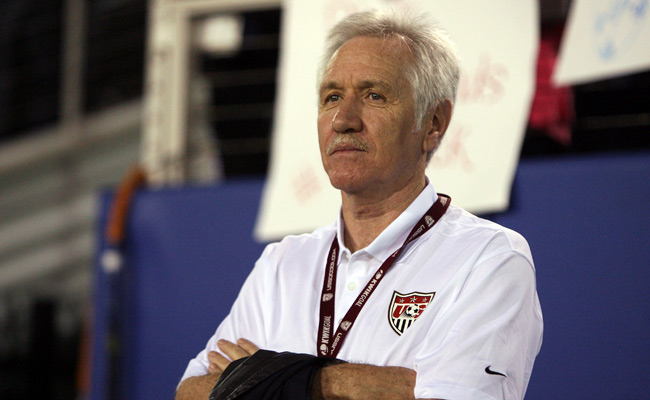
(NOTE: I wrote this on AWK last November when Tom Sermanni was hired.)
Had he known his job was on the line, it’s likely Tom Sermanni might have had a different mindset heading into the Algarve Cup last month. But with 15 months until his next (and really first) meaningful game at the World Cup in Canada, he was still in the process of trying to find out what he had.
The Algarve Cup has always been an oddity in the women’s soccer world, a tournament played in front of virtually no fans in Portugal, but featuring most of the best teams in the world. Even if you witnessed it online, you were one of the few, it wasn’t even available through ussoccer.com, let alone a cable television network.
Like seemingly everything else historically in women’s soccer, the USWNT has ruled the Algarve, winning 8 of the last 11 coming into the 2014 edition, with two of the non-winning years the result of penalty kicks in the finals. However, although it’s the stiffest competition the United States will likely face until next year’s Algarve, it’s also perhaps the only time a relatively new coach like Sermanni can look at new players in pressure situations (see: actual real live World Cup contenders).
With Sermanni maintaining from the time he took the USWNT job last year that his job was to help develop players for the future, and his track record showing how well his young players in Australia improved, it wasn’t a huge shock to see him name players like Morgan Brian, Samantha Mewis, and Sarah Hagen to the roster. In fact, it was probably more surprising that he didn’t include more (Sarah Killion went to Portugal, but wasn’t on the official roster).
Still, the lineup he trotted out against Japan on a sleepy Wednesday morning (in the States, at least) was likely the one he thought best to win at the time, a 4-4-2 with a backline of Ali Krieger, Becky Sauerbrunn, Whitney Engen, and Stephanie Cox, with Cox the only one of the four that might be a surprise to be starting in Canada. Megan Rapinoe and Heather O’Reilly took their places wide in the midfield as they had many times under the previous regime. Carli Lloyd was in the middle with Morgan Brian, a somewhat surprising pick, but she did just win the Hermann Trophy in the fall, and first-choice Lauren Holiday was unavailable for the tournament. Up top, Sermanni went with Christen Press and Sydney Leroux, two of the best goalscorers in the world by most accounts.
There was only one glaring omission (among the healthy with Alex Morgan injured): USWNT all-time leading scorer Abby Wambach, who had recently finished second in the FIFA Player of the Year voting (after winning the year before).
While dominating is a little strong, the United States had more of the ball, although it took a fluke goal by Sydney Leroux to give them the lead. If it weren’t for a ridiculous free kick by Aya Miyama late, the US would have had a solid victory, but settled for a 1-1 draw. Somewhat oddly, Sermanni used only two subs, Kristie Mewis for Morgan Brian and Tobin Heath for Heather O’Reilly.
Just 48 hours later, Sermanni rotated some players against Sweden, and again, the USWNT had much more of the ball, but Sweden had Lotta Schelin (who was inexplicably not a finalist for FIFA Player of Year), and the US didn’t. A 12-4 shots advantage meant nothing as Wambach missed a first-half penalty kick and Schelin’s first-half goal stood up, ending the USWNT’s 43-game unbeaten streak.
“You’re always going to lose games in football. That’s how it works,” Sermanni told the Associated Press. “Sometimes you win games that perhaps you should have lost. Sometimes you lose games that perhaps you should have won. But as I said, today we missed a penalty at nil-nil, and in the last 15 minutes we had four very good goal-scoring opportunities. And if you don’t take those, that makes a difference.”
Sermanni made some attacking subs, but one more curious than the others, putting Sarah Hagen on for Wambach in the 83rd minute with the US trailing 1-0.
While losing for the US is never an option, let’s put the two results that eliminated them in perspective. In my semi-expert opinion, the United States’ biggest obstacles to reclaiming the World Cup next year are probably Germany, Japan, Sweden, and Canada, with the USWNT happening to face half, possessing the ball more than either, and not getting a result either time.
Frustrating, but hardly cause for alarm, no?
Anyway, now eliminated, Sermanni had a chance to experiment even more against Denmark, and gave Sam Mewis her first international start, although he left a somewhat hobbled Rampone in at center back for the second straight match (and left Becky Sauerbrunn on the bench again), and the collective result was a nightmare, giving up three goals in 15 minutes, still nearly coming back, but losing 5-3.
Press and Leroux started up top, with Wambach not entering until the 85th minute, even though the US was in desperate need of offense.
Sermanni went back to what could be considered the “old guard” in a consolation game two days later and Wambach scored twice in a 3-0 beating of North Korea, which was nice, but a curious time to leave the youngsters on the bench.
So there were some curious moves, but Sermanni was learning, the United States was committed to a more attractive style of play, and it was still more than a year until the World Cup, by which time he’d have everything figured out.
Four weeks later, he was fired.
We have no evidence to point a finger at anyone as to why, although the mysterious phrase “cultural fit” seems to be the company line as to why this change needed to be made. We can speculate that maybe Wambach and the “old guard” didn’t like the tinkering with the lineup or that Jill Ellis somehow changed her mind about not wanting to be in charge, but the main feeling among many USWNT fans and followers is frustration.
Frustration because it finally seemed like the US was moving toward a more possession-based style that – despite all their success – they’ve never really employed. Maybe, over time, that would trickle down to the relatively unorganized youth structure the country has (there is still no female equivalent to anything resembling the USSF’s Academy program for boys on the table at the moment) where winning has become paramount even at the youngest of ages.
That, of course, is getting way ahead of ourselves. If the formation for Thursday night’s game was indeed Ellis’, it was perhaps the most inventive the USWNT has produced in years: a 4-3-3 with (a returning) Lauren Holiday playing as a False No. 9, allowing Megan Rapinoe to not only control the play, but make several runs in behind, and Carli Lloyd the space to do what she’s become an attacking force. Becky Sauerbrunn was shredding China with almost every touch, and the ball was being pinged from side-to-side faster than the Chinese could keep up.
Oh, and in that first half with everything looking so good? Abby Wambach and Alex Morgan weren’t on the field.
Good luck, new coach, whomever you are. Hope you’re the right cultural fit.
Support women's sports and SHARE this story with your friends!
MORE ABOUT THIS AUTHOR:
All White Kit offers coverage of women's soccer around the world from a fan's perspective. AWK will feature the latest news, analysis, and commentary ...
full profile
For more, visit jennaawk's Full Profile
LATEST ARTICLES & POSTS
Thu at 1:53pm
Thu at 1:52pm
Thu at 1:48pm
Thu at 1:47pm
Wed at 12:52pm
Wed at 12:50pm
Wed at 12:17pm
Wed at 12:16pm
RECENT COMMENTS
Great article but really not true; there are many players involved in the NPF that are not from the ...more
posted 08/26/14 at 1:28pm
on Softball Standouts Plourde and Prezioso Represent Atlantic 10, Exemplify Mid-Major Potential at Next Level

What she did I'd fantastic but she was still a good 14 seconds behind the winner and, really, the Ke...more
posted 07/22/14 at 4:04am
on 2 seconds, no finish clock picture, but satisfaction: Molly Huddle breaks her own AR

Does money make champions ! History have taught us that money does not means success overnight . Mos...more
posted 06/20/14 at 8:25pm
on Sparks need a change, but what kind?
congrats to Maria on her French Open win!!...more
posted 06/11/14 at 10:06pm
on Maria Sharapova Named The Face Of Avon Luck Fragrances
| SAUCUONY 500 MILE CHALLANGE |
| Daily Workout |

No one has commented on this yet. Be the first!