
It would be great to see Carano getting more publicity, everything helps in this game. And from what...more
posted 09/27/11 at 4:07am
on Rumor Mill � Gina Carano Heading to WWE�Films?





posted by The Glowing Edge
Friday, July 8, 2011 at 11:16pm EDT
Lisa Creech Bledsoe: Speaker, writer, media ninja, Apple fangirl, boxer chick. Online a bunch. Otherwise in the gym.
Support women's sports and SHARE this story with your friends!
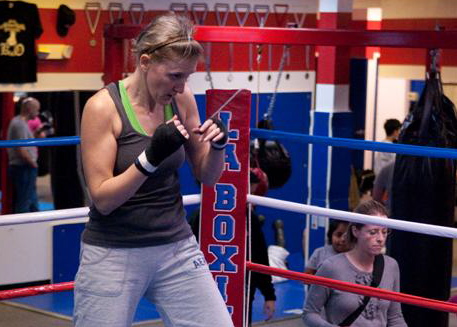
Whether you started boxing for fitness or because you want to compete, one of the most scary and exciting things you’ll ever do is step into the ring for your very first sparring session.
Depending on how long you’ve been training, who you’re stepping into the ring with, and how trustworthy your trainer is, your first experience in sparring may be vastly different than someone else’s, but there are several common factors that you are likely to encounter.
First of all, your conditioning sucks.
I have had to say this about myself at many stages of boxing, not just when I started sparring. It seems like every time I take things up a notch (going a lot of rounds in a row for the first time, sparring with a pro boxer, having my first real fight, shifting to a more competitive gym) I quickly find myself panting and heaving, wondering why on earth my conditioning is so bad when I thought it was so good.
But nearly everyone who gets into the ring for their first time sparring finds — very quickly — that they simply aren’t in the kind of anaerobic sprint condition that a short little 3 minute round of boxing calls for. I promise this gets better as you spar more, and as you begin to do more sprints and intervals in your training.
The urge for “flight” is really, really strong.
The whole “fight or flight” system in your body is pretty serious, and when someone is throwing punches at you this will become very apparent in short order. Some of your biggest mistakes, which will be overcome with practice, will be that you tend to look away or shut your eyes when a shot comes straight for your face, you have an overwhelming tendency to flinch, and you may even turn your back on your sparring partner in the ring (that last one is a massive no-no, by the way; your trainer should stop the sparring session to tell you this if she or he sees you doing it).
Your shots will be wild, and you may hurt someone.
Brand new boxers are the absolute worst at controlling themselves in the ring. Typically a trainer will put very experienced boxers in with a newbie, because there’s a pretty good chance that the new person is scared, hasn’t had a chance to learn how to manage the adrenaline pumping through their body, and simply can’t know the difference yet between getting and giving good boxing practice versus surviving in the ring.
All the nice footwork, pretty shots, and well-practiced combinations that you were able to do while working on the heavy bag just fly out the door when you step into the ring, leaving you swinging wildly and without much thought. Learning to think and plan under this kind of pressure takes time. It’ll come.
Ideally, you want to get in the ring for the first time with your trainer, or another very good boxer who can evade your wild shots and help you find some calm in the storm as you learn.
You’ll start thinking seriously about your gear.
You never really need to put a lot of thought into your boxing gear until you start sparring. But this is where it becomes important. With a little preparation, you can avoid some of the newbie problems.
Gloves: Any old gloves from the gym’s common supply will do for a beginner’s work on the heavy bag, but in the ring you should be wearing big, puffy 16oz gloves so that no one gets hurt. That’s what you’ll use in amateur competition, anyway. I used the gym gloves only once or twice before buying my own. I started with cheap gloves and moved up after those wore out about a year later.
Wraps: You’ve probably figured out what works by the time you start sparring, but if you are over the age of 30, you may want extra protection, because your hands ache after boxing. I used to cut up a beer cozy and tape the foam strips across my knuckles under my wraps. Now I just wear gel gloves (like the MMA fighters use) rather than wraps. Wraps and gels can both be washed, too.
Mouth guard: Fortunately, my trainer had been having our team train with mouth guards in for weeks prior to my first time in the ring, which meant I got over my gag reflex and also learned how to breathe comfortably with one in.
Mouth guards are made for men, so unless you’re a guy your first mouth guard may not fit well. If the regular size is too big, try a youth size. I’ve bought and tossed several, and always go back to the Shock Doctor gel guards. I don’t like the double (upper and lower) guards, but I find the regular guard that covers just your top teeth is perfectly adequate.
Get it in advance because it has to be boiled and formed to your teeth before sparring.
 Headgear: Common headgear problems have to do with fit: either it obscures your vision or slips around under fire. My first headgear was common gear from the gym’s pit, and it had a metal or plastic bar through the chin pad which gave me a monster bruise the first (and last) time I wore it. I bought a cheap $29 headgear from Dick’s Sporting Goods after that, and it served for a while even though it was very thin definitely not competition grade.
If you can, buy only USA Boxing approved headgear. Be willing to send it back over and over again until you have a perfect fit. It should be tight when you’re cold, because once you start to sweat it has to stay in place.
I’ve found the best kind of headgear has an adjustable lace top, velcro or lace-up back, and NO “Master’s” padding on the cheekbones.
Shoes: I boxed for a year or so before investing in shoes. I bought wrestling shoes since they’re pretty much the same as boxing shoes. The advantage that boxing or wrestling shoes gives you is that they fit tighter and don’t cling to the canvas like running shoes. They help you make tiny, quick footwork moves. You can feel the canvas, pivot easily, and bounce lightly on your toes.
Boxing or wrestling shoes have almost no padding or arch support, no matter what they advertise. They can’t be loaded down with it and still be light and flexible. So don’t wear them all the time, just for working in the ring.
You may be ridiculously self-conscious.
I was terribly nervous about my first time, and really wished I could suck in private, rather than embarrassing myself publicly for all the world to see. I didn’t blog about it, I didn’t allow photos of it, I tried not to let people know exactly when I was going to do it. But the day came and I had to get in and be every bit as terrible a boxer as I expected.
Listen. Everybody starts here. And yes, people are going to watch and see and think what they think. The truth is that everyone who has boxed before will understand, and everyone who hasn’t boxed before will be so glad it’s you and not them, hah.
You’ll come out feeling like a superhero.
If you have the right kind of trainer and gym (and not one of those crappy places where they beat you up in order to feel like they are bad ass and way cooler than you’ll ever be), you will be so grateful to have survived without weeping, puking, or dying! Your brain will be firing all kinds of crazy messages like
In fact it was a post by a friend of mine (and regular TGE commentor) Amy, who got me thinking about this again. You definitely need to read her thoughts on her first time sparring thoughts.
The next day, say hello to your sparring hangover!
It’s not unusual to be pretty worn out and have a headache the day after you spar. I typically don’t do serious sparring more than once a week because it’s fairly hard on the body, especially if you are working 8 or 10 hard rounds (which you can work up to, but shouldn’t be doing right off the bat). Ibuprofen should take care of most of your head and body aches.
You may have other, more specific pains. The first time I sparred I threw a slew of hard rights that didn’t land, hyper-extending my right elbow pretty painfully. For that I needed a big, flexible icepack, which for me was a bag of frozen peas. I later invested in two good icepacks, so I could use one while the other re-froze.
In my opinion, regular hard training hurts more than sparring.
You rock. You really do rock! Now go do it again.
You’ve done something most people would never dare try. Once  you’ve cleared that first monster hurdle, you need to do it again. It was terrifying, but you didn’t let that stop you. Now don’t let the long road to getting good in the boxing ring intimidate you. Most new boxers bail out of sparring sessions now and then, especially after a particularly bad sparring session; the fear factor is pretty high for quite a while, and maybe it never goes away entirely. I’ve been boxing for several years and I still get serious jitters.
Don’t let that stop you. You have accomplished a pretty incredible thing. Keep building on your success!
Superhero image by Gomez-C on Flickr; the rest are (of me on a sparring night) by Ken Hall Photography
Related posts:
Support women's sports and SHARE this story with your friends!
MOST POPULAR ARTICLES & POSTS
July 31, 2010 at 10:26pm
September 22, 2011 at 10:44am
July 29, 2009 at 12:41pm
September 23, 2011 at 10:14am
September 22, 2011 at 10:39am
September 14, 2011 at 2:05pm
September 2, 2009 at 9:31pm
August 30, 2011 at 1:55pm
LATEST ARTICLES & POSTS
Tue at 7:40pm
Tue at 7:38pm
Tue at 7:29pm
Tue at 2:31pm
Tue at 1:11am
Tue at 12:49am
Lisa Creech Bledsoe: Speaker, writer, media ninja, Apple fangirl, boxer chick. Online a bunch. Otherwise in the gym. ...
full profile
For more, visit Lisa Creech Bledsoe's Full Profile
RECENT COMMENTS
It would be great to see Carano getting more publicity, everything helps in this game. And from what...more
posted 09/27/11 at 4:07am
on Rumor Mill � Gina Carano Heading to WWE�Films?

"Having someone on your shoulder or to chase down brings out better more powerful technique and help...more
posted 09/23/11 at 2:56pm
on Athletes: Are We Fooling Ourselves?

Yeah, the women rabbits get paid, hopefully as much as the men. I am guessing it depends on their ag...more
posted 09/23/11 at 8:40am
on Male pacers banned from road racing?

there are 5 NCAA women's rugby programs and a few more in the hopper...
...more
posted 09/22/11 at 3:49pm
on Some ideas for reworking Title IX

great post!!! Thanks for the numbers and analysis. -nml
...more
posted 09/22/11 at 2:18pm
on NCAA Women's Basketball: Attendance Winners and Losers for 2010-11


No one has commented on this yet. Be the first!