

Hi Michael,
Thanks for commenting.
With due respect I don't think these kids are intending t...more
posted 03/04/13 at 3:49pm
on Young Irish wrestlers want their turn in the sun





posted by The Glowing Edge
Monday, November 26, 2012 at 6:16pm EST
Lisa Creech Bledsoe: Speaker, writer, media ninja, Apple fangirl, boxer chick. Online a bunch. Otherwise in the gym.
Support women's sports and SHARE this story with your friends!
I’m officially about 8 weeks out from my next fight, which is just the right amount of time I need to set up my training goals. About a year ago I started categorizing the main areas of my boxing training, and since then I’ve refined my system enough to find it pretty useful as I plan my workouts.
(It would be fair to say I’m a bit compulsive about organization. Obsessed, even. But people hire me for it, so I’m allowed. Note to you: try to get paid for the stuff that makes you weird.)
The acronym I use to lay out my goals is FASTER, although if you want to be picky about it — which I generally enjoy doing — you could also say FASSTER, because it stands for Form, Anaerobic Conditioning, Strength, Speed, Timing, Eating Clean, and Resting.
But first, a note about training hours…
How many hours of training each week?
Remember those awesome gold star stickers from first grade? I’ll still do damn near anything for those suckers.
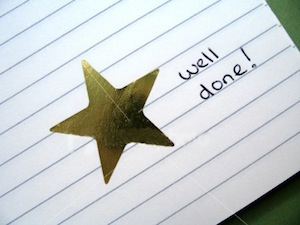
So when I’m in my normal routine, I use a “medal” system for every week of training. This means I give myself a mental bronze medal for every week in which I train three times, a silver for four good training sessions, and a gold for getting in five training sessions for that week.
I used to train two hours or more at a time, but now that I’m more efficient, I train about an hour to an hour and a half each time. If I’m focused and not jacking around, I’m finished inside of an hour.
I know plenty of people who put in far more training hours, but I just don’t have that luxury. And anyway, I would die of boredom spending long, slow hours on a trail or treadmill; besides, that sort of training doesn’t produce the kind of conditioning you need for boxing (see Anaerobic, below).
I average about 4 hours of training in a normal week, but when prepping for a fight, I try to stay consistently in a 5 workout-per-week mode.
Form
Ideally, you get your form cleaned up by shooting video of yourself sparring or working the heavy bag. That way you can watch yourself and correct the sloppy stuff. You can also watch yourself in a mirror. Either way, make sure you always have a form goal you’re working on.
Here are a few examples of good form goals:
Anaerobic conditioning
Anaerobic (coined in 1863 by Louis Pasteur, from the Greek: an- ”without” + aer ”air” + bios ”life”) is very different from aerobic conditioning. Anaerobic conditioning means you’re teaching your body to function at high levels for very short periods of time with a shortage of oxygen to your system.
The win here is in interval training. Nobody cares if you can run five miles because what you need to be able to do in boxing is sprint hard for two (women’s rounds) or three (men’s rounds) minutes, recover in one minute, sprint another round, recover, and sprint again.
You can do interval training on pretty much everything. Weights, jump rope, treadmill, stair runs, box jumps, tire flipping, elliptical, rowing, sprints, you name it.
Boxing Interval Training: Do as much of your training as you possibly can in rounds or two or three minutes each, with 30 second recoveries between. Work crazy hard during the round, and keep moving during the recovery. Don’t slouch over or put your hands on your knees during your rest period. Stand tall and get plenty of oxygen back in to your system.
Tabata Interval Training: I generally keep my intervals to boxing round times, but that’s not the only way to do it. Tabata interval-style training was founded by a Japanese scientist named Izumi Tabata, and someday soon I’ll write a post on Tabata training, but the basic gist is this: After your warm up, you do 8 intervals of 20 seconds all-out intensity exercise followed by 10 seconds of rest. Sound short and easy? Check out these killer Tabata-interval burpees. (Note he slouches to breathe at 2:30; Tabata will do that to you.)
Strength
For fight sports, speed and strength go hand in hand. When I do strength training I typically use light weights and high reps because I’m working for quickness and explosive power as well. Although I also slow it down and work heavier weights now and then because it’s so good for your bone density.
I’m not a huge exercise gadget person, but I do make use of dumbells, freeweights, tractor tires, sledgehammer, and medicine balls, and if I were in a fancy gym I’d be using slam ball, kettlebells, heavy rope, balance rings, and harness pulls as well.
Speed
You can build your speed by focusing on agility, explosion, and sprinting exercises. I have an agility ladder, but I’m just as likely to work along a sidewalk line or parking lot stripe. I also use dot drills, box (or wall or bench) jumps, and my general interval training to train for quickness.
You’ll definitely want to build up a set of reaction drills to use in building speed, too, and for some of those you need a partner. Practice letting your partner throw jabs at your head while you slip and duck. (good for Timing too, see below). Tie up a slip rope and work your way down it, moving quickly and lightly as you duck under and bob up on the other side.
Timing
If there’s an area in which I shortchange myself, it’s in timing. I do regular rounds on the speed bag (which really should be called a timing bag, because that’s what it trains), and once in a while I get on the double-end bag, but most of your practice in timing will come by way of regular sparring.
There’s just no substitute for learning to get out of the way than by having someone come after you with a blazing fast combo. And when you are getting regular sparring in, you’re also building timing by looking for the open shot and trying to land it consistently.
Eating Clean
My dietary outline comes mainly from the Dr. Sears Zone Diet, but I also incorporate Paleo once in a while. Above all, I work pretty hard to avoid the Forbidden Five foods (white bread, white rice, white pasta, white potatoes, and high fructose corn syrup). If you’re subscribed to my emails I love to send out recipes (as well as workout plans, training stories, playlists, random shenanigans, and free books once in a while; sign up here if you haven’t already).
And yeah, I cheat. You should too. Make your goals for eating sustainable, not ridiculously lofty. My goal in this area is usually to eat 80% clean every week. Which leaves room for spinach, mushroom, sausage, and onion pizza once in a while. (With extra garlic, yeah baby.)
Rest and Recovery
You’ve probably already heard the newsflash that you don’t build muscle while you’re training; you build muscle as you’re recovering. I have never been a train-every-day person anyway, but since I’m in my forties I’m particularly aware of a) being efficient with my time and training, and b) not getting injured by overtraining or making stupid mistakes.
Your turn… What’s missing? What do you include that isn’t listed here? Leave me a comment below and share your ideas, additions, and training secrets. CC image by Andrius Petrucenia
Related posts:
Support women's sports and SHARE this story with your friends!
Today on the Women's Sports Calendar:
| Edgy Women Festival Mar 2 - 10: Canada |
MOST POPULAR ARTICLES & POSTS
March 1, 2013 at 8:03pm
February 14, 2013 at 9:00am
February 28, 2013 at 10:41am
March 2, 2013 at 1:45pm
February 22, 2013 at 8:02am
November 28, 2009 at 5:06pm
March 2, 2013 at 10:23am
December 20, 2010 at 1:20pm
LATEST ARTICLES & POSTS
Mon at 8:18am
Mon at 8:00am
Sun at 7:05pm


Lisa Creech Bledsoe: Speaker, writer, media ninja, Apple fangirl, boxer chick. Online a bunch. Otherwise in the gym. ...
full profile
For more, visit Lisa Creech Bledsoe's Full Profile

RECENT COMMENTS
Hi Michael,
Thanks for commenting.
With due respect I don't think these kids are intending t...more
posted 03/04/13 at 3:49pm
on Young Irish wrestlers want their turn in the sun

Are you serious? Ms. Silberman's performance can fairly be called an epic fail by any fair and obje...more
posted 03/04/13 at 12:18pm
on Female Kicker Blazes Trail at NFL Regional Combine

The day was finally her Lauren Silberman did a great job ! At the New York Jets Regional Combine , ...more
posted 03/03/13 at 7:58pm
on Female Kicker Blazes Trail at NFL Regional Combine

I like the fact that wrestling is getting more attention but are we breeding an aggressive society ....more
posted 03/03/13 at 6:37pm
on Young Irish wrestlers want their turn in the sun
Thanks for reading-yeah it will be great to not have to watch a grainy internet version!...more
posted 03/02/13 at 8:13pm
on USWNT: U.S. Set for Algarve Cup, TV Schedule Announced

Women Talk Sports Podcast - January 28, 2013
In the January 2013 episode of the Women Talk Sports podcast, Cara and Stephanie share several points that will leave you feeling hopeful about the Na...[Listen/Download for iTunes]
Women Talk Running Podcast - January 28, 2013
In this episode of the "Women Talk Running" podcast, Cara and Stephanie talk about the stud-of-a-high-school-runner, Mary Cain. We weight in on whethe...[Listen/Download for iTunes]
Women Talk Sports Podcast - Happy New Year! (January 1, 2013)
See ya, 2012. What up, 2013?! In this edition of the Women Talk Sports podcast, Stephanie and Cara give you a run down of the top happenings of women'...[Listen/Download for iTunes]
No one has commented on this yet. Be the first!