




Olga Korbut: Gymnastics
International Star of the Women's International Sports Hall of Fame
Website: http://olgakorbut.com/

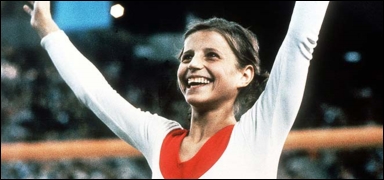
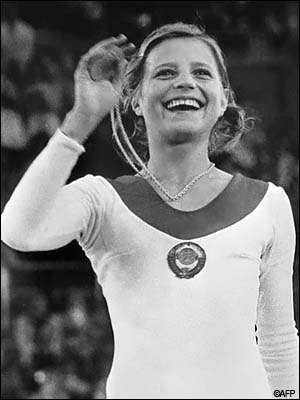
Olga Korbut seemed so tiny physically, but her smile was big enough to win the hearts of two nations at the 1972 Olympic Games held in Munich. She was a daring acrobat soaring above expectations for the sport of gymnastics, and her performance landed her in that golden spotlight known by only the world’s elite performers. Korbut won three gold medals in Munich and captured a silver medal too. The Cold War era characterized her place in history and why she will be remembered for the impact she had on not only the sport but also a relationship between her native land of Russia and the United States of America. Korbut has remained a central figure in gymnastics throughout the years, but sadly has faced the trials and tribulations that accompany fame.
Korbut’s tumbling seemed to begin in her mother’s womb and she developed her athletic skills throughout her youth with performances for her neighbors. Korbut was the youngest of four daughters born to Valentin and Valentina in Grodno, Belarus. Olga’s sister, Ludmilla, had earned the country’s coveted title, Master of Sports, as a gymnast. Olga soon followed in her sister’s athletic footsteps, and quickly demonstrated her speed and jumping ability. Her daring posture got her into trouble when she tried her acrobatic tricks climbing trees. She entered a gymnastics class at age eight and became infatuated with the rigorous sport. Her life took a dramatic turn at that moment. It was her adventurous spirit and obsession with the sport that would lead her away from her parents and their guidance.
She joined a sports school operated by a boldly innovative coach, Renald Knysh, and he would become the primary influence in her career and life. Knysh ran one of the Soviet Union-supported sports training facilities. The country’s need to establish its powerful presence had led to state-supported development in several notable areas. One was sports training facilities. Young children were selected at an early age for their talents and potential, then tested and pushed to extreme limits, in some cases, to develop the Soviet Union’s next athletic phenomenon. Knysh harnessed Korbut’s audacious nature through the development of bold new maneuvers that would challenge the routine climate of gymnastics. She perfected a backward aerial somersault on the balance beam, which she named the Korbut Salto, and a back flip to catch on the uneven bars, subsequently called the Korbut Flip. Abackward release move on the bars was unprecedented until Korbut demonstrated it during one of her first senior-level competitions. Due to the nature of the move, it was not as widely accepted among the judges of the sport or the National Soviet Sports Council but it was applauded by the audiences in attendance. Knysh and Korbut embarked on a journey to change the Soviet regime’s way of gymnastics by demonstrating that women could be both powerful and graceful.
Korbut’s determination would not yield and she continued perfecting her style of gymnastics. By 1971, she equaled her sister, Ludmilla, by earning her own Master of Sport title and she had refined her competitive routines in three national championships. The next year was an Olympic year, and Korbut had emerged as a Soviet star in gymnastics and a seasoned competitor. She focused on completing secondary school early and winning gold at Munich. The journey began with a third-place finish at the Soviet National Championships. She dazzled the judges at her first international competition, the Riga Cup, and they awarded her with a win! After graduation from school, she competed for the USSR Cup and Olympic team selection.
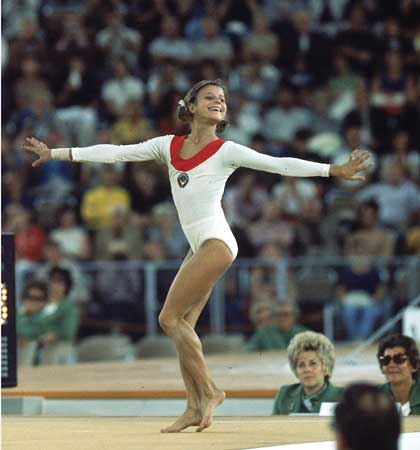
Munich will be remembered first for the Israeli hostage tragedy in the athlete housing, but also for Olga Korbut’s performance and ear-to-ear smile. She proved to be the human side of the Soviet Union and its Cold War persona. She wept openly when she fell short of a respectable score in the uneven bars, which crushed her hopes of an all-around title, and the audience seemed to feel her teardrops as if they were their own. She won over their hearts with her comeback performance on the beam and in the floor exercise, earning her the gold medal for both. The emotional young girl exhibited her steel reserve of determination as she competed in the individual uneven bar event—winning a silver medal. Her performance contributed to the Soviet team’s gold medal performance. ABC donned her the Wide World of Sports Athlete of the Year for her three gold medals and girlish smile. The Cold War seemed to be disarmed slightly by a pixie with a charming smile. President Richard M. Nixon even invited Korbut to the White House while she was visiting the United States to receive several of her awards. In 1975, the United Nations bestowed the “Gold Tuning Fork” to Korbut for her role in bringing the world together through sport and named her “Woman of the Year.”
Fame and extensive international travel came at a personal cost to Korbut. The Soviet Union used her as a marketing arm of the communist regime. Traveling across the globe left her rich in awards but unable to adequately train for the 1976 Olympics. Throughout those three years of travel the KGB trailed her to ensure that communism and their new jewel, Korbut, remained safe. During that same time, Korbut suffered through secret abuse from her coach, Knysh. She would not reveal the trauma until many years later, but Knysh got her drunk just before the 1972 Olympics and forced her to have sex with him. She lacked the support from her family and could only succumb to his sexual abuse as she did the physical and mental abuse she endured while training. In spite of everything, Korbut managed to make the Soviet team in 1976, but she could only muster an individual silver medal in the balance beam and help her team to one more gold medal at the Montreal Olympic Games. Korbut was replaced by Nadia Comaneci as the queen of gymnastics. However, she is still known as the mother of gymnastics for her daring moves and innovation of the sport. Korbut was removed from the Soviet team the next year.
Away from the demanding nature of the sport, she found a new balance in her life. She met Leonid Bortkevich, a Soviet rock singer, and they soon married. From the strife of gymnastics, Korbut found it difficult to conceive and give birth, but she and Bortkevich finally had a son, Richard. She soon transitioned into coaching for the Soviet team for a salary of approximately $312 per week.
After the Chernobyl disaster, only 180 miles from her family’s home in Minsk, they immigrated to the United States to protect their young son from radiation poisoning. Korbut had created the gymnastics market in the United States. Korbut felt compelled to help mothers back home who begged her to use her fame to draw attention to the widespread cancer affecting their children after Chernobyl. She organized the Olga Korbut Foundation to raise money for bone marrow transplants and other resources such as doctors and medicine.
Korbut has tried to transition into the private sector of coaching at several schools across the United States. She has difficulty making gymnastics fun and not as punitive and demanding as her experience in the sport. Her passion for the sport is still vibrant. She has a dream of creating a senior gymnastics level for gymnasts 18 years and older to accommodate the change in flexibility that occurs as women age. That is ironic considering her vigorous routines changed what the public expected from gymnastics: young girls with daring moves. Korbut envisions a sport that displays the grace a woman exemplifies in gymnastics as she ages. With grace and vigor, Olga Korbut changed a sport and brought warmth to a Cold War power struggle between two nations.
The previous excerpt was written by Stacy Martin-Tenney
IN SEASON:
Tue, Oct 1 at 12:03pm
Fri, Sep 6 at 9:32am
Fri, Nov 8 at 9:29pm
Fri, Nov 1 at 4:39pm
Today at 9:09am
Today at 9:04am
Sun, Nov 10 at 6:59pm
Thu, Nov 7 at 9:08pm
LATEST ARTICLES & POSTS
posted by Swish Appeal
Mon at 9:13am
posted by Swish Appeal
Mon at 9:11am
posted by All White Kit
Sun at 6:42pm

-
The body of this profile is an excerpt from 100 Trailblazers: Great Women Athletes Who Opened Doors for Future Generations.
This book is available on Amazon.com:
This book was written by Dr. Richard Lapchick, chair of the renowned DeVos Sport Business Management Program at the University of Central Florida, along with several of his students in the renowned program:
- Sara Jane Baker
- Jessica Bartter
- Catherine Lahey
- Stacy Martin-Tenney
- Horacio Ruiz
- Ryan Sleeper

The DeVos program offers students the opportunity to earn their Masters in Sports Business Management and a Masters in Business Administration. Focusing on ethics, diversity, leadership, and community service, the DeVos Program attracts some of the brightest and most committed students from across the country and across the globe.
-
This profile was built by:

Taunita Stephenson
About Taunita:
~*Member of the DeVos Sport Business Program (Top 4 Sport Business Programs in the Nation!), Class of 2012*~ ~*Class of 2009, Delaware State University Graduate-Making My Mark on the World!" ~*I am enthusiastic about equality and diversity and hope to begin a career in Player Development or Diversity Initiatives!*~ God, Family, Friends, Career Goals, Jay-Z, Lakers, Fashion-In that order! What I Live By: "Vision without action and a plan is an illusion"