 Twitter
Totally agree, Megan. Ann and I were just talking about the same thing. Great points....more
posted Tuesday, December 28, 2010 at 6:29pm EST on Why the media needs to back off Taurasi

|

|

|

|

|

|
 |

|

| |
|
| |||
"In all my years traveling around the world, I have witnessed soccer as the one thread that many cultures and people have in common," -Doug Band.
Help bring the World Cup to the United States in 2018/2022! Please visit gousabid.com for more ways you can support the sport- and the country- that you love.





|
posted by Balanced Health and Nutrition Food, nutrition and exercise information blended with a dash of opinion. |

|

|
|
Over-eating isn’t always to blame for people who struggle with extra weight. For some, the weight may come from health complications and disease.
Cushing’s syndrome is a health problem that affects 2-10 people per million. For those who are diagnosed, it is a serious issue for many of their organs and systems,and can cause weight gain.
Hypercortisolism is when levels of cortisol (the stress hormone) are elevated for a long period of time, which is the cause of Cushing’s syndrome. Cortisol is produced by the adrenal glands and is responsible for many mechanisms in the body, including blood pressure regulation, maintaining cardiovascular function, response to stress and metabolism regulation for fats, proteins and carbohydrates. Because of the vast array of responsibilities, excess cortisol can produce many complications in Cushing’s syndrome.
Signs and symptoms include: weight gain in the stomach, face (moon face) and back (buffalo hump), red or purple stretch-marks, muscle weakness, depression and anxiety, acne, decreased libido, headaches and possible glucose intolerance (diabetes).
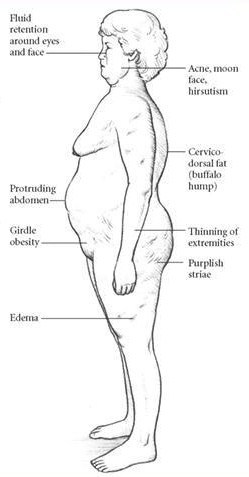
From: http://www.wrongdiagnosis.com/bookimages/7/2195.1.png
There are two types of Cushing’s syndrome: exogenous and endogenous. Exogenous is caused by use of oral corticosteroid medication, which is prescribed for asthma, arthritis, irritable bowel disease, lupus, and patients who have received transplant organs. Endogenous is caused by tumors on or near the adrenal glands, or primary adrenal gland disease, both of which can interfere with cortisol production.
Though Cushing’s syndrome is quite rare, it usually affects women more so than men, ages 20-50 years. To get tested, it is best to call your primary healthcare doctor first. Generally they will do a physical examination to assess the signs and symptoms, and then will perform urine, blood or saliva tests. If you are not on any medications that could affect your cortisol levels, they may decide to do imaging tests to screen for tumors as well.
View Original Post at rebeccascritchfield.wordpress.com | View rebecca's Full Profile
|
|
|
|
MOST POPULAR POSTS
posted by MarQFPR 12/20/10 at 7:13pm
posted by Women Undefined 07/31/10 at 10:26pm
posted by MsAkiba 10/11/09 at 2:40pm
posted by HoopFeed.com 12/27/10 at 12:12pm
posted by HoopFeed.com 12/27/10 at 12:09pm
posted by They're Playing Basketball 12/25/10 at 4:08pm
posted by Fair Game News 12/27/10 at 12:15pm
posted by HoopFeed.com 12/24/10 at 2:22pm
posted by C and R's Stanford Women's Basketball Blog 12/26/10 at 2:08pm
posted by Title IX Blog 12/17/10 at 10:37pm
LATEST WTS POSTS
posted by They're Playing Basketball
Today at 8:47pm
posted by The Track & Field Superblog
Today at 8:43pm
posted by Left Coast Hoops
Today at 6:41pm
posted by ...Because I Played Sports
Today at 6:20pm
posted by Jessica Mendoza's Blog
Today at 6:17pm
posted by Girls Riders Organization, Inc.
Today at 5:32pm
posted by Jayda Evans: Womens Hoops Blog
Today at 4:29pm
posted by They're Playing Basketball
Today at 4:25pm
posted by Swish Appeal
Today at 4:06pm
posted by Run Girl Run
Today at 1:56pm
RECENT COMMENTS
Totally agree, Megan. Ann and I were just talking about the same thing. Great points....more
posted Tuesday, December 28, 2010 at 6:29pm EST on Why the media needs to back off Taurasi
HEADLINE OF THE YEAR NOMINEES Shayna %u201CQueen of Spades%u201D Baszler wins FCF 8-woman 135-lb to...more
posted Tuesday, December 28, 2010 at 3:35pm EST on 2010 Women's MMA Awards Announced
Very cool. Thanks for sharing this....more
posted Tuesday, December 28, 2010 at 12:49pm EST on Video of Elite Hammer Throwers at Mt. SAC Relays 2010
Focus says a lot about a person's character. Looking for the downside to something, magnifying the f...more
posted Monday, December 27, 2010 at 4:56pm EST on Tiger loses Gillette; Influence Drops; Hordes Cheer
FREDDYKOOL: SHE PLAYED FOR RUSSIA????? LEFT THEM TO GO TO TURKEY, DO YOU THINK THEY (RUSSIA) WAS A ...more
posted Monday, December 27, 2010 at 3:06pm EST on Just the facts: Taurasi and Modafinil






No one has commented on this yet. Be the first!