 Twitter
Ms. Buzuvis - I've been reading you and Ms. Newhall's blog for some time now and I've got to thank y...more
posted Saturday, December 25, 2010 at 9:33am EST on Thanks for our new gym, Title IX!

|

|

|

|

|

|
 |

|

| |
|
| |||
"In all my years traveling around the world, I have witnessed soccer as the one thread that many cultures and people have in common," -Doug Band.
Help bring the World Cup to the United States in 2018/2022! Please visit gousabid.com for more ways you can support the sport- and the country- that you love.





|
posted by Balanced Health and Nutrition Food, nutrition and exercise information blended with a dash of opinion. |

|

|
|
By: Carlene Helble-Elite Nutrition Intern
The beverage industry provides a plethora of options for those seeking something fizzy, a drink with a kick, or beverages with advertised health benefits. Kombucha is a popular ‘health drink’ that uses a grouping of bacteria and yeast mixed in with tea. Ancient China is credited with the creation of this fermented tea, although many countries across the world have their own versions.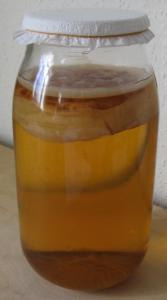
Kombucha is made by first obtaining a colony called the ‘mother’ which floats at the top of the batch of tea. The colony is saved for each brew (think of sourdough starter) and even passed along to friends so they can brew their own. After creating a large batch of tea (it can be green or black tea), sugar, and the colony are mixed together. The fermentation process then begins and for one to two weeks, the tea sits unrefridgerated.
Kombucha fans say the health benefits are numerous and include stimulation of the immune system, cancer prevention, improved liver function and digestion. The tea is also touted as a probiotic food. Up until the time of this post, there has not been a major medical journal that has done a report on kombucha. These claims are not scientifically proven and sometimes it may seem that personal stories are what keep this fermented tea popular. While it is possible that there are some benefits, there is no evidence at this point to prove it.
There have been, on the other hand, been major reports of ill effects including GI distress and allergic reactions. The FDA cautions, ‘the risk of contamination is high’ because it is often created within personal kitchens in non-sterile containers. Aspergillus, a fungus that produces a nasty toxin, is a particular concern in kombucha. Over a decade ago, the CDC filed two reports of metabolic acidosis one resulting in major illness and another in a death. The cases had possible, but not definite connections to daily intake of kombucha. To be on the safe side, the American Cancer Society advises those with compromised immune systems should avoid this beverage.
View Original Post at rebeccascritchfield.wordpress.com | View rebecca's Full Profile
|
|
|
|
MOST POPULAR POSTS
posted by MarQFPR 12/20/10 at 7:13pm
posted by MsAkiba 10/11/09 at 2:40pm
posted by Women Undefined 07/31/10 at 10:26pm
posted by Sports, Media & Society 12/22/10 at 12:05am
posted by Fair Game News 12/22/10 at 7:33pm
posted by MarQFPR 12/14/10 at 3:53am
posted by Women's MMA Roundup 12/23/10 at 9:53am
posted by Athletic Women Blog 12/22/10 at 12:08am
posted by HoopFeed.com 12/24/10 at 2:22pm
posted by One Sport Voice 02/05/10 at 3:44pm
LATEST WTS POSTS
posted by Girls Riders Organization, Inc.
Today at 6:15pm
posted by Swish Appeal
Today at 4:15pm
posted by They're Playing Basketball
Today at 4:08pm
posted by MMARising.com
Today at 1:29am
posted by MMARising.com
Today at 1:27am
posted by Title IX Blog
Today at 1:26am
posted by Swish Appeal
Today at 1:21am
posted by Wendy Parker's Extracurriculars
Today at 1:18am
posted by Moving Down the Right Track
Today at 1:17am
posted by Swish Appeal
Today at 1:14am
RECENT COMMENTS
Ms. Buzuvis - I've been reading you and Ms. Newhall's blog for some time now and I've got to thank y...more
posted Saturday, December 25, 2010 at 9:33am EST on Thanks for our new gym, Title IX!

To answer your question "What other banned categories are there besides steroids and recreational dr...more
posted Friday, December 24, 2010 at 6:11pm EST on Diana Taurasi tests positive for banned substance

My standard protein/carb recovery drink continues to be Organic Choco Milk... easy to pack in the as...more
posted Thursday, December 23, 2010 at 11:22am EST on Product Review and Another Contest!: Think Thin

You won't get an argument from me there. I would add, too, that Maya is a preternaturally gifted ath...more
posted Thursday, December 23, 2010 at 10:24am EST on Maya Moore - simply the best
Concerning the ko of the year there is a better video of the Celeste Saenz fight: http://www.youtube...more
posted Wednesday, December 22, 2010 at 8:47pm EST on 2010 Women's MMA Awards Announced



No one has commented on this yet. Be the first!