
"Having someone on your shoulder or to chase down brings out better more powerful technique and help...more
posted 09/23/11 at 2:56pm
on Athletes: Are We Fooling Ourselves?






posted by Fast at Forty
Thursday, July 28, 2011 at 5:05pm EDT
Fast at Forty was born while I was in the emergency room after crashing defending my title at the 70.3 World Championships in Clearwater, FL. In the midst of my anger over not being able to finish the race and being somewhat delirious from the pain, I decided that in 2010 I would start a campaign to be the first 40 year old woman to win a triathlon World Championship and it would be called “Fast at Forty”. During my recuperation from my injuries, which included shoulder surgery, I realized that this was a fantastic opportunity to inspire women in their 40’s to work through their challenges, overcome obstacles and attain new goals.
Support women's sports and SHARE this story with your friends!
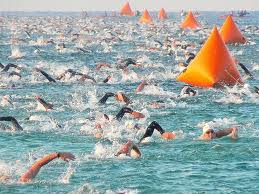 This morning, I had the pleasure of conducting an open water swim clinic with my good friend Krista Shultz (http://shedoestri.com/). The attendees were primarily beginners with very little open water experience. I began the discussion by querying the group whether they had anxiety about open water swimming. All of them indicated that they indeed had some fears about swimming in open water. Even though I had anticipated this might be the case, I was still somewhat surprised by the degree of anxiety these athlete’s were facing.
The issues were varied. I tried to tackle each of their concerns in an effort to alleviate their discomfort and make open water swimming enjoyable rather than a burden.
Wetsuit constriction
Even a perfectly fitting wetsuit feels restrictive compared to swimming without one. In addition, a wetsuit changes your body position in the water and if you are donning a full suit, it can change your arm swing. If you never wear your wetsuit before race day, these feelings will be unfamiliar and can cause a panic attack in the water. The best way to ensure this doesn’t happen during the race is to periodically wear your wetsuit prior to race day. If you do not have access to open water, wear your wetsuit in the pool (just be sure to wash it well after). The more often you wear it, the less strange it will feel on race day.
Mass start
There is no question; the start of a triathlon is frenzied. People jockey for position with no regard for those around them. There can be kicking and hitting. It is not for the faint of heart. Novice open water swimmers (and anyone who wants to avoid the fray, for that matter) should position themselves to the outside or to the back of the group. Try to minimize the number of people immediately around you. For those athletes feeling especially panicked by the mass start, let everyone go and then start your swim. Swimming a Masters workout can help emulate the feeling of a triathlon swim – often workouts have crowded lanes and there can be contact with swimmers around you (I often leave with bruised hands).
Not being able to make the distance
Whether you are racing in a sprint or an Ironman, you should swim the distance in training non-stop at least once to give yourself the confidence you make the distance and the time cut-off. I am constantly amazed at how often people ignore swim training until the last minute. Swimming is not like studying for an exam; you cannot cram.
Breathing
If you have trouble breathing during swimming in the pool you will have trouble breathing during swimming in the open water. The most common breathing problem is trying to breathe in and out when you turn your head. After you take your breath when your head is turned, blow the water out when you head is back in the water. Swimming, unlike running and biking, requires long, slow, controlled breaths. Practice this in the pool until it is second nature.
Sighting
One of the biggest concerns people have is swimming off course. We have all done it! In fact, earlier this year, almost the entire men’s pro field swam off course at a big race. Know the course beforehand. Some courses are triangular while others are a rectangle. Figure out which side the buoys are on and whether the turn buoys are a different color. Practice bilateral breathing in training just in case the buoys are on your non-preferred breathing side. The buoys can be hard to see, the sun may be bright, the waves very tall. Do not depend on the person in front of you to keep you on course. Yes, you can swim on someone’s feet. But, lift your head every few strokes to make sure you are still on course. Practice lifting your head during your swim training in the pool.
Panicking
Sometimes, even after all of the mental and physical preparation, a panic attack occurs during the swim. If that happens, turn over on your back and float or grab onto a kayak. Take a few deep breaths until you feel calm and then continue your swim. Try counting your strokes or singing a song to keep yourself calm.
Practice
The overwhelming theme here is that you must practice to overcome your fear of the open water. Each of the steps needs practice in the pool first and then implemented in open water. Whenever you have the opportunity to swim in the open water, take it! Over time, you will feel much more comfortable.
I applaud the athlete’s who came to the clinic. They recognized their fear of the open water and took a major step to overcoming it. They did not wait until race day and just hope for the best. I believe they all left with a little more confidence.
Support women's sports and SHARE this story with your friends!
MOST POPULAR ARTICLES & POSTS
July 31, 2010 at 10:26pm
September 22, 2011 at 10:44am
September 22, 2011 at 10:39am
September 2, 2009 at 9:31pm
September 23, 2011 at 10:14am
July 29, 2009 at 12:41pm
LATEST ARTICLES & POSTS
Sun at 5:09pm
Sun at 4:36pm
Sun at 4:31pm
Sun at 4:27pm
Sun at 4:22pm
Sun at 4:07pm
Fast at Forty was born while I was in the emergency room after crashing defending my title at the 70.3 World Championships in Clearwater, FL. In the m...
full profile
For more, visit joannazeiger's Full Profile
RECENT COMMENTS
"Having someone on your shoulder or to chase down brings out better more powerful technique and help...more
posted 09/23/11 at 2:56pm
on Athletes: Are We Fooling Ourselves?

Yeah, the women rabbits get paid, hopefully as much as the men. I am guessing it depends on their ag...more
posted 09/23/11 at 8:40am
on Male pacers banned from road racing?

there are 5 NCAA women's rugby programs and a few more in the hopper...
...more
posted 09/22/11 at 3:49pm
on Some ideas for reworking Title IX

great post!!! Thanks for the numbers and analysis. -nml
...more
posted 09/22/11 at 2:18pm
on NCAA Women's Basketball: Attendance Winners and Losers for 2010-11

Lesley, I agree with the points about Paula. That is without a doubt unfair. I'm not sure how they c...more
posted 09/22/11 at 1:46pm
on Male pacers banned from road racing?


No one has commented on this yet. Be the first!