
Congrats on a successful day, Amy!!...more
posted 07/05/11 at 6:41pm
on Race report: A Tri in the Buff




posted by LostCentury, a Women Talk Sports blogger
Friday, July 1, 2011 at 3:07am EDT
About LostCentury:
Media reports about the pioneers of American women’s sports & fitness originally published over 100 years ago....more
Support women's sports and SHARE this story with your friends!
April 26, 1890 – The Illustrated American
The physical culture of women is a subject that, starting as a fashionable fad, has attained the dignity of a real reform movement. Gymnastics are taught in numbers of the schools and colleges for girls both in Europe and America. Private classes for instruction in physical exercises have of late been formed in many of our large cities.
Physical culture goes hand in hand with dress reform---the one helps on the other. Women find it impossible to fence, or turn somersaults, or climb ladders, or perform any of the other unwonted feats that they are encouraged to attempt by their mentors for the development of muscle, so long as they are clad in the clinging petticoats and waist-squeezing corsets of their mothers.
The successful experience with short skirts, baggy knickerbockers and loose blouses, gained in exercise hours, will probably encourage the girl of the period to gradually adopt hygienic dress altogether. On the other hand, the young lady who starts in at the dress end of the combination and arrays herself in the divided skirt and new-fangled gowns advocated by the pioneers of dress reform, will be recommended physical exercise as a means of training, long-neglected muscles to perform their natural office of supporting a form hitherto dependent upon the stiff and ugly corset.
The bodily freedom and ease derived, according to the dress reformers, from the novel costume, will also be likely to awaken women to a sense of their physical possibilities, and regular healthful exercise may become a form of recreation as popular with the fair sex as with men. Enormous strides have already been made in the direction of athletics for American women, and although it has been left for the physical culture “craze” to popularize systematic exercise, especially in the world of society, number of girls have of late years “gone in” for outdoor recreation with a vigor that has probably already brought its own reward.
In England the majority of healthy young women think nothing of a ten-mile walk. They will play lawn-tennis for hours against a well-matched opponent, row a boat up stream, and swim half a mile or so without dreaming that they are doing anything extraordinary.
In America, too, many girls climb mountains, go fishing or hunting, and play lawn-tennis in a way that would have made their predecessors of a few years ago shudder. They ride to hounds occasionally; but, as yet, they are satisfied to participate in base-ball and foot-ball only as spectators and critics. We may, perhaps, witness the debut of a girl “nine” before many years have passed. Indeed, our fair English cousins have set an example of that kind in the formation of cricket “elevens.”
The average woman, however, will probably be satisfied to cultivate her bodily powers in the moderate but effective fashion now gaining so many adherents, and thus she may, unconsciously perhaps, play an important part in averting the physical degeneration of the human race that is predicted by certain scientific pessimists. It will make a vast difference to future generations whether the wives and mothers of our time are athletes or idlers.
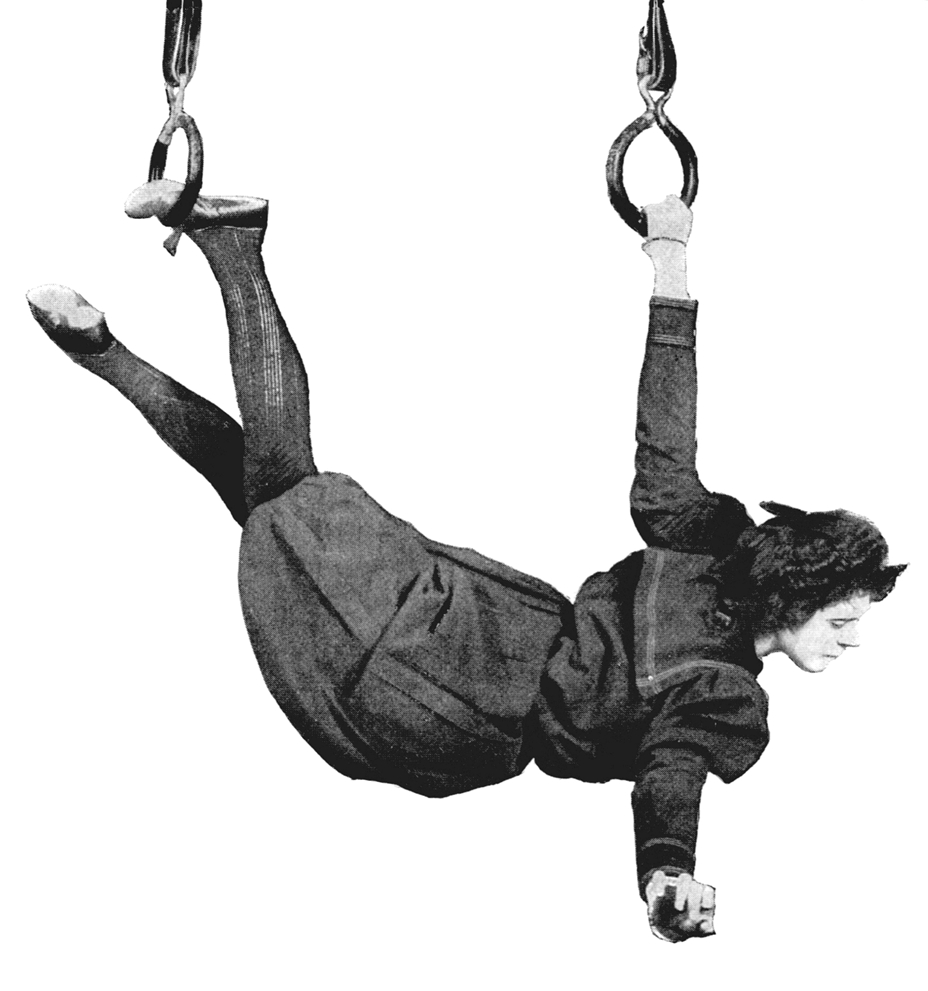
Dumb-bells, Indian clubs and gymnastic apparatus of various kinds are familiar to more women in the present day than ever before. Lots of girls can double themselves up into bow-knots with the aid of the hand-rings, swarm up poles like a schoolboy after apples, or swing from hand to hand along a horizontal ladder. The gymnasium begets a love for out-door exercise that is always beneficial, and when out-door exercise is impracticable the gymnasium is a very good substitute.
Of course, the chance to become especially proficient in some one branch of sport or recreation has induced many fair physical culturists to take up that mode of exercise which seemed to offer the most attractions or to promise the most beneficial results. Bowling is the delight of some women. Billiards attracts quite a number of others. Even boxing is said to have its adherents and proficients among the fair sex.
Whether the twentieth century will witness the development of the girl pugilist is an interesting problem. A Chicago physician is credited with introducing a set of boxing gloves into the family of one of his patients, and the result was said to be extremely satisfactory. Although bruised foreheads and bloodshot eyes were the first evidences of the operation of the novel tonic, the children for whose use the gloves were intended are now the hardiest and healthiest set of youngsters in the neighborhood. The only girl of the family is nearly fifteen years of age, but, animated by the example of her brothers, she went into training, and in a very short time became champion of the household, despite the thoroughly earnest efforts of her eldest brother, aged sixteen, to knock her out. She is one of the prettiest girls in Chicago, too, according to her fond father, and her sparring bouts are multiplying her strength without in the least impairing her modesty or her manners. Perhaps the time is coming when the idea of a manly escort will be laughed to scorn, and the “big brother” will no longer be needed to avenge slights upon a sister amply able to avenge herself.
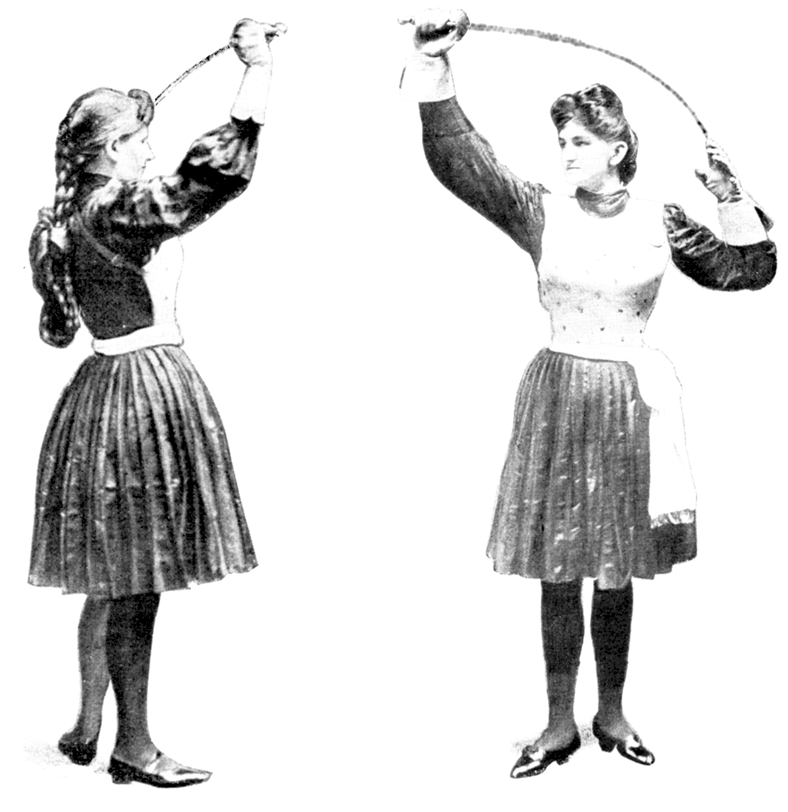
If dueling were yet the fashion many a woman might substitute a challenge for the commonplace proceedings of the breach-of-promise or divorce suit to which she now has recourse for satisfaction when betrayed by faithless man. Hundreds of ladies to-day can handle the fencing foil or dueling sword with a skill that many a gallant of bygone times might have envied. The Berkeley Athletic Club in New York has a ladies’ fencing class, many of whose members could hold their own with some of the best known amateur swordsmen in the country, and the number of women who can fence is constantly growing. Exercise with the foils is a capital thing for reducing superfluous avoirdupois and making the body supple.
Actresses discovered that fact long ago, and the stage favorite, whose beauty charms all who meet her and for whom time seems to have no terrors, admits that most of her health and endurance is due to fencing, which she learned some years ago and practises daily. Another well-known actress attributes the suppleness for which she is noted to the same exercise, It is in numerous private houses, however, that the clash of the foils is awaking an echo that will soon be ringing throughout the homes of the land. Matron and maid fence together, the one to avert stoutness, the other to attain agility.
Women prominent in society, in science, in literature and in art are among the devotees of the foils. Attired in suitable costumes they lunge and parry in a way that would captivate the hears of all the world, if the world could only witness their bouts. Men, however, are strictly barred from such exhibitions, and nothing is more abhorrent to lady fencers than publicity in their diversion.
Fortunately for the uninitiated who would fain know what women look like in fencing pose and costume, a staff photographer of the Illustrated American was enabled, through the courtesy of the manager of the Eden Musée, in New York, to take instantaneous photographs of several members of the female troupe of professional fencers who are giving exhibitions in this country, and these afford an excellent illustration of the subject.
From "Daughters of the Lost Century"
Support women's sports and SHARE this story with your friends!
This article was written by a WomenTalkSports.com contributor. Sign up here to start publishing your own women's sports content.
MOST POPULAR POSTS
posted by Girls Riders Organization, Inc.
07/01/11 at 9:45am
posted by From A Left Wing
06/27/11 at 8:06pm
posted by Loren Fogelman
07/01/11 at 9:39am
posted by All White Kit
10/19/10 at 2:15pm
posted by Women Undefined
07/31/10 at 10:26pm
posted by All White Kit
06/08/11 at 1:39am
posted by MsAkiba
10/11/09 at 2:40pm
posted by Swish Appeal
07/03/11 at 2:49pm
posted by Muslim Women in Sports
07/03/11 at 10:35am
posted by All White Kit
07/02/11 at 9:46am
LATEST WTS POSTS
posted by My so-called FABULOUS life: Brianna Glenn
Today at 5:41pm
posted by Byline to Finish Line
Today at 3:25pm
posted by SLAM Online -W
Today at 3:20pm
posted by Swish Appeal
Today at 3:15pm
posted by From A Left Wing
Today at 3:04pm
posted by Inspiring Sports Women
Today at 3:01pm
posted by Softball Performance Blog
Today at 2:57pm
posted by They're Playing Basketball
Today at 2:54pm
posted by SkaterGirl
Today at 2:52pm
posted by Wombat Sports
Today at 2:43pm
Media reports about the pioneers of American women’s sports & fitness originally published over 100 years ago....
full profile
For more, visit LostCentury's Full Profile
RECENT COMMENTS
Congrats on a successful day, Amy!!...more
posted 07/05/11 at 6:41pm
on Race report: A Tri in the Buff

thanks Emur....more
posted 07/03/11 at 11:21am
on Forget being a good skater for a girl. She is just an awesome skater in general.

you are awesome and an inspiration! good work sista !
...more
posted 07/03/11 at 8:55am
on Forget being a good skater for a girl. She is just an awesome skater in general.

that would be awesome.you can add me on facebook....more
posted 07/02/11 at 2:30pm
on Forget being a good skater for a girl. She is just an awesome skater in general.

Hey Brianna - Keep up the good work. We'll try to come out and watch you skate in LA later this mont...more
posted 07/02/11 at 1:43am
on Forget being a good skater for a girl. She is just an awesome skater in general.


No one has commented on this yet. Be the first!