
You had me going until that ignorant use of the word Homophobia.
Being opposed to people stea...more
posted 05/26/13 at 3:08am
on Scary Lesbian Kisses Threaten WNBA Viability





posted by The Rabbit Hole
Tuesday, December 27, 2011 at 10:06am EST
Blogger Courtney Szto is a Master's Student studying the socio-cultural aspects of sport, physical activity and health (or as some call it Physical Cultural Studies). Bachelor's in Sport Management. Former tennis coach & ropes course facilitator.
Support women's sports and SHARE this story with your friends!
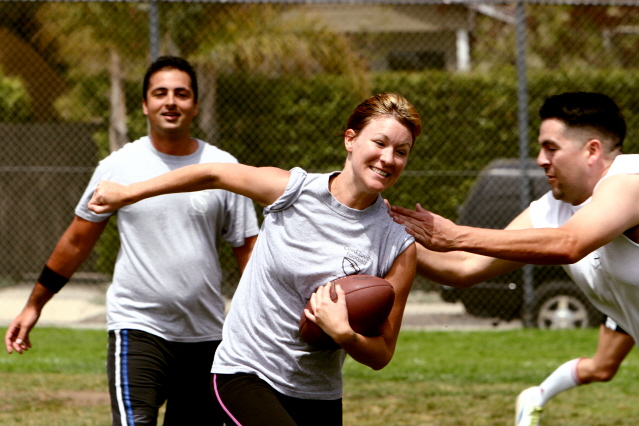 Photo from Plantsocialsports.com
Given that sport is one of the few arenas where genders are (predominantly) still separated from the outset, co-ed sport seems like a reasonable middle ground. The argument stands that co-ed sports provides more opportunities for women and young girls to participate, but I think it is about time that we re-vamp the co-ed sports system to move it past increased participation and towards equitable experiences.
For women, co-ed sports generally offer greater athletic challenges. The play is faster and the skill set often higher than that of playing with other women, at any level; yet for men, co-ed sports represents relaxed play. For women, co-ed forces you to step up your game; for men, co-ed is designed to make sure that you tone down your game. Sharing the same playing surface provides anything but an equal experience.
Most co-ed leagues institute rules changes to make things "more fair" for women participants. For example, goals/baskets/runs scored by women equal more points than any goal/basket/run scored by a man. There are rules on the numbers of genders on the field at the same time, which often states that it is okay to have more women than men on the field but it is never okay to have more men than women. As much as these rules might have been appreciated a few decades ago, these concessions just don't cut it anymore. Yes, the opportunities exist to compete with men, which would have been unthinkable before but these "rules" also reproduce the ideas that ALL women athletes are at a disadvantage on the field/court/ice and EVERY man poses more of a competitive advantage than any number of women. It is also important to note that novice men who participate in co-ed sports receive no advantages and are never perceived of needing them.
As someone who loves to play co-ed hockey, I have recently run into two personal co-ed conundrums. The first is that playing organized co-ed hockey (versus open competition where gender numbers do not matter) means that I usually don't get to play with my fellow women players. Recently, I was asked to be a spare in a co-ed league where a minimum of two women were required on the ice at all times. We had five women at this particular game - two on defense, three at forward positions. The team decided to switch out woman-for-woman. In other words, a woman defencemen would change with a woman defenceman and women forwards would only change for women forwards. Thus, we met the gender quota but I never got to play with my friend! Half the fun of sports is socializing with your friends but the emphasis on avoiding male domination makes it extremely difficult for women to bond with each other while playing.
The second occurrence which got me thinking was the locker room. This rink decided that it was better to place women competitors in the same locker room and men competitors in the same locker room rather than having opposing teams in different rooms. Arguably, the whole point of sports is Us vs. Them but suddenly I found myself in the locker room with Them! So rather than attempting to build relations between genders and through teams this particular co-ed rink reinforces the notion that gender is the defining line between people.
I have been looking into co-ed programming in Western nations and have found that, unfortunately, everyone operates on a very similar basis - rule concessions for women and gender quotas. The best thing that I have found so far is the 'open' competition I mentioned earlier where gender and skill are irrelevant and everyone plays together; however, depending on the individuals that show up for this I can see it going very well or very poorly. I am on a quest to figure out if there is a better way for men and women to compete against and with each other. I suppose I should mention that most of the gender discrepancies we see in sports today exist merely because sports were never created with women in mind; and hence, sports showcase the biological advantages that men possess - speed, strength, power etc. If sports were designed with difference skills in mind (e.g., strategy, endurance, accuracy) I doubt that the need for extra rules and quotas would be necessary. Nevertheless, I believe there is a way for women and men to compete in the sports that exist today in a far more equitable manner and I am reaching out to my fellow bloggers (and blog readers) to help me out. If you know of any programs or participate in any programs that seem to be doing something right I would really appreciate a comment or please contact me.
Support women's sports and SHARE this story with your friends!
MOST POPULAR ARTICLES & POSTS
LATEST ARTICLES & POSTS
Tue at 9:12am
Tue at 9:10am
Mon at 9:36pm


Blogger Courtney Szto is a Master's Student studying the socio-cultural aspects of sport, physical activity and health (or as some call it Physical Cu...
full profile
For more, visit Resident_Badass's Full Profile

RECENT COMMENTS
You had me going until that ignorant use of the word Homophobia.
Being opposed to people stea...more
posted 05/26/13 at 3:08am
on Scary Lesbian Kisses Threaten WNBA Viability

She is one of the best player in basket ball and is really good.
http://www.coomberlaw.com/bu...more
posted 04/30/13 at 3:56am
on The Chicago Sky Selects Elena Delle Donne Second Overall in 2013 WNBA Draft
The worst kept secret in all of professional sports is that the majority of WNBA ballers are lesbian...more
posted 04/24/13 at 11:41am
on Brittney Griner's way of coming out is progress in the sports world

In terms of sport figures, I'm sure a Pat Summitt statue is in the works.
...more
posted 04/15/13 at 10:11pm
on Statues of Female Leaders?

I'm not a big Stanford fan, but at least they have a legitimate program and did it largely without t...more
posted 04/10/13 at 5:50pm
on Why Cal is my new favorite team

Women Talk Sports Podcast - March 5, 2013
In the March edition of the "Women Talk Sports" podcast, Cara and Stephanie use their running background to explain the Dayton 500 and break down the ...[Listen/Download for iTunes]
Women Talk Running Podcast - March 5, 2013
In the March edition of the "Women Talk Running" podcast, Cara and Stephanie wrap up the Millrose Games, give you more Mary Cain news, give our respon...[Listen/Download for iTunes]
Women Talk Sports Podcast - January 28, 2013
In the January 2013 episode of the Women Talk Sports podcast, Cara and Stephanie share several points that will leave you feeling hopeful about the Na...[Listen/Download for iTunes]
There are 2 comments on this post. Join the discussion!
Thanks for asking! Equitable experiences meaning that I would like to see the dividing lines fall between skill levels rather than between genders. I don't, necessarily, think that everyone should have the same experience when playing sports because different roles and positions will always ensure a difference. But I would like to see co-ed sports move away from the assumption that women always need a little help to be successful when competing against and with men. Therefore, equitable as viewing each player as valuable not based on their gender but by what they bring to the team. Currently, most of the co-ed programs use an "affirmative action" type approach, which is not equitable it merely reinforces difference.
Wednesday, December 28, 2011 at 12:35pm EST
Wow! Okay, let's see if I can answer all that you have brought up:
1.) You are absolutely correct in saying that determining what an equitable system would look like is largely subjective, I agree. However, I don't think we can generalize to say that most women play sports for reasons outside of winning or competition. I certainly play to win/compete but I also think people who are drawn to team sports participate because of the camaraderie. I have no problem with guys wanting to win but lets put things in perspective here - most co-ed sports leagues are beer leagues, despite wins or losses no one is making a career out of their favourite sport.
2.) I agree that not all women would be comfortable enough or "good" enough to play in open competition; but, at the same time, I don't think most women want "pity" rules either. For example, my mother hates hitting of the "ladies tees", she takes every opportunity to hit off, what she calls "the boys tees". Like I said, the "gesture" of co-ed rules was nice but I think we have moved past the point of courtesy (or I HOPE that we have moved past the point of courtesy).
3.) I'm not entirely clear about your point about "dropping the gloves" - do you actually mean fighting in hockey? Or are we talking about a metaphorical "ability to protect myself on the ice"? If we're talking about actual fighting, it's not allowed in any recreational leagues that I know of, co-ed or otherwise, so I'm not sure why you think women would be a liability in this instance.
4.) I do not believe that men should have to play down in order to participate in co-ed sports. I would like to explore the possibility of men and women competing at their best on the same field. Is this possible? Maybe not but it doesn't seem like too many have put a lot of effort into figuring it out.
5.) I have completed my Masters now and am working in recreational programming. I have run into complaints in my day-to-day work about my program's current co-ed structure; hence, my blog post. I am not saying that women would/do excel at games of accuracy, strategy etc. but that it would be a step towards levelling the playing field because these skills do not play towards physiological advantages that men have (although endurance may).
6.) This certainly is a topic on a different tangent but funny that you include Brown in your statistics as my hockey playing friend I was alluding to played varsity for Brown. Anyways, I think the "appropriateness" comes down to what is the purpose of Ivy league athletics or NCAA athletics, which is to win, I would assume. Thus, you seek out the best players from wherever they hail. I was a competitive tennis player and I know that most of the US schools I was looking at boasted rosters full of international students (and not canadians since we aren't know for our tennis). Our Canadian Hockey League, which is a stepping stone to the NHL, has a rule of 2 international imports only - a way of keeping the CHL "pure". Not sure that I agree with it because it creates a sense of nationalism and us vs. them that I don't think is great for the game; but at the same time I can certainly understand wanting to keep spots open for those who are citizens. I guess in short, do you want the best competition or do you want collegiate sports to be a product of said nation?
I have a feeling we come from different sides of the bench on certain topics, given your comments about feminist social theory and the "sisterhood", but I appreciate the time and thought you have put into your comments. Thanks for reading and I look forward to more discussion.
Thursday, December 29, 2011 at 7:55pm EST