
You had me going until that ignorant use of the word Homophobia.
Being opposed to people stea...more
posted 05/26/13 at 3:08am
on Scary Lesbian Kisses Threaten WNBA Viability




posted by The Rabbit Hole
Tuesday, April 10, 2012 at 10:02am EDT
Blogger Courtney Szto is a Master's Student studying the socio-cultural aspects of sport, physical activity and health (or as some call it Physical Cultural Studies). Bachelor's in Sport Management. Former tennis coach & ropes course facilitator.
Support women's sports and SHARE this story with your friends!
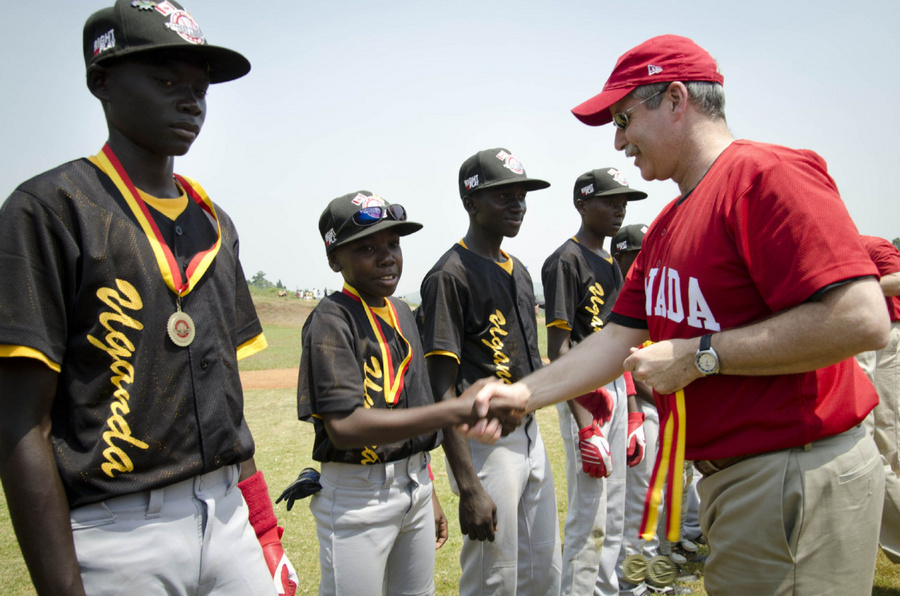 Photo from the Toronto Star.
Recently, Sportsnet aired a 30 minute documentary about the Canadian little league team flying to Uganda to play a World Series game that never occurred called Fair Ball. The documentary and the team were sponsored by Right to Play, an international humanitarian organization that uses sport and play as a means to facilitate international development. Despite the goodwill that was intended, I would like to take this opportunity to highlight the problematic power relations that are reproduced by this documentary.
In 2011, Uganda was the first African team to ever qualify for the Little League World Series. They were set to play Canada in their first game; however, due to improper documentation the American Embassy refused to grant the Ugandan team travel visas. Saudi Arabia took Uganda's place in the World Series. Five months later, the Canadian team from Langley, British Columbia decided that the game should still be played. The documentary is filled with all of the feel good moments: friends are made, Canadians are humbled by the experience, a "social injustice" is rectified, and Uganda would go on to win the game. How could this trip and documentary be a bad thing?
1.) Westerners are upheld as benevolent and Africans as grateful recipients. Many international development volunteer trips travel under the auspice that we, the privileged, will go and make a difference and the world will be a better place because of it. As Canada's head coach tells his team before they leave:
What Uganda is going to be for you is you're going to meet new friends, you're going to learn their lifestyle. I want you guys to embrace the experience in Uganda and if you do that you leave Uganda a better person.
During the baseball game, the Canadian coach approached the Ugandan coach and proposed that they end the game in a draw so that no one would walk away a loser. This was an extremely stereotypical Canadian act, but while it trumpets sportsmanship it also whispered - you're boys have so little, the last thing they need is a loss. Credit to the Ugandan coach for stating "I think we deserved a win" and, ultimately, won the game on the field. Yet, after the game one of the Canadian players says "We were happy they won because look how happy they were just to get the win." I do not fault the young Canadian for being happy for the Ugandan team, but his comment is saturated with how Western nations view the African continent - with pity.
2.) Westerners should feel sorry for Africa. In the documentary, a few of the Ugandan players showed the Canadians around their homes, which were mostly in Nsambya ghetto. All of the narratives that followed from the Canadian players and parents that travelled with the team were of heartbreak and pity:
"Your heart breaks."
"It was heart breaking. It was frightening. It was so devastating to me."
"I never expected it to be like this."
"What we have versus what they live with."
"I feel so sorry for them."
Admittedly, the Ugandan coach, George Mukhobe, said on camera that "Life in Uganda for my kids is horrible", but each of the boys who showed Canada how he lives did so with pride and even the Canadians commented on how proud they were of their homes. What does it say about us when someone proudly shows us their home and we feel nothing but pity? Is that a trained Western social response? Is that genuine guilt?
Felix, the Ugandan player who ends up scoring the winning run for Uganda tells the camera, "I'm very proud of where we live because we improve. We can improve on poverty."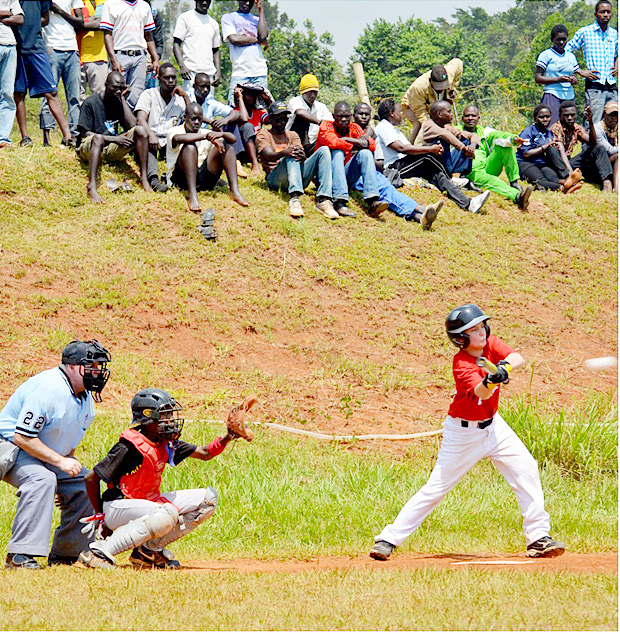 Photo from the Vancouver Sun.
3.) Africa is drawn as backwards and primitive. On numerous occasions the documentary reaffirms what most of North America assumes, that Africa is incapable of civilization by Western standards. It starts with the opening footage of the documentary showing young Ugandan boys playing baseball with makeshift equipment. Then progresses to explaining why the Ugandans were denied US visas in the first place. As the narrator, Gregg Zaun, former major league player explains:
Birth certificates aren't normally kept in Third-World countries unlike Canada and more developed nations. Even the President of Uganda is unsure of his actual age.
Then the narrator states:
I thought the Ugandan skill level would be raw and rudimentary, while the Canadians would be rusty having not played for months. I couldn't have been more wrong.
This documentary, like so many that feature African nations, does an excellent job of showing the squalor in which these children live. Raw sewage in the streets, small living quarters hosting large families, and flies landing on the faces of small children make it indistinguishable from a World Vision advertisement. Also, Kenneth, a Ugandan player, is explained as an orphan because of Uganda's "tribal culture", whereby widowed women who choose to remarry must give up all ties to her children.
Repeatedly, it is hammered home how primitive the lives of Ugandans are and how lucky we are to live in Canada. I do not deny that the living conditions of Ugandans are far less hospitable than that of the average Canadian but as a documentary, I believe that it owes Uganda the respect of explaining how British colonization led to civil unrest well into the 1960's, which then set the stage for Idi Amin's military coup. Furthermore, as Canadians we do not need to look any further than our own First Nations reserves to find unacceptable living conditions.
In Orientalism, Edward Said, wrote about how the Orient (largely referring to areas of the Middle East and India/Asia but can also be used to describe any place outside of Western Europe and America) was (and is) always described as the 'Other', as an entity that remains unchanged and fundamentally different from the West. The problem with these documentaries and descriptions is that they maintain the West as "modern, greater than the sum of its parts, full of enriching contradictions and yet always 'Western' in its cultural identity" (Said, 1997:10). It creates a terrible 'us' and 'them' reality that is only true because we make it so. In Fair Ball, despite the fact that the documentary highlights the lives of the Ugandan players, it is clearly told from a Western perspective and the Canadian players and representatives make up the bulk of the film. It is a story told by the West to the West and the Ugandans are merely filler for the film. It is a mediated pat-on-the-back for the Canadians more than it serves to rectify any social injustices. Some of you might argue that Fair Ball gives the Ugandans a voice that they would have never received otherwise. As I response I think that Bell Hooks (1990) explains it best:
No need to hear your voice when I can speak about you better than you can speak about yourself. No need to hear your voice. Only tell me about your pain. I want to know your story. And then I will tell it back to you in a new way. Tell it back to you in such a way that it has become mine, my own. (pg.151)
This is not unlike some of the Ugandan reactions to the Joseph Kony youtube video put out by Invisible Children. The Ugandans were upset that what was represented on film did not match their own experiences and that the story was told by a white foreigner. Ultimately, I think that what the Canadian team did was great and I would like to believe that both sides benefitted equally from the experience. However, it is dangerous to act like an saint when travelling across borders and think that your noble actions will be better than nothing. The stories, films and photos can be just as harmful from thousands of miles away as can be your presence in person. For it is the words and images that reproduce the assumptions and misguided ideas that separate 'developed' from 'undeveloped'. We set the standard and then applaud ourselves for meeting it.
For more on Orientalism, watch this clip:
hooks, b. (1990). Yearning: Race, gender, and cultural politics. Boston: South End.
Said, E. (1978). Orientalism. New York, NY: Random House.
Said, E. (1997). Covering Islam: How the media and the experts determine how we see the rest of the world. New York: Vintage Books.
Support women's sports and SHARE this story with your friends!
MOST POPULAR ARTICLES & POSTS
LATEST ARTICLES & POSTS
Tue at 9:12am
Tue at 9:10am
Mon at 9:36pm


Blogger Courtney Szto is a Master's Student studying the socio-cultural aspects of sport, physical activity and health (or as some call it Physical Cu...
full profile
For more, visit Resident_Badass's Full Profile

RECENT COMMENTS
You had me going until that ignorant use of the word Homophobia.
Being opposed to people stea...more
posted 05/26/13 at 3:08am
on Scary Lesbian Kisses Threaten WNBA Viability

She is one of the best player in basket ball and is really good.
http://www.coomberlaw.com/bu...more
posted 04/30/13 at 3:56am
on The Chicago Sky Selects Elena Delle Donne Second Overall in 2013 WNBA Draft
The worst kept secret in all of professional sports is that the majority of WNBA ballers are lesbian...more
posted 04/24/13 at 11:41am
on Brittney Griner's way of coming out is progress in the sports world

In terms of sport figures, I'm sure a Pat Summitt statue is in the works.
...more
posted 04/15/13 at 10:11pm
on Statues of Female Leaders?

I'm not a big Stanford fan, but at least they have a legitimate program and did it largely without t...more
posted 04/10/13 at 5:50pm
on Why Cal is my new favorite team

Women Talk Sports Podcast - March 5, 2013
In the March edition of the "Women Talk Sports" podcast, Cara and Stephanie use their running background to explain the Dayton 500 and break down the ...[Listen/Download for iTunes]
Women Talk Running Podcast - March 5, 2013
In the March edition of the "Women Talk Running" podcast, Cara and Stephanie wrap up the Millrose Games, give you more Mary Cain news, give our respon...[Listen/Download for iTunes]
Women Talk Sports Podcast - January 28, 2013
In the January 2013 episode of the Women Talk Sports podcast, Cara and Stephanie share several points that will leave you feeling hopeful about the Na...[Listen/Download for iTunes]
No one has commented on this yet. Be the first!