
Great article but really not true; there are many players involved in the NPF that are not from the ...more
posted 08/26/14 at 1:28pm
on Softball Standouts Plourde and Prezioso Represent Atlantic 10, Exemplify Mid-Major Potential at Next Level




posted by The Rabbit Hole
Wednesday, August 8, 2012 at 8:35pm EDT
Blogger Courtney Szto is a Master's Student studying the socio-cultural aspects of sport, physical activity and health (or as some call it Physical Cultural Studies). Bachelor's in Sport Management. Former tennis coach & ropes course facilitator.
Support women's sports and SHARE this story with your friends!
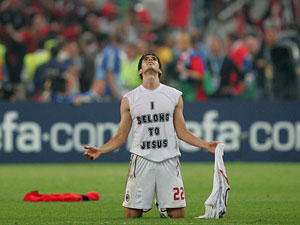 Photo from Local Secrets.As globalization continues to merge sports and cultures that have never met before, religion will increasingly become a factor in how we play and compete. Currently, the Summer Olympics happens to coincide with the holy month of Ramadan, in which Muslims observe a month-long fast during daylight. According to the BBC, London has done well to incorporate the needs of Muslim athletes:
Given the special circumstances, different teams and athletes have made different choices. Some have postponed the fast, some observe it strictly, and others have chosen a middle way.
Hadia Hosny, a women's single badminton player in the Egyptian squad, explained that some athletes have decided that they won't fast on competition days.
I write this as an agnostic who finds the multiple interpretations of religion in sport rather fascinating. For anyone who has seen the hockey movie, Breakaway, (and I know it's not many) a main tenant of the movie is the balancing between being Sikh and being a hockey player. At one point in the movie the Sikh players face disqualification for not wearing hockey helmets. The protagonist asks his teammates to remove their turbans to don a helmet and one teammate replies something to the effect, "I'm not a part-time Sikh." Which, begs the question - are Muslims who make "different choices" regarding Ramadan being part-time Muslims?
* * *
In a blog titled, Sport and Religion: Similarities and Differences, the author writes
Sport and religion are two of the oldest social institutes in history. They have been forever linked since the times of the Ancient Greeks to the contemporary athlete thanking god for victory.
He lists similarities that exist between the two institutions including the fact that both have places and buildings for their events, both are historically dominated by men, both can give deep personal meaning to people's lives, and both give a sense of belonging. It is not difficult to see why so many express that sport IS their religion. The author then lists some differences, some with which I must contend:
The purpose of religion is to transcend material life pursuing spiritual goals. Sport focuses on material issues.
Material yes, but I would argue that with our use of technology and attempts to modify genetics that (high performance) sport lives to transcend itself. Athletes constantly push their bodies past the limits of human ability and we love nothing more than a new world record so I would argue that transcendence is more a similarity than a difference.
Religion is rooted in faith. Sport is rooted in rules and relationships.
Right, because there are no rules in religion. None written down. Anywhere.
Religion is non-competitive, whereas sport exhibits a competitive lifestyle.
There is a reason that ethnic cleansing takes place. There is a reason why people of different religions have not gotten along for centuries and it is generally rooted in a belief that one set of beliefs is more superior than the other. It may not be a competition in a stadium but I definitely think it qualifies as a competition of beliefs.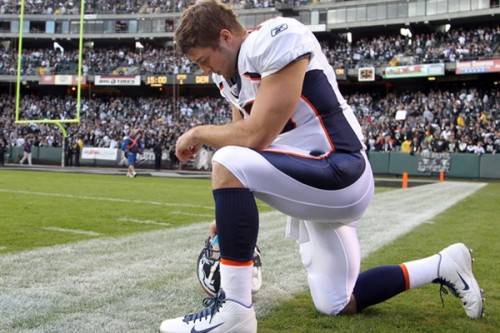 Tim Tebow. Photo from Holy Cross.Askmen.com posed the question - does religion have a place in sports? The article specifically draws upon Tim Tebow and his mixing of God and football. The unidentified author writes
Tebow has the right to be devout and be thankful for everything he has. But does religion have a place in sports? Is it acceptable to kneel and pray to God after every game, or is that too much? Should Tebow be thanking Jesus or his teammates first?
As fans, we're paying to watch football. We spend our hard-earned money on expensive tickets, overpriced food, beer and merchandise. Our Sunday ritual starts in the afternoon, when we take our seats in our hallowed domes or on our couches. Tebow is being paid millions this season to play and talk about football. And right now he's playing well (or well enough) to win games and electrify the crowd. But he needs to respect that he's being paid as a football player, and he should show that respect to the fans. He has every right to be deeply devoted to God, but we also have the right to watch football without constant religious commentary.
Religion, like politics, doesn't have a place in sports.
I suppose what this author wants is for Tebow to be a "part-time Christian". Yes, be as Christian as you like off the field but please check your cross at the door to the field. Unfortunately for this author, politics and religion do have a place in sports. Just as Tim Thomas exercised his free will to say "no thank you" when the Boston Bruins were invited to the White House, Tim Tebow is also allowed to thank God before his teammates. Venus and Serena Williams always thank their God, Jehovah, when lifting a new piece of hardware and if you don't want to watch it, you don't have to. But if you accept that these individuals have the right to pray to God, Jehovah, Allah and whoever/whatever else off the field then you must also accept that their beliefs do not stop once they put the jersey on. Expecting people to turn their beliefs on and off at will is a bit much. If someone is homophobic off the field that usually follows them onto the field as well. If someone doesn't believe women are equal off the field they generally don't appreciate them as equals on the field. The differences of the world do not disappear because we are all one happy family on the field with the same coloured jersey, even though many would have us believe this. Can sport bring us together? Yes. Absolutely. But it is in spite of these differences, not because they magically disappear. We acknowledge and incorporate.
What the Askmen.com author seems to have forgotten is that Tim Tebow is a human being. I know we like to think that millions upon millions of dollars can change that but it doesn't. We all have the human right to leisure time and play. We also have the human right to any faith that we choose. Let the negotiation continue.
Support women's sports and SHARE this story with your friends!
MORE ABOUT THIS AUTHOR:
Blogger Courtney Szto is a Master's Student studying the socio-cultural aspects of sport, physical activity and health (or as some call it Physical Cu...
full profile
For more, visit Resident_Badass's Full Profile
LATEST ARTICLES & POSTS
Fri at 7:35pm
Fri at 1:53pm
Fri at 1:51pm
Fri at 1:45pm
Fri at 1:44pm
Thu at 1:53pm
Thu at 1:52pm
Thu at 1:48pm
Thu at 1:47pm
RECENT COMMENTS
Great article but really not true; there are many players involved in the NPF that are not from the ...more
posted 08/26/14 at 1:28pm
on Softball Standouts Plourde and Prezioso Represent Atlantic 10, Exemplify Mid-Major Potential at Next Level

What she did I'd fantastic but she was still a good 14 seconds behind the winner and, really, the Ke...more
posted 07/22/14 at 4:04am
on 2 seconds, no finish clock picture, but satisfaction: Molly Huddle breaks her own AR

Does money make champions ! History have taught us that money does not means success overnight . Mos...more
posted 06/20/14 at 8:25pm
on Sparks need a change, but what kind?
congrats to Maria on her French Open win!!...more
posted 06/11/14 at 10:06pm
on Maria Sharapova Named The Face Of Avon Luck Fragrances
| SAUCUONY 500 MILE CHALLANGE |
| Daily Workout |


No one has commented on this yet. Be the first!