
She is one of the best player in basket ball and is really good.
http://www.coomberlaw.com/bu...more
posted 04/30/13 at 3:56am
on The Chicago Sky Selects Elena Delle Donne Second Overall in 2013 WNBA Draft





posted by The Rabbit Hole
Friday, December 21, 2012 at 12:23pm EST
Blogger Courtney Szto is a Master's Student studying the socio-cultural aspects of sport, physical activity and health (or as some call it Physical Cultural Studies). Bachelor's in Sport Management. Former tennis coach & ropes course facilitator.
Support women's sports and SHARE this story with your friends!
In effect, when the personal becomes political in sports, the cheerleading often comes to an abrupt halt. If athletes use their status and recognition to promote social and political causes, they often find themselves criticized and pushed to the sidelines (Kaufman, 2008). As Candaele and Dreier (2004) note, being a "jock for justice" is not without its consequences. Although it is generally accepted when Hollywood celebrities use their status to advance social and political issues, athletes are expected to play and not protest. When athletes do join the political discourse and advocate for social justice, they are likely to face a backlash of contempt and scorn. Indeed, there is a long list of athletes who have experienced such a reaction after publicly proclaiming their political convictions on the playing field: Tommie Smith and John Carlos (and Peter Norman), Muhammad Ali, Mahmoud Abdul-Rauf, Carlos Delgado, Toni Smith, Steve Nash, Marco Lokar, Etan Thomas, and Craig Hodges among others. (Kaufman & Wolff, 2010, p.156)
We live in a world where celebrity is probably the most valuable currency of them all. Have it and your opportunities are endless and those who want it will do almost anything to get it. It's not about anything but being known, and boy do we LOVE our celebrities. We talk about them, write about them, photograph them, and chat with them on Twitter. Some choose to use their celebrity to make good for themselves and some choose to use their celebrity to make good for others. Athletes are no different, but, as is touched on in the above excerpt, where Hollywood revels in politically active thesbians the world of sport generally discourages athletes from having anything more on their minds than the next game. Perhaps, this is because music and movies are supposed to come with a message and a story but sports are supposed to be nothing more than a test of wills. We watch sports to be entertained, drink beer, and to get away from the 'real' world. This would certainly explain the backlash against, NBC Sports commentator, Bob Costas for his comments on gun control during a recent episode of Sunday Night Football (talk to us about football Bob, not guns) and the athletes who have also been criticized for their personal activism. For example:
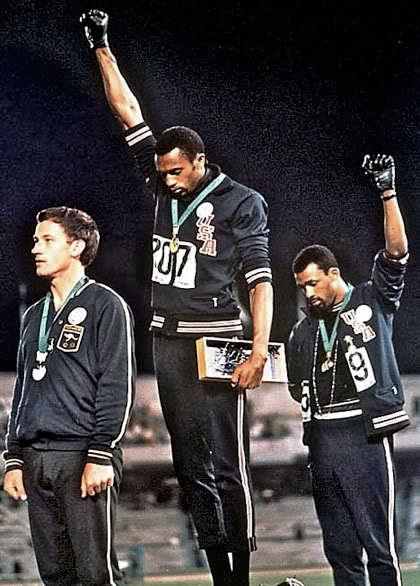 Photo from We Waste Time.Funny thing is that we are sold lots of ideas when watching sports. And I do mean sold. We are sold this beer over that beer, this bank over that bank, this team over that team. We are sold that this player is more valuable than that player, this defensive system is more effective than that one, and that this prospect will be a star and not that other guy. So then why is that we accept athletes trying to sell us a soft drink that they probably don't even like but not a political cause that they believe in? I'm not talking about safe charitable activities that teams do together like going to the children's hospital or the athlete that joins an organization like Right to Play for PR purposes but athletes who truly believe in a cause that happens to be controversial such as gun control, labour issues, racism, or war. And why is it that showing scenes of players hanging out with kids at that local children's hospital doesn't raise fury amongst drunk sports fans because *spoiler alert* health care and which kids receive it is also a political issue. How many actors spoke at both the Republican and Democratic conventions this year? And how many athletes? I can understand why athletes tend to shy away from controversial topics because it means financial repercussions for them from sponsors but if and when they are willing to put ethics over dollars then why are the fans not there to support them? Is it because we don't believe that athletes are credible authorities on issues that don't involve a ball or running? If credibility is the concern then we should be spreading the same blame across the table to everyone who talks about anything. There are academics, journalists, and heads of state that do not fully understand what they are talking about so if anyone should be raked over the coals for speaking outside of their comfort zone it shouldn't it be those who are paid to do it? As Kaufman and Wolff (2010) explain in their article about athlete activism many speculate that this disdain for politically inclined athletes stems from the belief that sports and politics should be as separate as church and state, and I think we know how un-separate those two latter issues can be:
Critics of activist athletes often argue that athletes should play and not pontificate, that the playing field is no place for political protests. Indeed, despite the views and actions of the athletes discussed in this article, we recognize that the overwhelming majority of athletes do not become political activists. In fact, many athletes seem to exist in a world devoid of political and social issues. Sage (1998) attributes this political inaction to a "neutrality vision of sport," which assumes that sport exists outside the social, political, and economic realms of society....But there is no denying the fact that sports are imbued with political meanings. From the financing of stadiums through public tax dollars to the display and veneration of the flag, sports are inherently political. Therefore, to suggest that athletes cannot comment on - much less take action on - important issues of the day is an affront to the meaning of participatory democracy. (p.165)
Kaufman and Wolff (2010) interviewed 21 athletes, from a variety of sports, who engaged in social or political activism to try and gain insight into why some choose to use their sport for social change. They also argue that sports and activism are not mutually exclusive, rather extremely similar. They break down their analysis into four explanations of why certain athletes choose to become politically and socially involved.
1.) Social consciousness - athletes often travel to many different cities and countries and have the opportunity to learn about different cultures and places in a way that most others are unable to do. These experiences can raise social consciousness for some athletes and inspire them to become more involved in political issues.
2.) Meritocracy - the notion that everyone has the right, and the opportunities, to achieve more. Some athlete activists cite meritocracy as a goal of creating a level playing field that will enable people to earn better life circumstances.
3.) Responsible Citizenship - the purpose of sports has traditionally been used to teach us how to become better individuals. We are supposed to learn teamwork, cooperation, and leadership so how can we fault athletes when they implement these skills off the field?
4.) Interdependence - this extends beyond the notion of teamwork but that we are all connected is some form and that success for one is dependent upon the support of many others.
There are some pretty interesting quotes from athletes in this particular article but I have selected a couple that I believe we should really consider when we challenge athletes who choose to use their celebrity to engage with political issues. Paul Farber, a former member of the University of Pennsylvania track team and a cofounder of PATH (Penn's Athletes and Allies Tackling Homophobia and Heterosexism) suggests
[A]thletics is all about pushing you to your best and pushing you to your most productive and your limits. So it should be all about doing away with the status quo. If the status quo is an 11.3 [second] 100 [meter sprint] then an 11.2 100 is breaking the status quo.
Matt McGraw, a baseball player at the University of Maine and one of the founding members of Male Athletes against Violence (MAAV), takes a socially responsible perspective to his activism:
On the one hand, I feel like everyone should have social responsibility and therefore as an athlete you shouldn't just write them off, but as an athlete you should use that too, to better a cause or promote some kind of social responsibility if you can in a proper manner. Athletes are people, and people should care what's going on in their world. Athletes are allowed to vote, they're still citizens, and it's the citizens of the world that make up how our society flows, and just because you play sports for a living or play sports in college you shouldn't lose that social power and just because you don't play sports doesn't mean that you should gain that social power. (p.166)
These gentlemen certainly offer valid arguments. Farber's statement about challenging the status quo could be slightly problematic in that the status quo where performance is concerned is quite different when compared to the status quo of institutional inequities but I choose to to take his statement as inspiration more than fact. Athletes are supposed to make us rethink what is possible as a human being, which, perhaps makes them the perfect candidates for political activism. Furthermore, as McGraw points out we should expect more from athletes than the dumb jock stereotype. We expect athletes to be role models for our children, even though they never really agreed to this, but we don't expect them to have (or share) an opinion on social, economic or political issues. Does this make sense? Is a role model someone who is unaware and/or too afraid of backlash to stand up for what they believe in?
I don't like Tim Thomas as an athlete or agree with his political beliefs but I do respect that he understands that his role as an athlete/human is not, to quote Kaufman and Wolfe, devoid of political or social issues and I think it is time that we support those athletes who choose to use their 15 minutes of fame to fight for something other than their pay cheques. This discussion opens a whole can of proverbial worms where celebrity philanthropy and activism are concerned and it is a topic that I will address in the new year but for now we are forced to wait and wonder if there will ever be another Billie Jean King or Muhammad Ali.
More reading on the complexities of athletes and activism:
What ever happened to the activist athlete? Huffington Post
Why don't more athletes take a stand? Sports Illustrated
Gingerly, the athlete turns activist. The New York Times.
Works Cited:
Kaufman, P. & Wolff, E.A. (2010). Playing and protesting: Sport as a vehicle for social change. Journal of Sport and Social Issues, 34(2), pp.154-175.
Support women's sports and SHARE this story with your friends!
Today on the Women's Sports Calendar:
| NCAA DI Tennis Championships May 16 - 27: Khan Outdoor Tennis Complex |
MOST POPULAR ARTICLES & POSTS
LATEST ARTICLES & POSTS
Sat at 9:12am
Sat at 8:49am
Fri at 8:44pm


Blogger Courtney Szto is a Master's Student studying the socio-cultural aspects of sport, physical activity and health (or as some call it Physical Cu...
full profile
For more, visit Resident_Badass's Full Profile

RECENT COMMENTS
She is one of the best player in basket ball and is really good.
http://www.coomberlaw.com/bu...more
posted 04/30/13 at 3:56am
on The Chicago Sky Selects Elena Delle Donne Second Overall in 2013 WNBA Draft

The worst kept secret in all of professional sports is that the majority of WNBA ballers are lesbian...more
posted 04/24/13 at 11:41am
on Brittney Griner's way of coming out is progress in the sports world
In terms of sport figures, I'm sure a Pat Summitt statue is in the works.
...more
posted 04/15/13 at 10:11pm
on Statues of Female Leaders?

I'm not a big Stanford fan, but at least they have a legitimate program and did it largely without t...more
posted 04/10/13 at 5:50pm
on Why Cal is my new favorite team

Ooh, is that bitterness I smell wafting up from Palo Alto? It almost seems like you are bashing Cal...more
posted 04/10/13 at 4:20pm
on Why Cal is my new favorite team

Women Talk Sports Podcast - March 5, 2013
In the March edition of the "Women Talk Sports" podcast, Cara and Stephanie use their running background to explain the Dayton 500 and break down the ...[Listen/Download for iTunes]
Women Talk Running Podcast - March 5, 2013
In the March edition of the "Women Talk Running" podcast, Cara and Stephanie wrap up the Millrose Games, give you more Mary Cain news, give our respon...[Listen/Download for iTunes]
Women Talk Sports Podcast - January 28, 2013
In the January 2013 episode of the Women Talk Sports podcast, Cara and Stephanie share several points that will leave you feeling hopeful about the Na...[Listen/Download for iTunes]
No one has commented on this yet. Be the first!