
She is one of the best player in basket ball and is really good.
http://www.coomberlaw.com/bu...more
posted 04/30/13 at 3:56am
on The Chicago Sky Selects Elena Delle Donne Second Overall in 2013 WNBA Draft




posted by The Rabbit Hole
Tuesday, April 2, 2013 at 8:55am EDT
Blogger Courtney Szto is a Master's Student studying the socio-cultural aspects of sport, physical activity and health (or as some call it Physical Cultural Studies). Bachelor's in Sport Management. Former tennis coach & ropes course facilitator.
Support women's sports and SHARE this story with your friends!
 What is the point of research sitting in some dusty old journal that isn't accessible to most of the public? Nothing, in my opinion; hence, the following is a shameless plug for my own research. This post touches on a couple of points from of a recent article I wrote that was published in the Sociology of Sport Journal about Nike's partnership with the Product RED campaign (Szto, 2013).
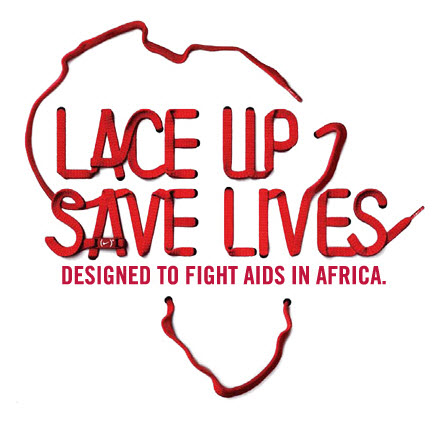
In 2009, Nike created the "Lace Up, Save Lives" campaign to launch its partnership with Product RED. Product RED was created in 2006 by Bobby Shriver and Bono "as a business strategy to raise awareness about the fight against HIV/AIDS in Africa [to] generate funds for the Global Fund to Fight AIDS, Tuberculosis and Malaria" (aka: the Global Fund). According to Nike "just by lacing up a pair of shoelaces in your favourite shoes and by going about your own life, you can help save someone else's." Sounds like a simple and noble endeavour but as they say 'the road to hell is paved with good intentions'.
As a rule of operation, RED partners are not allowed to donate more than 50% of profits to the Global Fund because Bono's intention was for RED to promote "hard commerce". The money made from RED products are directed to anti-retro viral (ARV) programs in Ghana, Lesotho, Swaziland, Rwanda, South Africa, and Zambia. Nike RED is different from other RED campaigns (e.g. Apple red iPods, American Express RED card etc.) for two reasons:
1.) Nike makes NO PROFITS from the sale of their RED merchandise
2.) Nike uses the other 50% of its profits to support grassroots educational soccer programs that focus on HIV education and testing. These programs use local African coaches to facilitate the sport education programs.
Nike is the only RED partner that makes no profits from the sale of RED products. With that said, we must also keep in mind that Nike does not donate any money unless you, the consumer, put your money on the table first. The first item launched was the Nike RED shoelaces that still sell for $4.00 USD on their website. In the promotional release Nike claimed that "wearing these RED laces is a sign that you care about others", which is great if you have the laces, I guess, but if you don't it suggests that you do not care about those living with HIV/AIDS in Africa. Other items sold under the RED label included a limited edition soccer ball and a Brazil track jacket, each retailing for $150 USD.
Nike RED is another example of how North American society continues to put the responsibility of social welfare on the individual consumer. Ethical consumption (also known as political consumerism, consumer philanthropy, compassionate consumption) describes the act of demonstrating social activism through one's purchases. The rationale behind ethical consumption is that "when aggregated, these individual choices will have the potential to transcend the actions of individuals" (Jacobsen & Dulsrud, 2007, p.471). The problem with these types of initiatives is that governments are allowed to hand their social responsibilities to corporations that are often ill-equipped to handle such issues and can operate in a manner that contradicts their attempted good deeds.
Nike RED's campaign is based on a unity between athletes, consumers and those living with HIV/AIDs. These laces, supposedly, tie us all together. However, this representation of unity with and among professional athletes performs an erasure of the African people by using professional athletes as the voices and faces of Africa's fight. To understand what I mean watch the Nike commercial below:
Did you learn anything about HIV/AIDS in Africa? Did you learn about the Global Fund? Did you see anything about the grassroots soccer programs? Did the commercial tell you how much the laces cost? What we learn from watching this commercial is that the laces can be used a bracelet, as a hair accessory, as ear phones, or eaten like spaghetti. We learn which athletes are involved but where are the people that Nike, Product RED and these laces are supposed to be helping? I argue that this commercial is a great example of Nickel and Eikenberry's (2009) argument that "celebrity philanthropy is an uncritical celebration of celebrities and their production of an elite society that can only be philanthropic by virtue of its ability to distance itself from poverty" (p.981). Nike could have used the significance of HIV/AIDS as a way of moving people to action, instead athlete endorsements are used as inspiration for consumption. This is the polar opposite to those television ads we see with emaciated African children living in squalor. There we are meant to pity them and to pick up the phone to make a donation. Here we are merely encouraged to buy stuff. You might ask what is the problem so long as the money gets to where it needs to go. Then I ask who is this campaign about? Is it about those living with HIV/AIDS or is it about Nike millionaire athletes? The problem with both of these scenarios, donating from pity or buying through inspiration, is that the beneficiary always becomes the Other - they are not us. They become faceless, distant, and a problem to be solved. They become the zoo exhibit and we are the ones behind the glass taking pictures. It makes us forget that there is no glass between us; we are as much part of the exhibit as they are. HIV/AIDS, its causes, and its victims become hidden among celebrity endorsements and Western representations of Africa.
With regard to the grassroots soccer programs Nike RED claims "through education these programs rob the virus of one of its most effective weapons - ignorance". Another blog asserts that by supporting the Nike RED campaign the people of Africa will be given "the real power: awareness". By attributing HIV/AIDS to ignorance and lack of awarness, Nike RED reproduces the idea that Africa is a "basket case" (Jardin, 2007, para.5) incapable of civilization (Hintzen, 2008). The stated purpose of the grassroots soccer programs is for its students to "make healthy choices in life" suggesting that without Nike's support young Africans naturally make unhealthy decisions. Nike promotes education (through soccer) as the only way to stop the spread of HIV/AIDS in Africa. Yet Nike RED fails to acknowledge recent research explaining how African youth have been so bombarded with HIV/AIDS education (Campbell, Gibb, Maimane, Nair & Sibiya, 2009; Niehaus, 2007) that the educational component can detract from the appeal of the sports programs. As an example, Delva et al. (2010) have found little impact on behaviour changes of the students in the Mathare Youth Sport Association program, which is one of Nike's grassroots partners.
The Nike RED website perpetuates the idea that Africa is helpless, uncivilized, and in need of Western guidance with little focus directed to larger issues such as poor governance, geography, postcolonial effects, or racism that amalgamate to keep Africa in "development" mode. We must question what role the private sector has in creating, maintaining, and/or exacerbating the situation in Africa. My biggest problem with the Nike RED campaign is the emphasis on a simple solution - buy shoelaces, save a life. Perhaps, Nike and Product RED emphasize simplicity in an attempt to attract and maintain supporters but this may also be based on an assumption that consumers are unable and/or unwilling to comprehend complex circumstances. Denying consumers information also denies them the ability to contribute more than just their purchases.
Moving forward, we need to consider how RED products are produced because if these "ethical" products are made through child labour or unethical labour conditions how can we then continue to rationalize our ethical purchases? In 2010, Nike RED also created a Nike Football (soccer) Training Center in Soweto, South Africa, which makes one wonder if Nike has disguised a scouting facility under the guise of philanthropy Does Nike's presence provide hope and support for young South Africans or is it another form of exploitation of African soccer players (Darby, Akindes, & Kirwin, 2007; Poli, 2006)? Are young South African girls allowed and encouraged to attend the training center? Lastly, what are the exit strategies of Nike and RED - what happens when Africa is no longer marketable?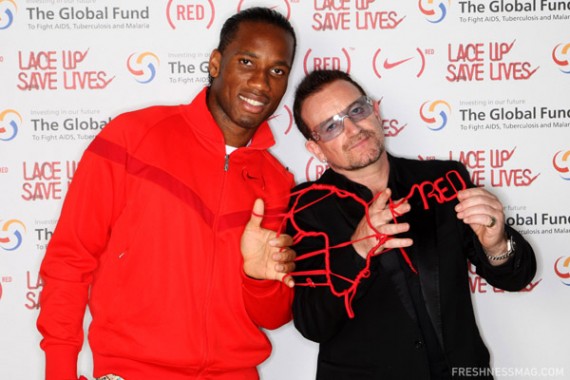 Didier Drogba and Bono. Photo from Freshness Mag.
Works Cited:
Darby, P., Akindes, G., & Kirwin, M. (2007). Football academies and the migration of African football labor to Europe. Journal of Sport and Social Issues, 31(2), 143-161.
Delva, W., Micheielsen, K., Meulders, B., Groeninck, S., Wasonga, E., Ajwang, P., ...Van-reusel, B. (2010). HIV prevention through sport: The case of the Mathare Youth Sport Association in Kenya. AIDS Care, 22(8), 1012-1020.
Hitzen, P. (2008). Desire and the enrapture of capitalist consumption: Product Red, Africa, and the crisis of sustainability. The Journal of Pan African Studies, 2(6), 77-91.
Jacobsen, E., & Dulsrud, A. (2007). Will consumers save the world? The framing of political consumerism. Journal of Environmental and Agricultural Ethics, 20, 469-482.
Jardin, X. (2007). Deconstructing Vanity Fair's "Africa" issue. Retrieved from http://boingboing.net/2007/06/20/deconstructing-vanit.html
Nickel, P.M. & Eikenberry, A.M. (2009). A critique of the discourse of marketized philanthropy. The American Behavioural Scientist, 52(7), 974-989.
Niehaus, I. (2007). Death before dying: Understanding AIDS stigma in the South Africa Lowveld. Journal of Southern African Studies, 33(4), 845-860.
Poli, R. (2006). Africans' status in the European football player's labour market. Soccer & Society, 7(2), 278-291.
Szto, C. (2013). Saving lives with soccer and shoelaces: The hyperreality of Nike (RED). Sociology of Sport Journal, 30, 41-56.
Support women's sports and SHARE this story with your friends!
Today on the Women's Sports Calendar:
| NCAA DI Tennis Championships May 16 - 27: Khan Outdoor Tennis Complex | Women's Leadership Symposium May 16 - 17: Omni Severin Hotel, Indianapolis, IN |
MOST POPULAR ARTICLES & POSTS
LATEST ARTICLES & POSTS
Fri at 8:44pm
Fri at 8:41pm
Thu at 10:23pm


Blogger Courtney Szto is a Master's Student studying the socio-cultural aspects of sport, physical activity and health (or as some call it Physical Cu...
full profile
For more, visit Resident_Badass's Full Profile

RECENT COMMENTS
She is one of the best player in basket ball and is really good.
http://www.coomberlaw.com/bu...more
posted 04/30/13 at 3:56am
on The Chicago Sky Selects Elena Delle Donne Second Overall in 2013 WNBA Draft

The worst kept secret in all of professional sports is that the majority of WNBA ballers are lesbian...more
posted 04/24/13 at 11:41am
on Brittney Griner's way of coming out is progress in the sports world
In terms of sport figures, I'm sure a Pat Summitt statue is in the works.
...more
posted 04/15/13 at 10:11pm
on Statues of Female Leaders?

I'm not a big Stanford fan, but at least they have a legitimate program and did it largely without t...more
posted 04/10/13 at 5:50pm
on Why Cal is my new favorite team

Ooh, is that bitterness I smell wafting up from Palo Alto? It almost seems like you are bashing Cal...more
posted 04/10/13 at 4:20pm
on Why Cal is my new favorite team

Women Talk Sports Podcast - March 5, 2013
In the March edition of the "Women Talk Sports" podcast, Cara and Stephanie use their running background to explain the Dayton 500 and break down the ...[Listen/Download for iTunes]
Women Talk Running Podcast - March 5, 2013
In the March edition of the "Women Talk Running" podcast, Cara and Stephanie wrap up the Millrose Games, give you more Mary Cain news, give our respon...[Listen/Download for iTunes]
Women Talk Sports Podcast - January 28, 2013
In the January 2013 episode of the Women Talk Sports podcast, Cara and Stephanie share several points that will leave you feeling hopeful about the Na...[Listen/Download for iTunes]
No one has commented on this yet. Be the first!