
Great article but really not true; there are many players involved in the NPF that are not from the ...more
posted 08/26/14 at 1:28pm
on Softball Standouts Plourde and Prezioso Represent Atlantic 10, Exemplify Mid-Major Potential at Next Level




posted by The Rabbit Hole
Monday, October 14, 2013 at 8:22pm EDT
Blogger Courtney Szto is a Master's Student studying the socio-cultural aspects of sport, physical activity and health (or as some call it Physical Cultural Studies). Bachelor's in Sport Management. Former tennis coach & ropes course facilitator.
Support women's sports and SHARE this story with your friends!
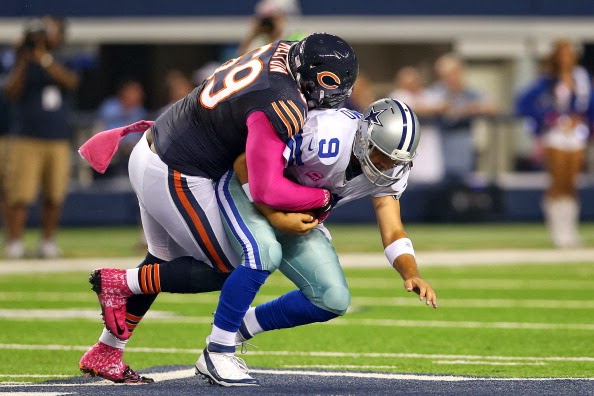 Photo from 1045theteam.comIt's October, which means it's Breast Cancer Awareness Month. I wasn't going to write a breast cancer post this year but I turned on the television this morning and there was Michael Strahan showing some pink football gloves and a pink towel that some NFL players don during October in 'solidarity' with the breast cancer cause. That reminded me of an article that Professor Samantha King wrote in 2001 about the questionable alignment between the NFL and breast cancer awareness, so here I am.
In 1999, NFL partnered with the Susan G. Komen Foundation, which essentially IS the pink ribbon campaign. It was a 'groundbreaking' move at the time pairing together a hypermasculine sport such as football with the hyperfeminine pink ribbon. The partnership was forged as a reaction to the fact that, at the time, 40% of the NFL's weekly viewers were women. It was a win for the Komen Foundation and the NFL "turned to breast cancer - an already tried and tested focus for a cause marketing campaign - [for] the cultivation of a compassionate, yet strong, masculinity" (King, 2001, p. 130). The partnership was founded on the Komen Foundation's principles of early detection and mammography but with the issues of cause and prevention nowhere on playing field.
The campaign kicked off in October 1999 with the "Real Men Wear Pink" tv spots. As Tony Gonzales, then tight end for the Kansas City Chiefs, said "Man, these people are the true warriors. Man, they're out there struggling with life and death. It's just...it's an inspiration for me." Yet, as King explains the fact that the NFL's decision to partner with the Komen Foundation did not merely enhance their access and connection with female football fans, its also helped the league temper criticism about some of the "character issues" associated with its players.
As King writes "Public discussions about the world of professional basketball and football have long been a site for the expression of cultural anxieties about race, crime, and violence" (p.133). In 2000, Rae Carruth of the Carolina Panthers and Ray Lewis of the Balitmore Ravens were both arreseted on charges of murder. The league was labelled the "NFL: National Felons League" (Baker, 2000). Fast forward 12 years and we are fresh off the Aaron Hernandez (former New England Patriots' tight end) murder case. Two years ago Justin Sparks of The Bleacher Report wrote an article titled "Top 25 Biggest Criminals in NFL history", which sadly implies that there are far more than 25 criminals on the NFL's player list. Thus, nothing much has changed for the NFL by way of so-called character issues; hence, such an alliance with the breast cancer cause helps the NFL tidy up its public image. King goes further to argue that "Moreover, the league looks to women, who are thus reaffirmed as the moral guardians of men, as key to the ethical transformation of their "troubled" players" (p.135).
At one level, the Real Men Wear Pink campaign promotes an alternative version of masculinity - one that is sensitive, compassionate, and charitable - from that with which the NFL is more commonly associated. For a culture obsessed with role models and citizen education, the image of five professional football players who are suitably "diverse" and who are engaged in genuine and meaningful service to their fellow citizens is surely ideal...
The Real Men Wear Pink campaign is problematic not because there is something inherently wrong with sensitive or compassionate masculinity, but because the brand of masculinity the campaign produces gains its very meaning, legitimacy, and appeal form its implicit difference from a demonized masculinity that is constituted through the inscription of criminality and "bad character" on the bodies of black men. (p.136)
Today the NFL's major breast cancer campaign is called "A Crucial Catch" and is in partnership with the American Cancer Society. The NFL makes no profits from the sale of pink ribbon items but, as with all ethical consumption, it is up to you (the consumer) to make a difference. The NFL merely provides pink products but unless you consume their products and their awareness messages all will be for not. The fate of breast cancer lies in your hands and wallet.
The pink movement has been so successful that
According to the American Heart Association half of all women who will die this year will die from heart disease of stroke; 500,000 per year compared to 40,000 from breast cancer. Yet, 67% of women name breast cancer as their biggest health concern compared to 7% for heart disease and 1% for stroke (Mosca et al., 2003).
Additionally, though men can get and are getting breast cancer in increasing numbers, the disease is generally perceived of as a female affliction (Selleck, 2010, p.122).
So the question I would like to pose is: are you a consumer or a citizen? Are you a consumer of health services (defined by the money you can put on the table) or a patient (defined by those with the greatest need)? Should we fund the causes with the best marketing campaigns or the ones that have the largest impact on our health? Are we responsible citizens if we watch NFL football and buy pink foot ball gloves and team hoodies? Are we irresponsible if we do not? 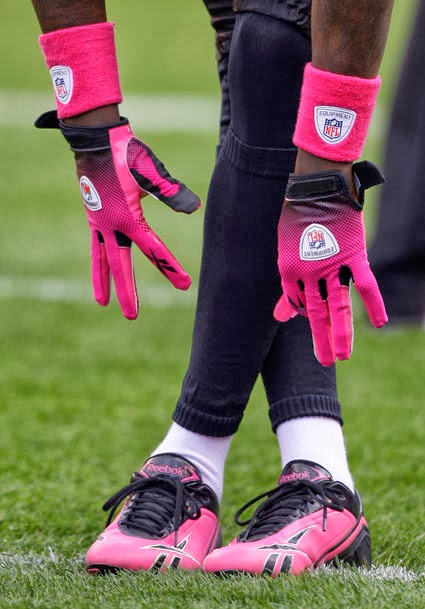 Photo from
https://kickdes.wordpress.com/tag/breast-cancer/
Did you know that the pink ribbon can be used by anyone? It is an unregulated symbol and can be used regardless of whether a company donates to the cause or not. How long must we be made aware that breast cancer and mammography exist? Isn't it time we question what causes it and why women of different social classes are affected differently? Shouldn't we ask why some women are unable to access mammography services? We assume that all that is needed is more money - more money for research, more money for treatment - and then all will be well. Unfortunately, money doesn't solve everything. King wrote her article in 2001, her book was released in 2006 and in 2013 we continue to deal with awareness and buying pink. Despite claims of progress and beating the disease it seems to me that buying pink has helped reproduce and sustain the status quo. Long live breast cancer.
Works Cited:
King, S. (2001). An all-consuming cause: Breast cancer, corporate philanthropy, and the market for generosity. Social Text, 19(4), pp.115-143).
Selleck, L. G. (2010). Pretty in Pink: The Susan G. Komen Network and the Branding of the Breast Cancer Cause. Nordic Journal of English Studies. (Available online).
Support women's sports and SHARE this story with your friends!
MORE ABOUT THIS AUTHOR:
Blogger Courtney Szto is a Master's Student studying the socio-cultural aspects of sport, physical activity and health (or as some call it Physical Cu...
full profile
For more, visit Resident_Badass's Full Profile
LATEST ARTICLES & POSTS
Fri at 1:53pm
Fri at 1:51pm
Fri at 1:45pm
Fri at 1:44pm
Thu at 1:53pm
Thu at 1:52pm
Thu at 1:48pm
Thu at 1:47pm
Wed at 12:52pm
RECENT COMMENTS
Great article but really not true; there are many players involved in the NPF that are not from the ...more
posted 08/26/14 at 1:28pm
on Softball Standouts Plourde and Prezioso Represent Atlantic 10, Exemplify Mid-Major Potential at Next Level

What she did I'd fantastic but she was still a good 14 seconds behind the winner and, really, the Ke...more
posted 07/22/14 at 4:04am
on 2 seconds, no finish clock picture, but satisfaction: Molly Huddle breaks her own AR

Does money make champions ! History have taught us that money does not means success overnight . Mos...more
posted 06/20/14 at 8:25pm
on Sparks need a change, but what kind?
congrats to Maria on her French Open win!!...more
posted 06/11/14 at 10:06pm
on Maria Sharapova Named The Face Of Avon Luck Fragrances
| SAUCUONY 500 MILE CHALLANGE |
| Daily Workout |

No one has commented on this yet. Be the first!