
Great article but really not true; there are many players involved in the NPF that are not from the ...more
posted 08/26/14 at 1:28pm
on Softball Standouts Plourde and Prezioso Represent Atlantic 10, Exemplify Mid-Major Potential at Next Level





posted by The Rabbit Hole
Monday, May 12, 2014 at 7:48pm EDT
Blogger Courtney Szto is a Master's Student studying the socio-cultural aspects of sport, physical activity and health (or as some call it Physical Cultural Studies). Bachelor's in Sport Management. Former tennis coach & ropes course facilitator.
Support women's sports and SHARE this story with your friends!
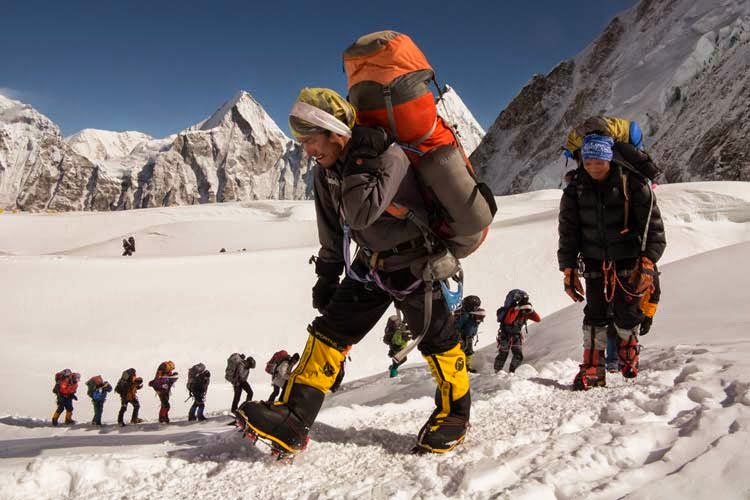 Photo from National Geographic.On April 18th the tragic deaths of 16 Sherpas closed tourist access to Mount Everest for the remainder of the season. The Sherpas were swept away by an avalanche while trying to prepare route access for tourists on the Khumbu icefall. This event has brought into question two issues that I would like to discuss: the role of dangerous and exploitative tourism, and gender roles in Nepal.
Sherpas are an ethnic group of people who live in the Himalayas of Nepal. They have become renowned for their mountaineering expertise and hardiness. It is through the commodification of their skills that Western tourism has quite literally put a price on the lives of Nepalese Sherpas. In 2012, Outside Magazine estimated costs for summiting Everest to be anywhere between $30,000 for those "on a budget" to $100,000 for fully guided tours. Add the cost with the two weeks to two months it takes to actually climb Everest (weather dependent) and it becomes clear that regardless how much you spend on your Everest trip - you ain't poor. Sherpas, on the other hand, generally earn $9000 for leading a group to the summit. Admittedly, this is ten times the average wage in Nepal but one has to wonder why the human life line that you hire is only worth a fraction of the total trip cost. It's also not a lot of money for a family to live off of if mom or dad doesn't make it home. The New York Times published an article with footage from April 18th captured minutes before the avalanche showing exactly how harrowing the work is and that these Sherpas were nervous about what was ahead:
Nearly all of the men in the video would be killed around 30 minutes later, their bodies smashed under house-sized chunks of ice that broke loose from the glacier and barrelled down the ice field….When Sherpa leaders at the mountain's base camp first called for a moratorium on climbing, experienced Everest-watchers from the West shrugged it off, confident that the season would simply continue after a few days of mourning. The costs were simply too enormous. Some 300 international mountain climbers had already gathered at the base camp, having spent as much as $100,000 for a chance at reaching the summit.
But they were dead wrong. Tensions between Sherpas and Nepal's government boiled over when state officials offered a compensation of just $400 to the families of the dead men...
How disrespectful for the Sherpa leaders to cancel the season when so many tourists had spent tens of thousands of dollars on their Everest adventure. I mean, know your role, right! We pay to come here, you just live here. Sure, it is sad that your family members died, but hey that's just part of the job. If you don't like it go get a different job. Take your $400 and let's get on with it. We'll wait here until you get over your grief but don't take too long.
And we wonder why "non-Western" cultures continue to think of our tourist presence as somewhat colonial, oppressive and arrogant.
The second issue I would like to discuss is that from this increased media attention on Everest a light has been shone on the lesser known, but equally proficient, female Sherpas. Nepal, like most countries, abides by traditional gender roles in which men provide and women are expected to care for the home and family. Until recently, only sons have been able to inherit parental property. Of the 4000 climbers that have ascended Everest, since Sir Edmund Hillary was the first 60 years ago, only 400 have been women. So when the Chettri sisters decided to open up the Three Sisters Adventure Trekking Industry there was obvious resistance from the male dominated industry and their own family. The sisters came up with the idea of female guided tours when they heard stories about foreign female trekkers who encountered harassment and sexual assault while on expedition. Today the Three Sisters company is flourishing and they train other Nepalese women who want to become guides. Times are changing in Nepal.
Male guides are often away from home 10 months out of the year, leaving the wives to tend to their families, farming, livestock and cultural customs. Hence, as Tenzin Norgay's (the first Sherpa to summit Everest) son explains "In a sense, the woman climbing Everest is a bigger loss for the family" in that there is a larger void to fill. I think that the Nepalese Sherpas are an interesting site of exploration for gender roles because this example very vividly illustrates the accepted social norm that men's bodies are built for violence and danger. Male Sherpas are seen as (relatively more) expendable and society has a way of dealing with their absence. Thus, while women are ascending Everest, and the Nepalese gender hierarchy, the role of men appears to remain stagnant. But this is certainly not isolated to Nepal.
Too often are the bodies of boys and men uncritically encouraged and trained to endure physical abuse. It goes with the rough and tumble notion of masculinity that boys and men should obviously take on the most physical and dangerous tasks. Yes, this is limiting for girls and women but it is equally limiting for males. I am not saying that we should be excited to throw young girls into arenas where physical harm is not only likely but imminent; however, we why don't we question putting the bodies of young boys in those same situations? Boys football. Boys boxing. Boys hockey. Nothing seems out of the ordinary. Yet, when it comes to little girls taking up kickboxing suddenly there is a moral panic over protecting our "princesses". It is ironic that we work so hard to 'protect' women from harm, which also helps keep women in their place. Protection equates to oppression and the freedom for 'boys to be boys' puts them in harms way without a second thought. It is important to note that with the increasing frequency of concussions and the severity of their ramifications we have finally begun to question the social expectations of boys and men. But, the fact that many tourists are waiting for Sherpas to get back to work illustrates that we still accept violence on the body of many men, particularly men of colour.
If Everest were located in the United States or Switzerland or France would we have shrugged off the deaths of sixteen men? How much compensation would these families have received? Would different regulations be put in place? Would we stop tourism?
Additional reading:
Sherpa woman overcomes prejudice for Everest record - Reuters
The legacy of Sherpa women mountaineers - PBS
To donate to the Sherpas Fund click here
Support women's sports and SHARE this story with your friends!
MORE ABOUT THIS AUTHOR:
Blogger Courtney Szto is a Master's Student studying the socio-cultural aspects of sport, physical activity and health (or as some call it Physical Cu...
full profile
For more, visit Resident_Badass's Full Profile
LATEST ARTICLES & POSTS
Thu at 12:49pm
Thu at 12:43pm
Wed at 1:38pm
Wed at 10:11am
Tue at 1:43pm
Tue at 1:41pm
Tue at 1:36pm
RECENT COMMENTS
Great article but really not true; there are many players involved in the NPF that are not from the ...more
posted 08/26/14 at 1:28pm
on Softball Standouts Plourde and Prezioso Represent Atlantic 10, Exemplify Mid-Major Potential at Next Level

What she did I'd fantastic but she was still a good 14 seconds behind the winner and, really, the Ke...more
posted 07/22/14 at 4:04am
on 2 seconds, no finish clock picture, but satisfaction: Molly Huddle breaks her own AR

Does money make champions ! History have taught us that money does not means success overnight . Mos...more
posted 06/20/14 at 8:25pm
on Sparks need a change, but what kind?
congrats to Maria on her French Open win!!...more
posted 06/11/14 at 10:06pm
on Maria Sharapova Named The Face Of Avon Luck Fragrances

http://allezweitagediat.de/...more
posted 03/07/14 at 3:29am
on USWNT: USA Draws With Japan in Algarve Opener
| SAUCUONY 500 MILE CHALLANGE |
| Daily Workout |
No one has commented on this yet. Be the first!