
Great article but really not true; there are many players involved in the NPF that are not from the ...more
posted 08/26/14 at 1:28pm
on Softball Standouts Plourde and Prezioso Represent Atlantic 10, Exemplify Mid-Major Potential at Next Level




posted by The Rabbit Hole
Thursday, September 18, 2014 at 1:33pm EDT
Blogger Courtney Szto is a Master's Student studying the socio-cultural aspects of sport, physical activity and health (or as some call it Physical Cultural Studies). Bachelor's in Sport Management. Former tennis coach & ropes course facilitator.
Support women's sports and SHARE this story with your friends!
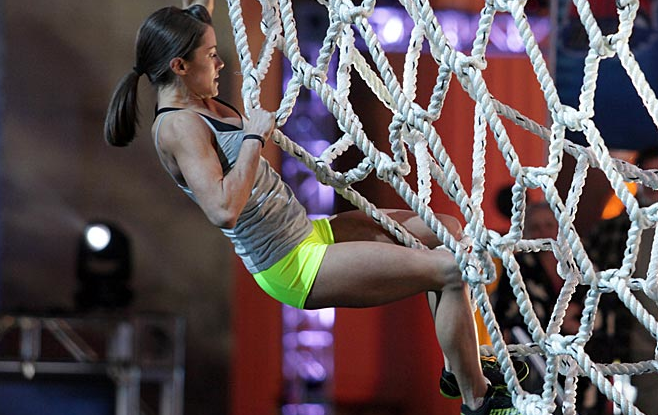 Kacy Katanzaro. Photo from Zap2it.American Ninja Warrior (ANW) is awesome. If you haven't seen this show - where the heck have you been??? We are amused by embarrassing falls and face plants. We are inspired by people like tiny Kacy Katanzaro, who even made me rethink the physical capabilities of women. The show can also be somewhat frustrating. Reason #1: it is clearly a show made by men for men. But that is not the topic for discussion today. What I find frustrating about ANW is that it has taken play at its finest and transformed it into a "sport" when it didn't need to.
For the most part, ANW lends itself to spontaneity and creativity, at least that is the idea on which it is premised. I think part of the enjoyment that ANW provides is a public celebration of adults playing in an unstructured fashion. That is why the competition is generally dominated by rock climbers and parkour artists, both activities that have spontaneity, versatility, and adaptability built into them. But when you call it a "sport" and you add commentators, training, and money - it's not play anymore. I find it odd that they have commentators for ANW because it would be like having adults commentate for children while they played on the playground - "Oh and Sally bites it hard on the see-saw". The more you watch ANW the more you will become familiar with certain obstacles: the warped wall, salmon ladder, quintuple steps, and spider climb. And even though the show does a decent job of changing up the obstacles as often as possible, those who compete in ANW have taken to training for a competition based in the unknown.
It happens to any sport with commercial value or potential - we standardize it. It happened to skateboarding, snowboarding, parkour, and ultimate among many others. We take something that has no or few rules and we give it a rule book. We give it an organizing body. We create an accompanying training regimen. The standardization of ANW is best exemplified by two of the show's biggest celebrities: Brett Steffenson and Brian Arnold.
Brett Steffenson, boyfriend of the indomitable Kacy Katanzaro (see how I switched that around!), turned his love and passion for ANW into a career as an obstacle course trainer. It's certainly not a job that you are going to find at many career fairs, although if the popularity of ANW continues it may soon be. He trains people to compete in obstacle course races. So you can hire him to train you just like you would hire a tennis coach or a personal trainer.
Brett Steffensen in the Jump Spider.Someone who went the other route, but definitely still took the play out of it, is Brian Arnold. He remains the closest thing anyone can call an American Ninja Warrior because he has achieved more on the finals course than any other American. But even he has never completed stage 3 of the finals course (out of four total stages). This past year he quit his job in order to train full time with the hope of winning the $500,000 prize that no one, in the six years of the show, has ever won. I understand that $500,000 is an enticing prize but given that no one has ever won it, coupled with the fact that you don't receive any money for competing, makes it an extremely risky (and kinda dumb) move.
I'm not saying that any of this is bad per se. However, I would like us to reflect on how quickly and uncritically we stamp new physical challenges with the sport model. It's almost too easy to transition an activity from play to sport. When we take something playful and transform it into a "sport" we inherently alter the role that the body plays in that relationship. We use our body to experience play and movement; they are symbiotic. Conversely, when we compete in sport our body becomes a tool for success and discipline. As Brian Pronger (1995) explains in his article, Rendering the Body: the Implicit lessons of gross anatomy, "Here was the confirmation of what science had always told me, but which from my own experiences had always rung false: The body is an object…As a student of physical education, I realized that the power of my profession lay in its ability to manipulate the body, to make it an efficient resource" (p.427).
Like I said, I love watching ANW. There are a lot of good things about the competition and I think it does a great job of showcasing what is possible with regard to human movement. I love that it emphasizes functional movement rather than fitness for the sake of looking good (because those who look the best don't necessarily perform the best). But it is also okay for play to remain unstructured. I would love if each season ANW created completely new obstacles so that people could not train on homemade courses. I think that would speak more "accurately" to the notion of a Ninja Warrior (whatever the heck that is). Especially given the social reality of eating disorders, doping, concussions and the dominance of the pharmaceutical, plastic surgery, and weight-loss industries, it is important that we re-conceptualize the relationship that we have with our bodies. It is not an object to be manipulated and crafted into a socially constructed ideal of acceptability. I think when we release the desire to control and discipline our body as merely a tool to reach greater goals, only then can we appreciate all of which it is capable. Our body is not a resource. At least, it is not only a resource.
Support women's sports and SHARE this story with your friends!
MORE ABOUT THIS AUTHOR:
Blogger Courtney Szto is a Master's Student studying the socio-cultural aspects of sport, physical activity and health (or as some call it Physical Cu...
full profile
For more, visit Resident_Badass's Full Profile
LATEST ARTICLES & POSTS
Fri at 6:28pm
Fri at 6:26pm
Thu at 2:39pm
Thu at 2:37pm
Thu at 2:18pm
Wed at 1:53pm
Wed at 1:52pm
RECENT COMMENTS
Great article but really not true; there are many players involved in the NPF that are not from the ...more
posted 08/26/14 at 1:28pm
on Softball Standouts Plourde and Prezioso Represent Atlantic 10, Exemplify Mid-Major Potential at Next Level

What she did I'd fantastic but she was still a good 14 seconds behind the winner and, really, the Ke...more
posted 07/22/14 at 4:04am
on 2 seconds, no finish clock picture, but satisfaction: Molly Huddle breaks her own AR

Does money make champions ! History have taught us that money does not means success overnight . Mos...more
posted 06/20/14 at 8:25pm
on Sparks need a change, but what kind?
congrats to Maria on her French Open win!!...more
posted 06/11/14 at 10:06pm
on Maria Sharapova Named The Face Of Avon Luck Fragrances
| SAUCUONY 500 MILE CHALLANGE |
| Daily Workout |

No one has commented on this yet. Be the first!