




Willye White: Track & Field
American Star of the Women’s International Sports Hall of Fame
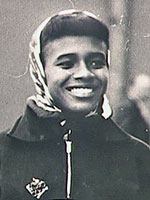
Olympic medalist Willye White dies
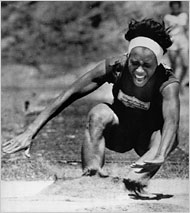
Willye White has given so much to the sport of track and field. However, if she was still alive, White would tell you how much more the sport gave to her. The multiple Olympian credited track and field for not only helping her overcome obstacles, but more important, for teaching her important life lessons.
Although White was one of the great pioneers for track and field, her most fulfilling work came after she retired from the sport. Her experience in athletics motivated her to get involved with the community. White loathed the selfish athletes who did not do anything to help the less fortunate, so after her retirement from track and field, she fought to make a difference for Chicago’s youth. She established a sports program for young girls; however, White’s goal was not to teach them the fundamentals of sports. Rather, she only used sport as a vehicle to reach her students, and then taught them important life lessons. It was through sports that White learned these same valuable life lessons.
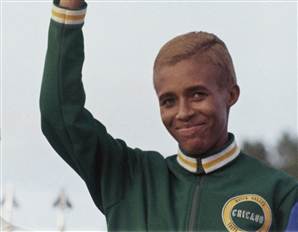
White faced racism at a very young age while growing up near a cotton field in Money, Mississippi. After seeing her bright-green eyes and reddish-light brown hair, White’s father insisted that White could not possibly be his child, and he left shortly after her birth.1 Overcome with the difficulties of being a single parent, White’s mother soon entrusted White to her grandparents. Her grandfather, whom she considered her hero, would wake her up at 4 or 5 every morning to drive 60 miles to pick cotton. He used this labor to teach White important life lessons.2 Like most places in the Deep South, racism was prevalent in Money. White described cross burnings and lynchings as an everyday part of her life. She was not allowed to play with the girls in her neighborhood, so instead she would play Cowboys and Indians with the boys. Ironically, this is where her athletic ability first surfaced.
At the age of 10, White and her cousin tried out for the high school track team. The coach quickly took notice when White was beating many of the girls on the varsity team. Although White had tremendous speed, she started long jumping because the team already had enough sprinters. Even at such a young age, White exhibited passion, drive, and commitment. All her hard work paid off as she qualified for the Olympic Games in Melbourne, Australia, at the age of 19. She won a silver medal and became the first female American to medal in the long jump. Upon White’s return home, Tennessee State, under the leadership of Ed Temple, offered her a scholarship. Temple was highly regarded in the track and field world as he also coached Olympic champion Wilma Rudolph and the great Mae Faggs. White, however, quickly realized that Temple was too controlling for her, so she left after only six months and transferred to Chicago State University.
Despite no longer having a coach, White’s amazing success continued. White coached herself to every Olympics from 1960 to 1972. She remains the only American to have competed on five Olympic track and field teams. At the 1964 Games in Tokyo, she won her second silver medal as a member of the 400-meter relay team. Despite competing in five consecutive Olympics, White never won a gold medal, which she contributed to helping her keep her motivation and drive. Competing internationally in the Olympic Games also taught her an important lesson: racism and hatred do not exist everywhere in the world. Upon reflection on her Olympic experience, she said, “The Olympic movement taught me not to judge a person by the color of their skin but by the contents of the heart.”3
This life lesson motivated White to succeed long after her retirement from track and field. When White moved to Chicago in 1960, she became a nurse and public health and administration quickly became another one of her passions. Five years later, in 1965, she became a public health administrator at the Chicago Health Department. In 1976, White graduated from the University of Chicago with a degree in public health administration.
In addition to working in public administration, White continued to play an active role in sports. She served as the president of the Midwest chapter of U.S. Olympians for 12 years. White also served as a coach for athletes competing in the National Sports Festival and the World Cup Track and Field Championship Games. In 1990, she founded WBWHang on Productions, a sports and fitness consulting firm.
White used her years of experience as an athlete, administrator, and coach to reach the youth of Chicago. She chose to remain in the inner city of Chicago, where she felt the most needed. She used her close proximity to mentor and teach Chicago’s south side. In 1990, she founded the Willye White Foundation in Chicago. This Foundation helped raise money and develop self-esteem for underprivileged children. One big initiative for her Foundation was the Robert Taylor Girls Athletic Program, which reached the children living in the nation’s largest housing project. In addition to teaching children sports and important teamwork skills, it also provided them with a summer day camp and healthcare services like immunizations, dental check-ups, and medical check-ups.
White received a lot of recognition for her success in track, as well as her movements off the track. One of her proudest moments came when she became the first American to receive the UNESCO Pierre de Coubetin International Fair Play Trophy, the world’s highest sportsmanship award. She was inducted into 11 halls of fame, and she was named one of the greatest athletes of the century by Sports Illustrated for Women and Ebony Magazine.4
On February 6, 2007, Willye White passed away from pancreatic cancer. Although White lost this battle, she overcame so many barriers throughout her lifetime. Her legacy as a track and field star will remain for decades to come, but her impact as a teacher and mentor will live on forever.
Notes
1. Frank Litsky, “Willye B. White, the First 5-Time U.S. Track Olympian, Dies at 67,” New York Times, February 7, 2007.
2. Kenny McReynolds, “Willye White,” Chicago Sun-Times, September 19, 1988.
3. “Olympic Track Star Willye White Dies,” AP, February 7, 2007.
4. “Willye B. White Biography,” The History Makers, http://www.thehistorymakers.com/biography/biography.asp? bioindex=190 (accessed July 10, 2008).
The previous excerpt was written Sara Jane Baker
IN SEASON:
Tue, Oct 1 at 12:03pm
Fri, Sep 6 at 9:32am
Fri, Nov 8 at 9:29pm
Fri, Nov 1 at 4:39pm
Today at 9:09am
Today at 9:04am
Sun, Nov 10 at 6:59pm
Thu, Nov 7 at 9:08pm
LATEST ARTICLES & POSTS
posted by Swish Appeal
Mon at 9:13am
posted by Swish Appeal
Mon at 9:11am
posted by All White Kit
Sun at 6:42pm

-
The body of this profile is an excerpt from 100 Trailblazers: Great Women Athletes Who Opened Doors for Future Generations.
This book is available on Amazon.com:
This book was written by Dr. Richard Lapchick, chair of the renowned DeVos Sport Business Management Program at the University of Central Florida, along with several of his students in the renowned program:
- Sara Jane Baker
- Jessica Bartter
- Catherine Lahey
- Stacy Martin-Tenney
- Horacio Ruiz
- Ryan Sleeper

The DeVos program offers students the opportunity to earn their Masters in Sports Business Management and a Masters in Business Administration. Focusing on ethics, diversity, leadership, and community service, the DeVos Program attracts some of the brightest and most committed students from across the country and across the globe.
-
This profile was built by:
Taunita Stephenson
About Taunita:
~*Member of the DeVos Sport Business Program (Top 4 Sport Business Programs in the Nation!), Class of 2012*~ ~*Class of 2009, Delaware State University Graduate-Making My Mark on the World!" ~*I am enthusiastic about equality and diversity and hope to begin a career in Player Development or Diversity Initiatives!*~ God, Family, Friends, Career Goals, Jay-Z, Lakers, Fashion-In that order! What I Live By: "Vision without action and a plan is an illusion"