




Nancy Lopez: Golf
Future Hall of Famer
Website: http://www.nancylopezgolf.com/en/home.aspx?language=eGfVCrPSj3gueIx0aTb0gg1


It is the most coveted championship in women’s professional golf. The only tournament that has been recognized as a major event by the Ladies Professional Golf Association (LPGA) since its founding in 1950. The U.S. Open has been won by many of the greatest golfers in history, several of whom can be found in the pages of this book, including Patty Berg, Betty Jameson, Louise Suggs, Mickey Wright, Carol Mann, JoAnne Carner, and Annika Sorenstam. However, the victors list is missing one woman, Nancy Lopez, who has been credited with touching women’s golf like none other before or since.1 Lopez is different from the aforementioned legends in that she transcended the game of golf and impacted so many, not solely by her talents on the course, but with her endearing personality and downto-earth approach to the game and its fans.
Lopez did come very close to capturing the championship that eluded her during her illustrious golf career, placing second on four occasions. Never was she closer than in 1997, when she became the first woman to post all four of her U.S. Open scores in the 60s (69-68-69-69), but still lost to Alison Nicholas by just one stroke.2 As she tearfully watched the trophy presentation, many others in the crowd were also moved to tears. Wearing her emotions on her sleeve and allowing the public to see her true feelings was just one way Lopez connected with fans all over the world. She had a more lighthearted runner-up finish in 1977, and still jokes today about why she fell short. Believe it or not, that year she got a hole in one. Unfortunately,it wasn’t on the course. Instead, it was in a pair of her pants.
In another, not-so-close run at the Open, Nancy marched down her final fairway of the tournament waving a putter with a white towel wrapped around it in surrender before missing the cut by shooting a 71 and an 83 in the first two rounds of the competition. She has said, “Do your best, one shot at a time and then move on. Remember that golf is just a game.”3 These stories illustrate why she is such a fan favorite on the tour. She is a fierce competitor who is not afraid to let her emotions be known, yet humble, with a sense of humor. Quite simply, Nancy Lopez is herself whether she is at home with her husband and three daughters, or playing on television in front of millions of spectators. It should be of no surprise, then, that she has been compared to Arnold Palmer, perhaps the most loved player in the history of men’s golf. Like Palmer, who had a large fan base nicknamed “Arnie’s Army,” Lopez’s following is similarly called “Nancy’s Navy.” What appeals to fans is her humility and willingness to talk to everyone and anyone while paying them the same individual attention she would bestow a best friend. She fondly explains her fan encounters, saying, “I feel like I’m wearing a shirt these days that says ‘Talk to me.’ So many people come up to me and feel they know me, like we have been friends. It’s nice, because you meet a lot of nice people that way.”4 Despite winning only three major championships during her career, and never winning the Open, there is one category Lopez never placed second in: gallery size. Lopez had the ability to fill the stands with fans who would enjoy watching her even miss a cut (a rare occurrence) more than seeing any of the other golfers on the tour win the tournament.5
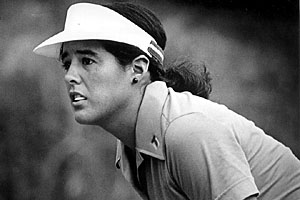
While Nancy Lopez was best known during her career for the way she played the game and not whether she won or lost, make no mistake about it, she had her moments of greatness on the greens. She started her winning ways at the age of 12, when she won the New Mexico Women’s Amateur. She also won the U.S. Junior Girls Amateur in 1972 and 1974. A year later at the age of 17, she would place second for the first of four times in the U.S. Women’s Open. She continued her amateur career by attending Tulsa University for two years, where she was named an All-American in 1976 before turning pro after her sophomore year in 1977. She burst into the professional spotlight in 1978 by again placing second in the Women’s Open. That year she also won nine titles, including a streak of five in a row, and became a superstar when she graced the cover of Sports Illustrated. That same year, Lopez became the first woman to be named Rookie of the Year and Player of the Year, and to win the Vare trophy all in the same season. The Vare trophy is awarded annually to the woman golfer with the lowest scoring average over the season. She experienced her career year in her first full season on the LPGA tour.
Lopez’s style was marked by extremely aggressive play. “I think when I came out on tour, I wanted to beat the JoAnne Carners and Judy Rankins and I didn’t have any pressure on me,” Lopez said. “I wanted to beat them really bad. I felt like they had a lot to lose if I beat them, but I didn’t have anything to lose if I shot 80. I was just somebody starting on the tour. So I played very aggressively and I loved it. The tour was comfortable to me and golf was fun. Still is.” She stuck with what worked for her and went on to win two more Vare trophies (1979 and 1985) and three more Player of the Year awards (1979, 1985, and 1989). She was also a member of the 1976 Curtis Cup, a member of the 1990 Solheim Cup, and the captain of the U.S. team in the 2005 Solheim Cup. These achievements earned her spots in the LPGA Hall of Fame and the World Golf Hall of Fame.
Lopez said her inspiration came from her first and only golf teacher, her father. Domingo Lopez, who introduced her to the game when she was just eight years old, and did not have to train his daughter that much considering she was such a natural that she could out-drive both her mother and father the first day she ever picked up a golf club. “My dad was such a great inspiration to me,” Lopez said. “He always told me to enjoy what I was doing. And always smile.”6 Lopez would benefit greatly from learning to play the game in such a supportive environment, with people who encouraged her to be herself with everything from her personality to her unconventional style of play. She actually attributes having never changed her unorthodox swing to the discriminatory practices of a local country club where she grew up in Roswell, New Mexico. Lopez and her family are Mexican-Americans, and they were unwelcome guests at the nicest course in her neighborhood. She believes that if an instructor from the club latched onto her and influenced her golf development, she may have never became the Hall of Fame golfer she is today. She learned to be comfortable with her swing, especially after seeking guidance from fellow Mexican-American golfer, Lee Trevino. She asked, “Mr. Trevino, what should I do about my golf swing? I have a bad golf swing and yet I play very well.” Without even seeing her swing, he responded, “You can’t argue with success. If you swing badly but still score well and win, don’t change a thing.”7
Nancy Lopez, while humbly never dwelling on the fact, became a role model for athletes all over the world. She is living proof that people can be successful without sacrificing who they really are. As she walked up her final U.S. Open fairway in 2002, she cried, and thousands cried with her. “Well, I knew eighteen would be tough,”8 she said through the tears. She befriended so many by being genuine and approachable with fans, showing she was just like them. She returned every letter and offered encouragement to every young boy and girl. She never put up a wall like so many highprofile athletes and entertainers do today. “If I can make somebody feel good by smiling at them or saying ‘hi’ to them then I’m doing my job,” she said during her touching sendoff, “at least for my dad.”9
Notes
1. Joe Posnanski, “Nancy Lopez Touched Many and Many Touched Her,” The Kansas City Star, July 6, 2002.
2. Brian Wicker, “Queen of the LPGA,” Minneapolis Star Tribune, August 16, 1998.
3. Brent Kelley, About.com: Golf, “Biography of Golfer Nancy Lopez,” http://golf.about.com/od/golferswomen/p/nancy_lopez.htm (accessed March 30, 2008).
4. Wicker, “Queen of the LPGA.”
5. Ibid.
6. Posnanski, “Nancy Lopez.”
7. Nancy Lopez, The Education of a Woman Golfer (New York: Simon and Schuster,1979), 24.
8. Posnanski, “Nancy Lopez.”
9. Ibid.
The previous excerpt was written by Ryan Sleeper
IN SEASON:
Tue, Oct 1 at 12:03pm
Fri, Sep 6 at 9:32am
Fri, Nov 8 at 9:29pm
Fri, Nov 1 at 4:39pm
Today at 9:09am
Today at 9:04am
Sun, Nov 10 at 6:59pm
Thu, Nov 7 at 9:08pm
LATEST ARTICLES & POSTS
posted by Swish Appeal
Mon at 9:13am
posted by Swish Appeal
Mon at 9:11am
posted by All White Kit
Sun at 6:42pm

-
The body of this profile is an excerpt from 100 Trailblazers: Great Women Athletes Who Opened Doors for Future Generations.
This book is available on Amazon.com: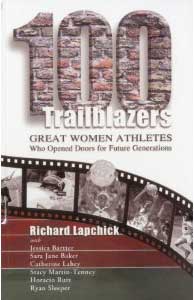
This book was written by Dr. Richard Lapchick, chair of the renowned DeVos Sport Business Management Program at the University of Central Florida, along with several of his students in the renowned program:
- Sara Jane Baker
- Jessica Bartter
- Catherine Lahey
- Stacy Martin-Tenney
- Horacio Ruiz
- Ryan Sleeper

The DeVos program offers students the opportunity to earn their Masters in Sports Business Management and a Masters in Business Administration. Focusing on ethics, diversity, leadership, and community service, the DeVos Program attracts some of the brightest and most committed students from across the country and across the globe.
-
This profile was built by:
Taunita Stephenson
About Taunita:
~*Member of the DeVos Sport Business Program (Top 4 Sport Business Programs in the Nation!), Class of 2012*~ ~*Class of 2009, Delaware State University Graduate-Making My Mark on the World!" ~*I am enthusiastic about equality and diversity and hope to begin a career in Player Development or Diversity Initiatives!*~ God, Family, Friends, Career Goals, Jay-Z, Lakers, Fashion-In that order! What I Live By: "Vision without action and a plan is an illusion"