




Venus and Serena Williams: Tennis
Future Hall of Famers

In 1973, seven and eight years before Venus or Serena Williams were born, Bobby Riggs, the 1939 Wimbledon champion, claimed that the women’s tennis game was so inferior to that of the men’s that he, at 55 years old, could beat any of the current top female players. I imagine Venus and Serena would have gladly accepted Riggs’s challenge, but it was before their time, so another tennis-great, Billie Jean King, accepted his offer. In front of more than 30,000 spectators in the Houston Astrodome on September 20, 1973, King made Riggs eat his words as she diligently laid to rest his sexist claim with threestraight set victories, 6-4, 6-3, and 6-3. Perhaps Riggs cannot bear all the blame for his chauvinistic attitude, as it seemed to be the product of the times. In 1972, the Association of Tennis Professionals (ATP) was established. Though the name doesn’t suggest any exclusion, its purpose was to protect the best interests of male professional tennis players. Perhaps as an afterthought or perhaps thanks to Billie Jean King’s “Battle of the Sexes” victory, the Women’s Tennis Association (WTA) was born a year later in 1973. Women in general have faced such inequalities and underestimations, as well as this afterthought mentality for centuries.
Nonetheless, the year 2000 marked a new millennium and this new century would suggest the tables have turned, at least in tennis. Even John McEnroe, who was known for his criticism of the women’s game, among other things, acknowledged in 2000 that “you can’t deny it . . . right now the women have the better product.” A USA Today poll supported McEnroe’s claim when it published the fact that 75 percent of tennis fans preferred the women’s game to that of the men’s. 1 Thanks in part to the powerful, dominant strength and style of the Williams sisters, tennis fans have not only expanded in quantity, but have also expanded in age, race, creed, and economic status.

Venus and Serena Williams helped bring tennis out of the country clubs and into the inner cities with the great talent they developed that was first learned on the old, rundown courts of Compton, a city in Los Angeles known for its gang violence and poor neighborhoods. One day while practicing around the potholes and raggedy nets of the Compton municipal courts, Venus and Serena found themselves in between two rival gangs and narrowly escaped the exchanged gunfire. 2 Gunfire was not uncommon at night either, but luckily the sisters shared a room and therefore a safety in each other’s presence. Jon Wertheim, author of Venus Envy, shared their typical conversation after having “listened nightly to an urban symphony of car horns, screams, sirens and the occasional rat-a-tat of gunfire”:
Venus, Serena would whisper.
What is it, Serena?
Don’t go to sleep before me.
I’m tired, Serena.
Well, I’m scared.
Venus would sigh, but she would force herself to stay awake until Serena had drifted off. “Same thing every night,” Venus recalls, shaking her head. “That was Serena, getting her way.” (“My responsibility in life is to be the annoying little sister and I’ve always taken that responsibility seriously,” responds Serena with a laugh.)3
Their candor is well established and long evolved. Their mother, Oracene Williams, once said, “They love each other so much they’re almost like a husband and a wife.” 4 Oracene had long ago pulled them aside and taught them that while matches with any other opponents could be treated as war, it was just a game when played among sisters.5 This lesson remains with them.
Compton’s dangerous gunfire and sleepless nights pushed their father, Richard Williams, to coach them to success and off the streets of Los Angeles. Richard had first recognized the lucrative business that tennis was, even for women, after he witnessed Virginia Ruzici win tens of thousands of dollars after a fourth-round defeat in the late 1970s. Thus, Richard put each of his two youngest daughters on the court when they were just four or five years old. Though not familiar with the game himself, Richard bought a book about tennis and shouted instructions from the sidelines to his daughters who played with used balls they had found since they could not afford new ones.6 At times he even made them return balls with a slim baseball bat rather than the large face of a racket.7
After their skill showed true potential, the Williams family relocated to Florida, where Venus and Serena accepted scholarships to the Rick Macci Tennis Academy, though father/coach Richard never stepped too far from the court. When Venus was nine and Serena was eight, they entered their first tournament, where they met each other in the finals. Age presided in this tournament and Venus was victorious in their first of what would become many head-to-head match-ups. They continued to enter junior tournaments and continued to be victorious. However, it was only a couple of years before Richard pulled them off the junior circuit to refocus his daughters’ attention on their educations. Both straight-A students, they excelled in the classroom enough for Richard to believe they could return their attention to tennis a few years later.
At age 14, Venus turned pro, playing in tournaments sparingly, but really made a name for herself in 1997, when she joined the tour more regularly at age 17 and reached the finals of the U.S. Open.
In 1995, a year after Venus, also at the age of 14, Serena joined the pro-circuit tour. She entered the 1999 U.S. Open seeded seventh. She went on to upset the World No. 4 Monica Seles, the World No. 2 Lindsay Davenport, and the World No. 1 Martina Hingis to take the U.S. Open title. She became the first Williams sister and the second African-American woman to ever win a Grand Slam event (French Open, Australian Open, U.S. Open, and Wimbledon). Althea Gibson was the first African-American Grand Slam Champion when she won the French Open in 1956.
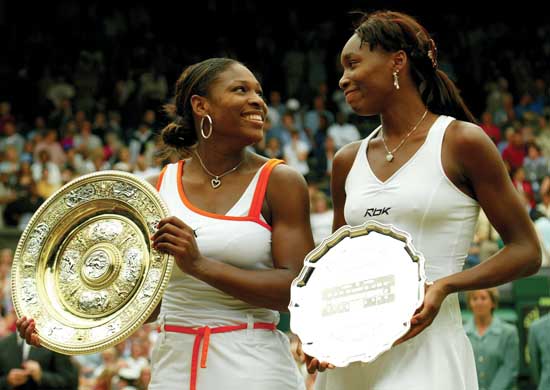
After early rumors of her retirement and despite battling tendonitis in her wrists that sidelined her for four months, 2000 turned out to be a great year for Venus, as she defeated World No. 1 Hingis in the quarterfinals, Serena in the semifinals, and defending champion Lindsay Davenport in the finals to win her first Grand Slam title at Wimbledon. The Williams duo joined forces to win the Wimbledon doubles title that year as well, after already notching doubles victories together at the French and U.S. Opens in 1999. Venus faced and conquered the still-World No. 1 Hingis in the semifinals and the World No. 2 Davenport in the 2000 U.S. Open to win her second Grand Slam singles title. At the 2000 Olympics, the pair teamed to represent the United States and earned gold medals in the doubles at Sydney. Venus also took home the coveted gold medal in the singles. To cap it off, 2000 marked Venus’s $40 million endorsement deal with Reebok that was the largest ever awarded to a female athlete (until Serena signed a $60 million deal with Nike in 2003). Dad/ Coach Richard had tremendous foresight in identifying tennis as a lucrative means to succeed financially and rise above the struggles of living in a rough neighborhood.
Venus successfully defended her Wimbledon and U.S. Open titles in 2001. She won three more Wimbledon championships in 2005, 2007, and 2008. While it appears Wimbledon has been good to her, Venus has criticized tournament officials and those of the French Open for paying its female competitors less than their male counterparts. After unsuccessfully pleading with the tournament officials in 2005, she went public with an essay in The Times on June 26, 2006, in which she stated, “Wimbledon has sent me a message: I’m only a second-class champion: The time has come for it to do the right thing: pay men and women equal prize money,” a struggle that still exists more than 30 years after Billie Jean King’s victory over Bobby Riggs.8
Serena’s Grand Slam title total currently matches her big sister’s seven titles. Though she ran dry for a couple of years after her 1999 U.S. Open win, 2002 brought Serena three Grand Slam titles, winning the French Open (after defeating her sister in the finals), Wimbledon, and the U.S. Open again. In 2003, she defended her Wimbledon title and beat her sister Venus in the finals of the Australian Open. Serena earned Australian Open titles in 2005 and 2007 as well. In September 2008, Serena beat Venus in the quarterfinals and went on to win the U.S. Open, which helped her regain a world ranking of No. 1 as of this writing.

The WTA pro tour consists of more than 50 tournaments year round, including the four Grand Slam events. As of September 2008, Venus had 37 WTAtitles and her career singles record was 503-119 (106-20 in doubles play) and she was ranked eighth in the world. Similarly, Serena had 32 WTA wins and her career singles record was 398-83 (110-17 in doubles play) with a world ranking of No. 1. Despite two early upsets in single play at the 2008 Beijing Olympics, the Williams sisters brought home the doubles’ gold medal. Afterward, in response to questions about their poor singles play, Serena said, “I’d much rather win with Venus than without her.”9 Though their professional tennis dominance is undeniable with no signs of slowing down, both Venus and Serena recognize that tennis will not dominate the rest of their lives.

Venus has already pursued her interests in fashion, designing a line of clothing available at any budget called EleVen. At its launch in November 2007, it was the largest line of clothing launched by a female athlete. Venus named the line EleVen so that every woman can feel like an 11 on a scale of 1 to 10. Venus serves as a global ambassador for the United Nations Educational, Scientific, and Cultural Organization (UNESCO). She donates all of the proceeds from a specially designed t-shirt in her EleVen collection to UNESCO. Venus also designs a line of women’s leather apparel for Wilson’s Leather. Venus’s creativity extends beyond fashion with her interior design company called V Starr Interiors. In addition to her fashion and interior design interests, after tennis she would like to further pursue choreography and music production.
In June 2004, Serena launched her own line of clothing, Aneres. Aneres is designed for “the independent woman who works, enjoys life, and is at the prime of her life . . . She chooses to wear Aneres because Aneres is in style yet follows its own trend. Aneres reflects Serena’s style at its best; complex simplicity.”10 In addition to fashion, Serena is interested in acting.
Among the popular fan favorites, Venus and Serena Williams have often experienced the peaks and valleys of support and criticism drawn from their occasional lackluster appearances, seemingly timely injuries, and their contentiously outspoken father and coach who appears to appreciate the spotlight more than either of his daughters desire. But, as many athletes would argue, the wins column is the most important and the only aspect worthy of criticism, leaving naysayers with little argument. Talent is not something anyone can attack when it comes to the Williams sisters, who have traded world rankings of No. 1 and No. 2, most often remaining in the top 10 for the past 10 years. Known for their strong returns and serves as well as their strong attitudes and opinions, there is no doubt both Venus and Serena will continue to make names for themselves, both in and out of tennis. The story of Venus and Serena Williams may just be beginning. The first act has been quite enjoyable to watch and may certainly be hard to follow. But I’d bet there are many more acts to come and many more fans eager at the sidelines to see what they can achieve next.
Notes
1. John Wertheim, Venus Envy (New York: HarperCollins, 2001), 4.
2. “Venus and Serena Williams: Such Devoted Sisters,” The Scotsman, July 6, 2002.
3. Wertheim, Venus Envy, 173–74.
4. Ibid., 175.
5. “Venus and Serena Williams: Such Devoted Sisters.”
6. “Venus and Serena Williams: Queens of Women’s Tennis,” Westside Gazette, February 17, 2005.
7. “Venus and Serena Williams: Such Devoted Sisters.”
8. Venus Williams, “Wimbledon has sent me a message: I’m only a second-class champion,” The Times, June 26, 2006.
9. Serena Williams, Access Hollywood on NBC, August 18, 2008.
10. Aneres, “Mission,” http://www.aneresdesigns.com/aneres.html (accessed April 3, 2008).
The previous excerpt was written by Jessica Barter
Articles Tagged with "Venus and Serena Williams" on WomenTalkSports.com:
- Style Statements at The 2012 U.S. Open
- Serena Williams: More of a rock star than she lets on
- London 2012: Title IX Olympics?
- "Sexism and the Games" - takes on Serena, Lolo, Gabby and more
- Black History Month – Female Athletes Who Changed the World
- Where is the Dominance in Women's Tennis?
- Venus & Serena Williams Switch to Raw Diet in 2012
- Love means nothing...to tennis champ Serena Williams
- 2011 U.S. Open: Serena, Venus, Mother Nature & More
IN SEASON:
Tue, Oct 1 at 12:03pm
Fri, Sep 6 at 9:32am
Fri, Nov 8 at 9:29pm
Fri, Nov 1 at 4:39pm
Today at 9:09am
Today at 9:04am
Sun, Nov 10 at 6:59pm
Thu, Nov 7 at 9:08pm
LATEST ARTICLES & POSTS
posted by Swish Appeal
Mon at 9:13am
posted by Swish Appeal
Mon at 9:11am
posted by All White Kit
Sun at 6:42pm

-
The body of this profile is an excerpt from 100 Trailblazers: Great Women Athletes Who Opened Doors for Future Generations.
This book is available on Amazon.com:
This book was written by Dr. Richard Lapchick, chair of the renowned DeVos Sport Business Management Program at the University of Central Florida, along with several of his students in the renowned program:
- Sara Jane Baker
- Jessica Bartter
- Catherine Lahey
- Stacy Martin-Tenney
- Horacio Ruiz
- Ryan Sleeper

The DeVos program offers students the opportunity to earn their Masters in Sports Business Management and a Masters in Business Administration. Focusing on ethics, diversity, leadership, and community service, the DeVos Program attracts some of the brightest and most committed students from across the country and across the globe.
-
This profile was built by:

Taunita Stephenson
About Taunita:
~*Member of the DeVos Sport Business Program (Top 4 Sport Business Programs in the Nation!), Class of 2012*~ ~*Class of 2009, Delaware State University Graduate-Making My Mark on the World!" ~*I am enthusiastic about equality and diversity and hope to begin a career in Player Development or Diversity Initiatives!*~ God, Family, Friends, Career Goals, Jay-Z, Lakers, Fashion-In that order! What I Live By: "Vision without action and a plan is an illusion"